
July 2026 | Medical Practice Cybersecurity Salt Lake City | HIPAA-Compliant IT Services | Healthcare Ransomware
On the surface, the water looks calm. That's what makes Shark Week fascinating every year — the danger is never visible on the surface. It's already moving underneath, tracking patterns, waiting for the right moment.
Cybercriminals targeting Salt Lake City medical practices operate exactly the same way. The threats facing your practice right now are designed to look like normal clinical operations — patient referrals, insurance authorizations, lab supply invoices — until the moment something breaks, PHI is exfiltrated, or your EHR goes offline and patient care stops.
Healthcare is the single most targeted industry for ransomware. And during the summer months, when providers take vacation, front desk coverage shifts, and clinical oversight thins out, attackers know your practice is paying less attention. Here are three ways they're circling right now — and what your Salt Lake City IT support team should be doing about it.
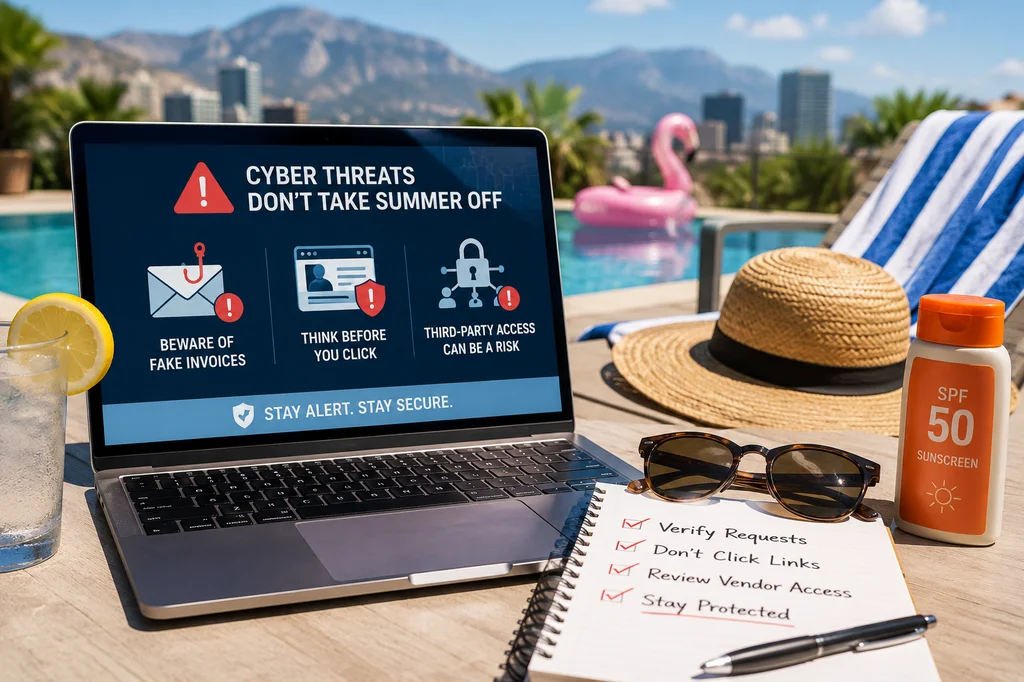
1. Fake Invoices and Medical Supplier Impersonation
Attackers don't always need to hack your EHR. In many cases, they just need to send one believable email to the right person on your front desk or billing team.
This is called business email compromise (BEC), and in healthcare it works by impersonating a trusted vendor — a medical supply company, a lab, a billing service like AdvancedMD, or even your EHR vendor. The email arrives looking completely normal: an updated invoice, a payment change request, a renewal notice. Someone on your team processes it. By the time anyone realizes the request wasn't legitimate, the money is gone — and depending on what was in that communication, you may also have a HIPAA issue.
These attacks spike during summer for a predictable reason: when your practice administrator or the person who normally approves payments is on vacation, requests get rerouted to front desk staff or medical assistants who don't always know what the normal vendor relationship looks like. Temporary stand-ins are less likely to question urgency — and cybercriminals know exactly how clinical coverage works.
The fix is straightforward to implement and should be part of your standard operating procedure: build a verification process for any financial request received via email. A quick confirmation call to a known number — not the number listed in the email itself — is enough to stop most of these before they go anywhere. This is a foundational element of cybersecurity for any Salt Lake City medical practice, regardless of size.
It's also worth training your billing team and front desk staff specifically on what legitimate communications from your lab partners, EHR vendor, and supply companies actually look like — so an impersonator doesn't get through on a busy Tuesday afternoon when three providers are behind schedule.
2. Phishing Attacks Disguised as Patient Referrals and Insurance Authorizations
Phishing works in medical practices because it's engineered around how clinical staff actually behave when they're busy — which is almost always.
A front desk team member gets an email that looks like a patient referral from a specialist. The format looks familiar, the subject line references a real-sounding provider name, and there's an attachment with what appears to be clinical notes. She clicks it — because that's exactly what she does dozens of times a day with legitimate referrals. The attachment is malware. Your network is now compromised.
Or a medical assistant gets a text that looks like it came from IT, asking him to verify his Epic login credentials because of a system update. He's juggling three patients in the queue and clicks the link. His credentials are now in the hands of someone who will use them to access patient records, exfiltrate PHI, and potentially hold your EHR for ransom.
Cybercriminals design these moments deliberately, timing them for the moments of peak clinical busyness. The most effective protection isn't a software solution alone — it's culture. Your clinical staff and front desk team need to feel comfortable slowing down when something seems off:
- An unexpected referral document from an unfamiliar address
- An insurance authorization request with unusual urgency
- A login request for Epic, Cerner, or Athenahealth that came out of nowhere
- A link in an email they weren't expecting, even if the sender looks familiar
Speed is the weapon attackers use against busy clinical environments. Slowing down — even by 30 seconds to verify a sender — and having a clear process for flagging suspicious requests is how you take that weapon away from them. Security awareness training tailored to healthcare workflows is one of the most cost-effective cybersecurity investments a Salt Lake City medical practice can make, and it needs to be refreshed more than once during onboarding.
Your front desk team processes more potential phishing attempts than anyone else in the practice. They're the target. Train them accordingly.
3. Third-Party Billing Vendors, Labs, and Supply Chain Risk
When a vendor with access to your systems is compromised, the threat doesn't stay contained to them. It travels directly into your environment through whatever connection they have to your PHI.
This is supply chain exposure — and most Salt Lake City medical practices have significantly more of it than they realize. Your billing company accesses AdvancedMD or your practice management system. Your lab partner has a portal integration with your EHR. Your telehealth vendor like Doxy.me stores session records. A medical supply company communicates via email threads that contain clinical details. A transcription service receives dictated notes.
Each of those relationships represents a path into your patient data environment. When any one of those vendors is breached, HIPAA's Breach Notification Rule may apply to your practice — regardless of whether your own systems were directly compromised. Outsourcing a clinical or administrative function doesn't outsource your HIPAA accountability.
To understand your supply chain exposure right now, you need to be able to answer three questions:
- Which vendors, contractors, and software platforms can access your patient records or PHI?
- What exactly are they connecting to, and how is that access secured?
- Do you have a current Business Associate Agreement with every one of them?
If those answers aren't clear — and for most practices, they aren't — your IT security posture has gaps you haven't mapped yet. A ransomware attack that enters through your billing vendor's compromised credentials is still your breach. The HHS Office for Civil Rights doesn't accept "we didn't know" as a defense.
Summer is also when vendor relationships are most likely to be handled informally. A billing company brings on a subcontractor to cover volume. A lab partner updates their portal without notifying your practice. A supply chain vendor experiences a breach that they report quietly and slowly. Your IT partner should be monitoring these relationships year-round — not just when you think to ask.
By the Time You See It, It's Already Moving
Sharks don't announce themselves — and neither do the cybercriminals targeting Salt Lake City medical practices right now. Healthcare organizations averaged more than one data breach per day in 2024. The practices that get hit aren't always the ones ignoring obvious warning signs. They're the ones who assumed everything was fine because the EHR was still running and nobody had complained.
Summer is when clinical schedules get complicated, coverage shifts, providers travel, and front desk attention spreads thin. It's also when attackers are most active — precisely because they track those patterns.
Proactive cybersecurity for Salt Lake City medical practices means building the defenses before the threat arrives — security awareness training completed before the summer rush, vendor access reviewed before vacations begin, verification processes in place before the fake invoice lands in the billing inbox. Not scrambling after the breach, the federal notification, and the patient letters.
Frequently Asked Questions
What is business email compromise and how do Salt Lake City medical practices protect against it?
Business email compromise (BEC) is a cyberattack where criminals impersonate a trusted contact — often a medical supplier, lab, billing vendor, or EHR company — to trick clinical staff or administrators into wiring money or sharing credentials. Protection starts with verification: any financial request or payment change received via email should be confirmed by phone using a known contact number before action is taken. Your front desk and billing teams need specific training on this, not just a general IT policy.
Do you offer HIPAA-compliant IT services for medical practices in Salt Lake City?
Yes. Qual IT works with Salt Lake City medical practices to provide HIPAA-compliant IT services, including cybersecurity training for clinical staff, phishing simulations tailored to healthcare workflows, vendor access reviews, Business Associate Agreement oversight, and ongoing threat monitoring. We help practices build the processes and culture that stop attacks before they reach patient data.
Why do cyberattacks on medical practices increase during summer months?
Attackers look for moments when oversight is thinner and verification processes are more likely to be bypassed. During summer, more providers and administrators are on vacation, coverage gets rerouted to less experienced staff, and security awareness tends to dip. Cybercriminals track healthcare staffing patterns and increase targeting during predictable coverage gaps.
How do I know if my Salt Lake City medical practice has third-party vendor risk?
If any billing company, lab partner, telehealth vendor, or software platform has access to your patient records or practice management systems — and you don't have a documented, current Business Associate Agreement and a clear record of what they can access — you have HIPAA-relevant vendor risk. A managed cybersecurity review for your medical practice can map your full exposure and flag any access that should be revoked or formalized.
Don't Wait Until You See the Fin
We work with Salt Lake City medical practices to protect patient data and maintain HIPAA compliance. Qual IT helps practices identify cybersecurity vulnerabilities, close vendor supply chain exposure, and build the security culture and clinical workflows that stop attacks before they reach your patient records.