
Cybersecurity | Salt Lake City Medical Practices | HIPAA-Compliant IT
School's out, which means for many Salt Lake City medical practice owners and office managers, the workday doesn't look quite the same as it did a few weeks ago.
Maybe you're starting earlier so you can wrap up before the kids get home. Maybe you're fielding calls from staff who've adjusted their hours, covering exam rooms with a skeleton crew, or squeezing administrative tasks into whatever gaps appear between patient appointments.
Either way, your clinic is adjusting to the new rhythm — and cybercriminals are adjusting right along with you. For medical practices, that risk carries more weight than most. It's not just business data on the line. It's protected health information (PHI), patient records, and HIPAA compliance.
This Isn't Your Normal Clinic Day
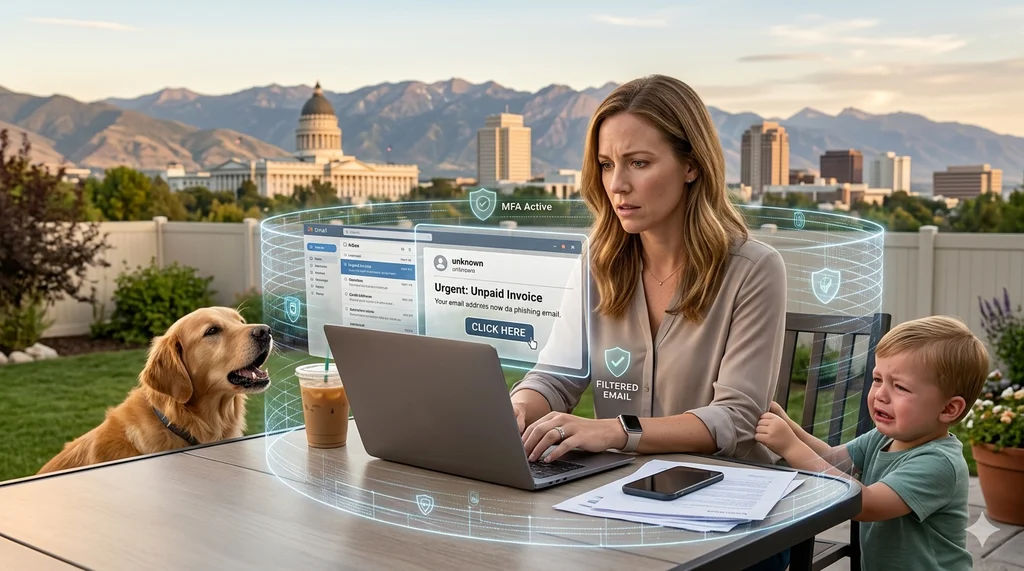
Hackers know the summer schedule shift, and they plan around it. When your day is fragmented — front desk stretched thin, providers moving between rooms, office managers handling twice the usual interruptions — all it takes is one well-timed moment.
Not a major lapse. Just a quick decision made while someone's attention is somewhere else.
Summer creates more of those moments because routines are less consistent and distractions are higher. For Salt Lake City medical practices, work happens in between everything else. Appointment scheduling, insurance authorizations, EHR documentation — it all continues regardless of who's in the office. And when that's the case, speed tends to win over scrutiny.
That's where the real cybersecurity risk starts.
Cybercriminals don't rely on big, obvious scams. They send messages that look routine — a referral request, a shared patient intake form, an insurance authorization, a quick message that looks like it came from Epic or Athenahealth support. These are designed to catch your staff in the middle of something else. Not when they're focused. When they're busy.
In that moment, it's easy to move quickly instead of looking closely. That's when the click happens.
The Click Isn't the Problem — It's What That Click Has Access To
When a staff member clicks a phishing link disguised as a referral or downloads a malicious attachment that looks like an insurance form, it doesn't stop there. It opens the door to patient records, EHR systems, billing platforms, and the clinical infrastructure your Salt Lake City medical practice relies on every day.
None of these systems operate in isolation. Your EHR talks to your billing software. Your scheduling platform connects to your patient communication tools. Once access is gained through one entry point, it rarely stays contained.
From there, malware can move quietly through your environment — spreading across accounts, accessing protected health information, or disrupting your EHR before anyone realizes what's happening. By the time it's noticed, the impact is already much bigger than a single mistake.
At that point, the issue isn't just a bad click. It's everything that click was able to reach — and for a medical practice, that can mean a HIPAA breach, mandatory patient notifications, regulatory fines, and significant reputational damage.
Why 'Just Be More Careful' Doesn't Work in a Busy Clinic
It's easy to say the solution is for your staff to be more careful. But that assumes your front desk coordinator, your medical assistant, and your billing specialist all have time to stop and evaluate every email and every link.
They don't.
A busy clinic moves fast. Attention is split between patients, documentation, phone calls, and provider requests. People are juggling conversations, switching between Phreesia check-ins, Klara messages, and EHR updates — and moving quickly to keep patient care on track. That's why the goal shouldn't be perfect attention. It should be building systems that don't rely on it.
Relying on human vigilance alone is not a HIPAA compliance strategy. It's a liability.
What Actually Protects Your Practice and Your Patients
If your team is moving fast, getting interrupted, and juggling more than usual this summer, your cybersecurity must account for that. The right guardrails help ensure a normal clinic day doesn't turn into a security incident — or a HIPAA breach.
That means limiting what a single mistake can affect and catching problems before they spread. For Salt Lake City medical practices, putting guardrails in place looks like:
- Using unique passwords for every system — EHR, billing, email, scheduling — so one compromised login doesn't unlock everything else
- Turning on multi-factor authentication so a stolen password alone isn't enough to access patient records or PHI
- Filtering and flagging suspicious emails before they reach your staff, so fewer risky decisions can be made during a busy patient day
- Making it easy for someone to pause and ask, "Does this look right?" — especially when an unexpected referral, authorization, or vendor message arrives
None of this depends on perfect behavior. It's designed for real clinic days where staff move quickly, get interrupted, and don't have time to second-guess every click.
What to Do Now While Things Still Feel 'Mostly Fine'
If someone on your team makes the wrong click this afternoon, is it a small issue or something that spreads into your EHR? Would you catch it right away, or only after it's already accessed patient records?
Summer doesn't create these risks. It just makes them easier to miss.
For Salt Lake City medical practices, HIPAA compliance isn't a nice-to-have — it's a legal requirement with real consequences. If your practice still depends on everyone catching everything perfectly, it's time to take a closer look before the pace picks up again and an incident becomes unavoidable.
Frequently Asked Questions
Do you offer HIPAA-compliant IT services for medical practices in Salt Lake City?
Yes. Qual IT works with Salt Lake City medical practices — including clinics, specialty practices, and urgent care — to put the right security guardrails in place. From multi-factor authentication and email filtering to HIPAA-compliant infrastructure and employee security awareness, we make sure one distracted moment doesn't turn into a breach.
What is phishing and why is it a bigger risk in summer for medical practices?
Phishing is when attackers send messages that look routine — referral requests, insurance authorizations, shared patient forms — designed to trick someone into clicking. Summer increases the risk because clinic routines are disrupted, staff coverage is thinner, and employees are more distracted, which is exactly the environment attackers plan around. Healthcare is one of the most targeted industries precisely because of the value of PHI.
How quickly can Qual IT respond if something goes wrong at my clinic?
Our team monitors systems proactively, which means we often catch issues before they affect patient care or compromise PHI. When something does go wrong, we respond quickly so the impact stays small instead of spreading across your practice's systems.
We work with Salt Lake City medical practices to protect patient data and maintain HIPAA compliance.
Let's make sure one mistake doesn't turn into a breach — or a billing nightmare — for your Salt Lake City medical practice.
Book a quick discovery call and we'll show you exactly where your practice stands: www.qualit.com/discoverycall