
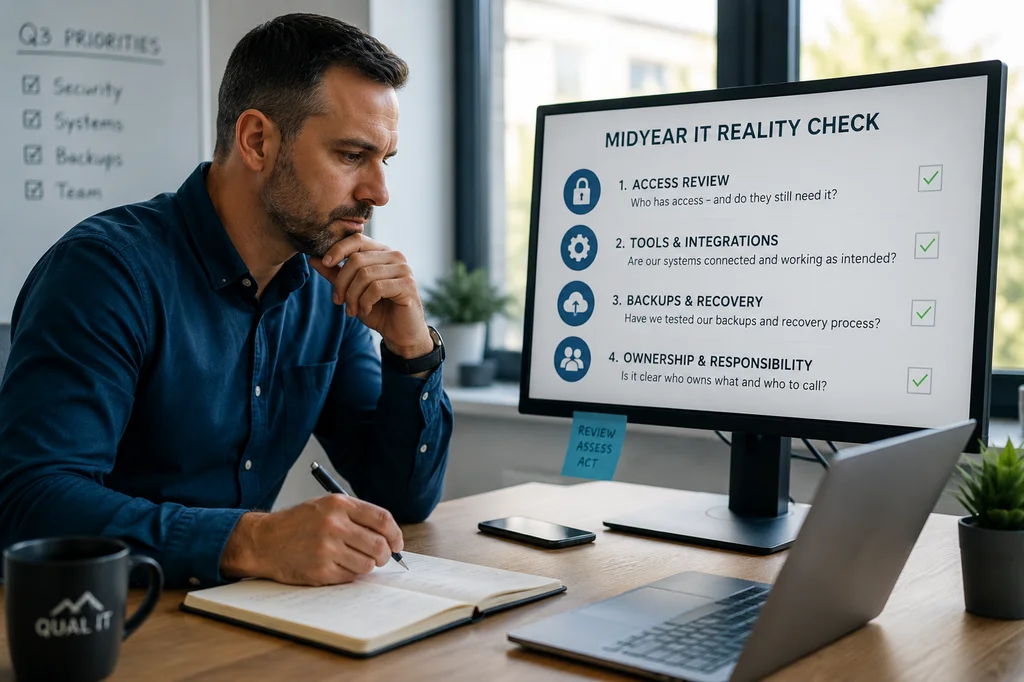
July 2026 | Legal IT Services Utah | Midyear Security & Systems Review | Law Firm Cybersecurity Salt Lake City
Your Salt Lake City law firm hasn't stood still since January — and your IT systems haven't either.
You've brought on new attorneys and staff, adopted new practice management tools, and made fast decisions to keep client matters moving. What's harder to track is the trail those decisions leave behind: who still has access to confidential case documents they no longer need, where client data ended up across your Clio, NetDocuments, and billing platforms, and who is actually responsible for managing each system when something goes wrong.
By July, most law firms are operating on assumptions about how their systems work — assumptions built during busy stretches when there wasn't time to verify them. Here are four things every Salt Lake City law firm should examine before those assumptions create a confidentiality exposure, a bar compliance gap, or a recovery failure at the worst possible moment.
1. Access to Client Files Was Expanded. Was It Ever Revisited?
New attorneys and paralegals needed access to Clio quickly. Staff moved into new roles and picked up permissions in NetDocuments along the way. Temporary access was granted to a contract paralegal or e-discovery vendor to keep a case moving. A billing coordinator needed access to TimeSolv while covering for someone who was out.
But access to confidential client files almost never gets revisited after it's no longer needed. Inside most law firms, the picture looks like this:
- Attorneys and staff have access to client matters beyond their current caseload or role
- Former employees, contract attorneys, or vendors may still carry active credentials in Clio or NetDocuments
- There's no clean record of who can actually access which client files across practice management and document systems
Do the right attorneys and staff have the correct access to the right client files today? If that answer takes longer than a few seconds, it warrants a closer look. For law firms, unreviewed access isn't just an IT issue — it's a potential attorney-client privilege issue. Reviewing user access to confidential case documents is one of the most impactful steps in legal IT security Salt Lake City firms can take.
2. Your Legal Software Stack Solved Problems While Creating New Ones
Your litigation team adopted Relativity for e-discovery. Billing added TimeSolv or Bill4Time to streamline invoicing. Attorneys started using Clio Connect to share documents securely with clients. Someone brought in a communication app that wasn't officially approved because it was faster. DocuSign got added to close engagement letters quickly.
Every one of those was a reasonable decision at the time. Collectively, they created something harder to manage: confidential case data now lives in more places, integrations between Clio and document management were set up quickly and may not be working as intended, and visibility across your entire legal software environment has fragmented.
When your Clio, NetDocuments, research, billing, and e-discovery platforms coexist without anyone owning the full picture, risk doesn't announce itself. It shows up as confidential documents stored in unsanctioned tools, billing data that doesn't reconcile, or a client file that nobody can locate when it's needed most. Proactive legal IT services in Salt Lake City can audit this before it becomes a professional liability.
3. Your Backup of Client Matter Files Is Probably Assumed, Not Verified
Most Salt Lake City law firms have backups in place and operate under a sense of security that hasn't actually been tested. Recovery is rarely verified, the realistic timeline to restore client case documents is unclear, and ownership of the recovery process — if ransomware hit tonight — often isn't formally defined.
When something goes wrong — ransomware targeting a law firm's confidential data, a server failure mid-trial, or an accidental deletion of a client matter file — the conversation too often starts with: 'Wait, who handles this?'
Having backups is not the same as being able to recover client files under pressure. The difference only becomes clear at the worst possible time — when a client's case documents are inaccessible and the clock is running. Law firms are high-value ransomware targets precisely because attackers know client confidentiality creates pressure to pay quickly. A midyear IT review is the right moment to test your recovery process — before you need it in front of a client or a judge.
4. Responsibility for Client Data Systems Has Blurred as Your Firm Has Grown
When the firm was smaller, who owned what was reasonably clear. Your internal team handled certain systems, your IT provider handled others, and responsibilities were roughly understood — even if nobody had formally documented them across your Clio, NetDocuments, and billing platforms.
Then the firm added attorneys, brought in new practice management tools, expanded to additional office locations or remote work, and somewhere in the middle of that growth, ownership got blurry. Now when something breaks across systems or vendors — Clio and NetDocuments aren't syncing, a billing integration is producing errors, or a remote attorney can't access case documents — the question of who takes the lead gets answered in real time.
Issues bounce between vendors and internal staff. Problems with confidential client data systems sit unresolved longer than they should. Nobody's sure whose job it is. Outsourced IT support for Salt Lake City law firms can solve this by establishing documented ownership and clear escalation paths — so when something alarming happens with a client's data, everyone knows exactly what to do.
Most Risk Comes From What's Changed, Not What's Broken
The vulnerabilities that create the most serious exposure for law firms aren't usually dramatic failures. They're the slow drift — access to confidential case documents that was never revoked, legal software tools that were never properly integrated, backups of client matter files that were never actually tested, and responsibility over critical systems that was never formally handed off.
A data incident at a law firm isn't just an IT problem. It's a potential bar association issue, a malpractice exposure, and a breach of the trust your clients have placed in your firm with their most sensitive legal matters.
A midyear IT review with your Salt Lake City legal IT services team is the right time to close those gaps before Q3 opens new ones.
Frequently Asked Questions
Why should Salt Lake City law firms do a midyear IT review?
By July, most firms have made enough changes — new attorneys, new software, new vendors, expanded remote work — that their IT environment looks different than it did in January. A midyear review helps confirm that access to confidential case documents, backup coverage, and security controls still match how the firm actually operates today — and that bar association IT obligations are being met.
Do you offer cybersecurity services for law firms in Salt Lake City?
Yes. Qual IT works with Salt Lake City law firms to secure client files, review access to Clio and NetDocuments, test backup and recovery processes, and ensure IT controls align with bar association cybersecurity requirements. We understand what's at stake when confidential client data is involved.
How long does a midyear IT assessment take for a law firm?
For most small and mid-sized Salt Lake City law firms, a focused IT review can be completed efficiently. Qual IT offers a free discovery call to identify where to start — and what matters most given your firm's practice areas and risk profile.
Ready to Clear the Assumptions Before They Become a Professional Problem?
We work with Salt Lake City law firms to protect client confidentiality and meet bar association IT requirements. Qual IT helps law firms identify where their systems have drifted, where access to confidential client files has accumulated beyond what's appropriate, and what needs attention before it becomes urgent.