July 2026 | CPA Firm Managed IT Salt Lake City | IRS Publication 4557 Compliance | Accounting Firm Cybersecurity Utah
Not all compliance failures start with a breach — but they all start with assumptions.
A Salt Lake City CPA firm can have the right tools in place and still be dangerously unclear on what's actually working. UltraTax CS is installed. TaxDome is configured. The firm has endpoint protection and multifactor authentication. On paper, everything looks fine. But when a client asks for proof of data security, or when an IRS examination of your Written Information Security Plan reveals gaps, assumptions aren't enough. You need to know what's in place, what's documented, and what needs attention.
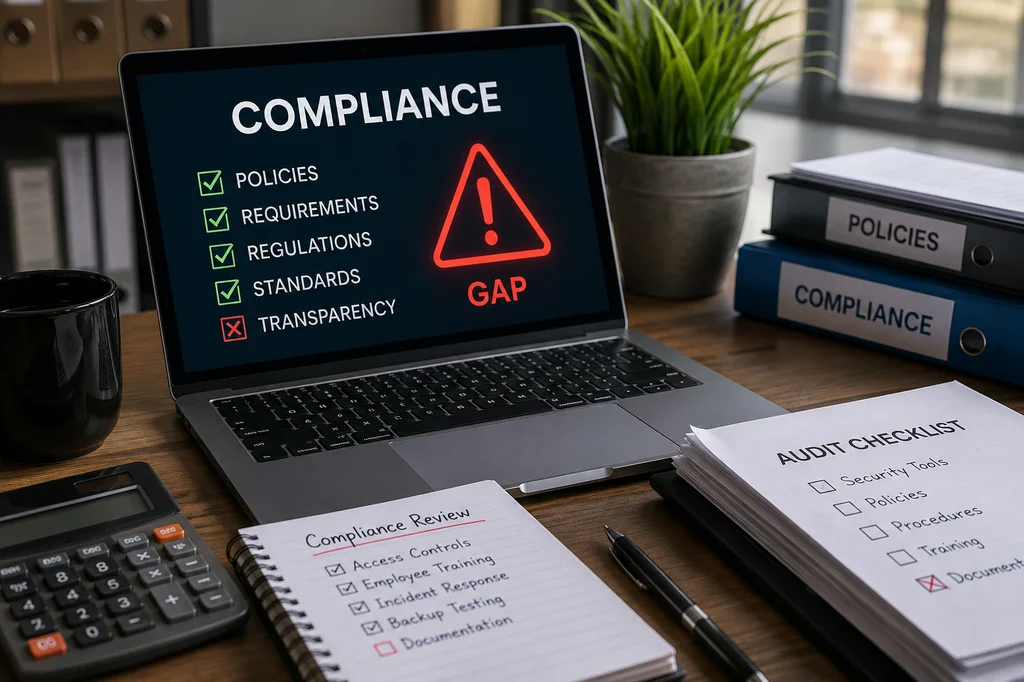
CPA firms hold some of the most sensitive data in existence: client SSNs, bank account numbers, business tax returns, financial statements. IRS Publication 4557 exists specifically because the stakes are this high. Unfortunately, most accounting firms don't discover their compliance gaps during normal operations. They discover them under pressure — when a data breach happens, when a malpractice claim surfaces, or when a client asks hard questions about how their information is being protected. Here are four compliance gaps that can cost Salt Lake City CPA firms thousands when left unchecked.
Gap 1: Security Tools Nobody Actually Monitors
Most Salt Lake City accounting firms already pay for security tools: endpoint protection on workstations, multifactor authentication on UltraTax CS and client portals, firewalls, email filtering to catch IRS phishing attempts. On paper, the firm looks covered under IRS Publication 4557. The problem is ownership.
Who confirms those tools are configured correctly across every workstation your accounting staff uses? Who checks that multifactor authentication is actually enforced on TaxDome and ShareFile — not just enabled by default? Who reviews the security alerts from endpoint protection? Who catches failed updates on the server running your tax software? Who responds when a system flags a suspicious login attempt to your Lacerte database?
Security software can't protect client tax records it doesn't cover. It can't respond to IRS phishing alerts that nobody reads. It can't close gaps left open by partial deployment or warning signs that got dismissed during a busy filing season.
From a distance, your firm's IT security looks solid. Under the scrutiny of an IRS examination or a client inquiry, the picture often changes quickly. Buying the tool is step one. The protection of client SSNs and financial data comes from how that tool gets managed, monitored, and maintained month after month — across every workstation, every portal, and every integration in your tax software stack. That distinction matters when a client asks for proof. A checkbox answer gets noticed. Documented, active management earns trust.
Gap 2: Accounting Staff Behavior No One Has Revisited
Your accounting staff isn't trying to create risk — they're trying to close client returns before the deadline. That's exactly why many compliance gaps come from routine behavior that nobody has stepped back to review.
A senior accountant emails a completed return to a client from a personal device because the VPN was slow during extension season. Someone reuses a password across UltraTax CS and a personal account because they can't remember which credentials go where. An employee clicks a link in what looks like an IRS e-services notification without thinking twice — because they receive dozens of legitimate IRS emails every week. A seasonal staff member accesses client files from an unsecured home network because nobody told them that wasn't allowed.
These everyday shortcuts become serious IRS Publication 4557 compliance gaps when no one reviews or corrects them. Your accounting staff needs clear expectations, practical guidance on handling client tax records securely, and systems that make safe behavior the easiest path — not just a policy document they signed during onboarding and haven't seen since.
For Salt Lake City CPA firms subject to IRS data security requirements, unreviewed accounting staff behavior is consistently one of the most common sources of compliance risk — and one of the easiest to address before it becomes costly.
Gap 3: IRS Data Security Documentation That Gets Built After Someone Asks
IRS Publication 4557 requires CPA firms to maintain a Written Information Security Plan (WISP) that documents how taxpayer data is protected. Many Salt Lake City accounting firms have a WISP — but it was written during a slow week two years ago and hasn't been updated since the firm added TaxDome, switched document management platforms, or hired its last three employees.
You may be doing everything right operationally — but if the documentation doesn't reflect current practice, that becomes a significant problem the moment someone asks for proof. Scrambling to update a WISP after a data breach, a client inquiry, or an IRS examination creates inconsistencies and raises doubts about whether proper controls were being followed in the first place.
Strong IRS compliance documentation for CPA firms means:
- The Written Information Security Plan is reviewed and updated at least annually — before anyone asks
- Access records for UltraTax CS, Lacerte, TaxDome, and document management systems are maintained proactively
- Vendor security assessments are tracked before clients request proof of third-party data handling
- Incident response plans are written and tested before an incident forces you to improvise
Documentation needs to be current, accurate, and easy to produce on demand — not assembled under pressure after the damage is already done.
Gap 4: Security That Didn't Keep Pace with Your Client Roster and Software Stack
This gap matters especially during a midyear review, because your Salt Lake City accounting firm may have changed significantly more than your security posture has in the first half of this year.
Maybe you took on 40 new clients, each bringing their own financial complexity and data volume. Maybe you added ProConnect or switched from Drake Tax to CCH Axcess mid-season. Maybe you started using Karbon for practice management, added SafeSend for return delivery, and onboarded a new client portal without a full security audit of how it integrates with your existing systems. Maybe three new accounting staff joined and you gave them access to everything quickly to keep up with the filing pace.
A security setup built for 8 accounting staff doesn't automatically scale to 20. A backup plan that covered UltraTax CS and one document vault may not cover the four platforms your firm now uses to manage client returns. Access rules that made sense for your client roster in January may be too loose now that you're holding sensitive data for twice as many businesses and individuals.
That's how CPA firms outgrow their IRS compliance posture — not through negligence, but through growth that security didn't keep pace with. A midyear IT security review helps confirm whether your current controls actually align with how the firm operates today, and whether you're still meeting the data security requirements that protect your clients and your professional license.
The Real Cost of Finding Out Late
Compliance gaps for CPA firms usually surface when money, trust, or professional liability are already on the line. By that point, you're doing damage control under the worst possible conditions — trying to explain to a client why their SSN was exposed, working with a malpractice attorney, or rebuilding a WISP that should have been current all along.
The time to identify these issues is before someone else asks the hard questions. A focused IRS data security compliance review for your Salt Lake City accounting firm can surface where client tax records are exposed, where systems have drifted from your written security plan, and whether your current cybersecurity posture meets the requirements your clients expect and IRS Publication 4557 demands.
Frequently Asked Questions
Do you offer cybersecurity and IT support for CPA firms in Salt Lake City?
Yes. Qual IT works with Salt Lake City CPA firms to protect client tax records, close IRS Publication 4557 compliance gaps, and confirm that the firm's security posture keeps pace with its growth. We understand the software CPA firms rely on — UltraTax CS, Lacerte, TaxDome, ShareFile — and the unique compliance obligations that come with holding sensitive taxpayer data.
What are the most common IRS compliance gaps for Salt Lake City CPA firms?
The most common gaps include unmonitored security tools with no clear ownership, outdated Written Information Security Plans that don't reflect current software and staff, accounting staff behavior that creates data handling risks, and security setups that haven't scaled with firm growth. A proactive managed IT services review can identify all of these before they become costly under IRS Publication 4557 or during a client inquiry.
How does IT compliance affect professional liability for CPA firms in Utah?
CPA firms that experience a client data breach without adequate IRS Publication 4557 controls in place face significant professional liability exposure — including malpractice claims, state licensing board inquiries, and cybersecurity insurance claim denials. Insurers increasingly require documented evidence of active controls, not just installed tools. Businesses without proof of monitoring, backup testing, and WISP maintenance may face higher premiums or coverage gaps at renewal.
How often should Salt Lake City CPA firms review their IRS data security compliance?
IRS Publication 4557 requires that your Written Information Security Plan be reviewed regularly. At minimum, annually — but a midyear check-in is strongly recommended after tax season, when staff, software, and client volumes have all changed. Quarterly reviews are ideal for firms that are growing quickly or have added significant new software and vendor relationships.
We work with Salt Lake City CPA firms to protect client data and keep systems running through tax season.
Close the IRS compliance gaps before they cost you. Schedule your free discovery call today.