
August 2026 | CPA Firm Managed IT Salt Lake City | Business Continuity | IRS Data Security Compliance IT Utah
When your flight hits turbulence, the last thing you want to hear from the pilot is, "Give me a minute — I have never handled this before."
CPA firms understand this principle in their own work. When a client calls with an urgent IRS notice, your accounting staff does not stop to research the regulations from scratch. They respond from preparation built long before the call came in. The question is whether your IT infrastructure and incident response planning work the same way — because when a system failure hits during extension season, the worst time to build a recovery plan is in the middle of it.
IRS Publication 4557 requires CPA firms to have written incident response procedures specifically because the IRS understands what happens when firms must figure out their response under pressure. The extension deadline does not pause while your accounting staff figures out what to do.
The Disruptions CPA Firms Are Not Practicing For
Disruptions show up during normal operations and force immediate decisions under pressure, affecting multiple parts of the practice at once.
Tax software environments go offline. Lacerte or UltraTax CS databases become corrupted. Ransomware encrypts the network share where client return files are stored. A critical workstation fails two days before an October extension deadline. These are not hypothetical scenarios — they are the kinds of incidents that happen to CPA firms every year.
Most firms have invested in backups, antivirus software, and security tools to reduce these risks. What most have not done is document exactly what happens when something goes wrong — which system gets restored first, who is responsible for communicating with clients, and what the accounting staff does while systems are being recovered.
That gap stays invisible until something breaks. Then, all at once, questions that should have simple answers become complicated under deadline pressure:
- Who takes charge of the incident response?
- Which client returns need to be accessible first?
- How long will restoring UltraTax CS or Lacerte actually take?
- What do you tell clients whose returns cannot be filed on time?
- Does your incident response satisfy IRS Publication 4557 requirements?
Accounting staff end up working through those answers during the disruption itself — slowing decisions, adding confusion, and extending downtime that a managed IT services partner in Salt Lake City could have helped prevent.
The Hidden Cost of Figuring It Out During the Crisis
When a CPA firm is building its response in real time, the impact spreads quickly across the entire practice.
Accounting staff lose billable hours waiting for system access to be restored. Partners spend time managing the incident instead of working on client matters. Client communication becomes inconsistent as the practice tries to triage the situation without a clear plan or defined spokesperson.
Recovery takes longer when priorities have not been established in advance. Should the tax preparation software be restored first? The document management system? The client portal in TaxDome or ShareFile? Without a documented order of operations, every step requires a decision — and every decision slows the recovery.
For firms with extension deadlines approaching, those delays are not just an inconvenience. They can mean IRS penalties for clients, strained relationships that damage the practice's reputation, and compliance exposure because the incident response did not follow the documented procedures IRS Publication 4557 requires.
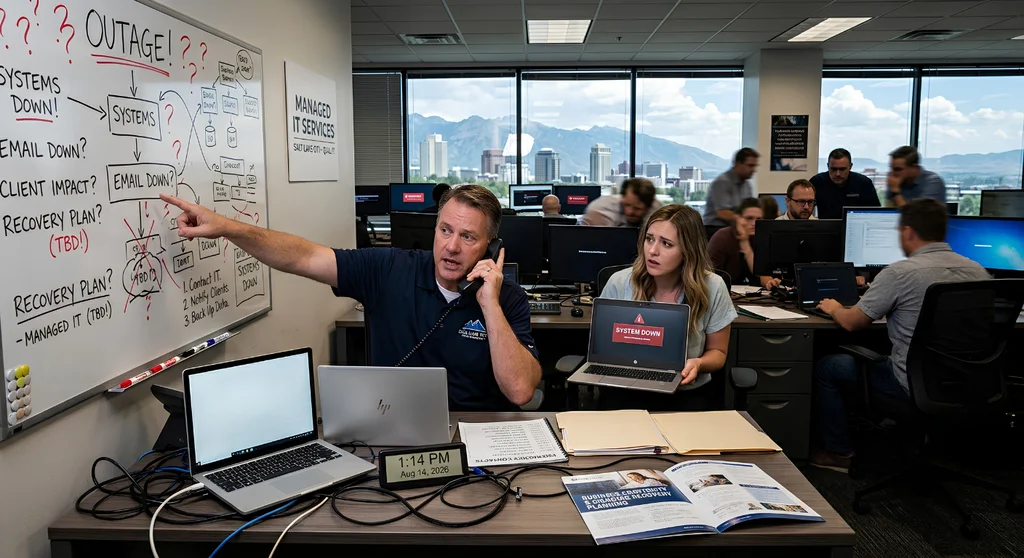
Now picture two Salt Lake City CPA firms facing the exact same system failure two days before the October extension deadline. Same software down. Same client load. Same starting point.
One firm has a documented recovery plan. The order of operations is clear, the restore process for their UltraTax CS environment has been tested, and a communication template for clients was written months ago. The other firm is building its response as it goes — every decision triggers three more questions, hours pass, and what could have been resolved in a few hours becomes a disruption that stretches across days.
The difference between disruption and disaster is almost always preparation — and for CPA firms, preparation means more than having backups. It means knowing exactly what happens after the backups are called upon.
What IRS Publication 4557 Requires
IRS Publication 4557, "Safeguarding Taxpayer Data," does not just require that CPA firms protect client information. It requires a written information security plan that includes documented procedures for responding to data breaches and system failures. That means identifying who is responsible for incident response, how client tax records will be recovered, and how the firm will communicate with clients and regulators when something goes wrong.
A documented plan that has never been tested is not the same as a working plan. The IRS expects firms to know their own response procedures — not to develop them during an incident. Qual IT helps CPA firms in Salt Lake City build, document, and test the recovery procedures that IRS Publication 4557 requires so that when a system failure occurs, your firm has a defensible, practiced response ready to execute.
Firms that have completed this planning also communicate with clients more effectively during a disruption. When you know how long recovery will take and which systems come back first, you can give clients accurate information — which is itself a form of protecting client trust.
The Value of Being Ready
No client expects their CPA firm to improvise when something goes wrong. The expectation is that the firm has controls in place, knows how to respond, and will protect their information regardless of what happens. That expectation applies whether the disruption is a ransomware attack on client SSNs or a hardware failure during the October extension rush.
CPA firms that operate this way respond faster when incidents occur, maintain client confidence through consistent communication, and avoid the compliance exposure that comes from an undocumented response to a covered event.
We have worked with accounting firms through ransomware incidents, tax software failures, and data loss events that could have caused serious damage. The firms that came through with their practices and reputations intact were not the ones with the most expensive technology. They were the ones who had a documented plan and a partner who knew how to execute it.
That is what Qual IT does for CPA firms in Salt Lake City. We work with your accounting staff to build and test the response procedures your practice needs — so no one is starting from scratch when an extension deadline is two days away.
Frequently Asked Questions
What is business continuity planning for CPA firms in Salt Lake City?
Business continuity planning for CPA firms covers how your practice will keep operating — or recover quickly — during a disruption. It includes who owns each response step, how tax software environments and client returns get restored, what the order of operations is, and how clients are communicated with when systems are down during critical filing periods.
Do you offer cybersecurity and IT support for CPA firms in Salt Lake City?
Yes. Qual IT helps CPA firms across Salt Lake City prepare for, respond to, and recover from IT incidents — including ransomware attacks targeting client SSNs, UltraTax CS and Lacerte outages, hardware failures, and data loss events. We also support IRS Publication 4557 compliance as part of our managed IT services for accounting firms.
How does a managed IT provider help CPA firms meet IRS data security requirements?
A managed IT provider like Qual IT builds, documents, and tests your incident response and recovery plan before anything goes wrong. When a disruption occurs, you are not starting from zero — you have a defined process that satisfies IRS Publication 4557 requirements and a partner who knows how to execute it alongside your accounting staff.
Know Where Your Practice Stands Before the Next Deadline
When a system goes down during extension season, will your firm execute a documented plan — or be forced to create one in real time while client deadlines pass?
The firms that recover fastest from disruptions are not the ones that avoided the incident. They are the ones that prepared for it before the pressure arrived. For CPA firms in Salt Lake City, that preparation is the difference between a disruption your clients barely notice and one that damages the trust you have spent years building.
We work with Salt Lake City CPA firms to protect client data and keep systems running through tax season.
Schedule a 10-minute discovery call with Qual IT to evaluate how prepared your CPA practice is to respond, recover, and keep client returns moving when the unexpected happens. Book your discovery call here.