
July 2026 | Dental Office Cybersecurity Salt Lake City | Summer Threat Awareness | HIPAA IT Support for Dentists
On the surface, the water looks calm. That's what makes Shark Week fascinating every year — the danger is never visible on the surface. It's already moving underneath.
Cybercriminals targeting Salt Lake City dental offices operate the same way. The threats your practice faces right now are designed to blend into normal operations — an email from what looks like your dental supply vendor, a login request that arrives during a busy Tuesday morning, a software update notification that isn't what it appears to be — until the moment something breaks, patient records are exposed, or Dentrix goes dark mid-schedule.
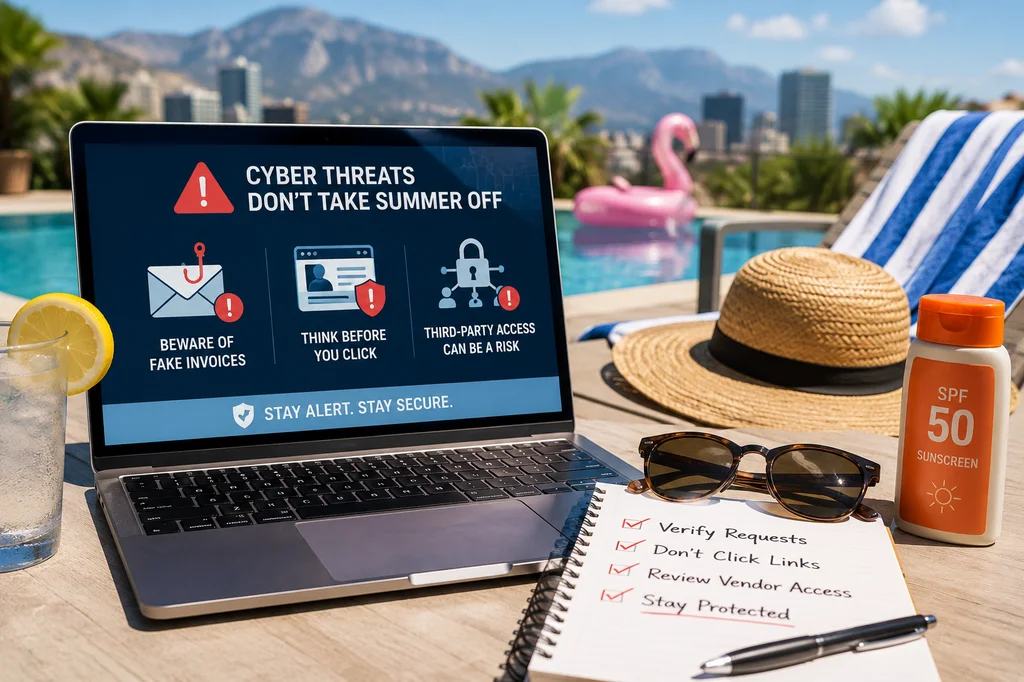
During summer months, when team members take time off, the front desk gets stretched thin covering for each other, and oversight gets thinner, cybercriminals know dental practices are paying less attention. Here are three ways they're circling right now — and what Salt Lake City dental offices can do about each one.
1. Fake Invoices and Vendor Impersonation Targeting Dental Practices
Attackers don't always need to hack anything. In many cases, they just need to send one believable email.
This is called business email compromise (BEC), and for dental offices it works by impersonating vendors your practice already trusts — a dental supply company, your imaging software support team, your billing service, or even your practice management software provider. The email arrives looking completely normal. Someone on your front desk staff processes the payment request. By the time anyone realizes the request wasn't legitimate, the money is gone.
These attacks are especially effective in dental practices for a straightforward reason: the front desk staff who handle financial requests are also the same people managing the phones, greeting patients, processing insurance, and confirming appointments. They're busy, they're moving fast, and they trust the vendors they've been working with for years.
Cybercriminals study your vendor relationships. They know which dental supply companies serve Salt Lake City practices. They can spoof an email from your Carestream or Dexis support team. They know that a request arriving right before lunch — when the schedule is packed and attention is stretched — is more likely to get processed without a second look.
The fix is straightforward to implement: build a verification process for any financial request received via email. A quick confirmation call to a known number — not the number listed in the suspicious email — is enough to stop most of these before they go anywhere. This is a foundational element of cybersecurity for dental offices in Salt Lake City, and it costs nothing to implement beyond a clear policy and a few minutes of training with your front desk staff.
2. Phishing Attacks That Target a Busy Front Desk
Phishing works because it's engineered around how people actually behave when they're busy. And dental front desk staff are among the busiest people in any office.
Think about what your front desk coordinator is managing at any given moment during a morning: answering the phone, pulling up the next patient in Dentrix, processing an insurance verification, responding to a message in Weave, handling a billing question from the back office, and confirming tomorrow's schedule. In that environment, a phishing email that arrives between patients doesn't get scrutinized. It gets clicked.
Cybercriminals design these moments deliberately. A fake password reset notification for your Dentrix login. A text that looks like it came from your IT vendor. An email asking for urgent approval on a supply order. An alert from what looks like your dental imaging system flagging an error. Nobody stops to verify because stopping feels like falling behind — and in a dental office, falling behind means patients waiting.
The most effective protection isn't a software solution alone — it's culture. Your dental team needs to feel comfortable slowing down when something seems off:
- An unexpected login request for Dentrix or Eaglesoft arriving by email
- A payment instruction that came out of nowhere from a 'vendor'
- A link in an email they weren't expecting from what looks like their imaging software provider
- A text message from an unknown number claiming to be from IT or a software vendor
Speed is a weapon attackers use against you. Slowing down — and having a clear, simple process for flagging suspicious requests before acting on them — is how you take it away from them. Security awareness training tailored to front desk staff in dental offices is one of the most cost-effective cybersecurity investments a Salt Lake City dental practice can make. It doesn't require technical knowledge. It requires a clear protocol and practice.
3. Third-Party Risks: Your Imaging Vendor, Billing Service, and Software Integrations
Your dental practice doesn't operate in isolation. You have vendors, software providers, and service partners who have varying degrees of access to your systems and patient data. And when one of them is compromised, the threat doesn't stay contained — it travels directly into your environment through whatever connection they have to your practice.
This is supply chain exposure, and most dental offices have significantly more of it than they realize.
Your Planmeca or Dexis imaging software vendor may have remote access credentials to service your equipment. Your billing company connects to Dentrix or Eaglesoft to pull claims data. Your patient communication platform — Weave, RevenueWell, Lighthouse 360 — has deep integration with your practice management system. Your dental supply company may use a portal that connects to your ordering system. Each of these is a legitimate, necessary relationship. Each of them is also a potential path for an attacker if that vendor's systems are compromised.
This isn't hypothetical. Healthcare supply chain attacks have increased significantly in recent years, specifically targeting vendors who serve small medical and dental practices — because those practices often have weaker defenses and more valuable patient data than their size would suggest.
To understand your supply chain exposure, you need to be able to answer three questions about your dental practice:
- Which vendors, software providers, or billing services can access your patient data or practice systems?
- What exactly are they connecting to — and do they have more access than they actually need?
- Who is responsible internally — even if 'internally' means you — for managing and reviewing those vendor relationships?
If those answers aren't clear, your dental practice's IT security has gaps you haven't seen yet. And under HIPAA, you're responsible for the security practices of your business associates — the vendors who handle your patient data. That responsibility doesn't go away just because someone else manages the connection.
By the Time You See It, It's Already Moving
Sharks don't announce themselves — and neither do the cybercriminals targeting Salt Lake City dental practices right now.
The practices that get hit aren't always the ones that ignore obvious warning signs. They're the ones who assume everything is fine because nothing looks wrong on the surface. Summer is when the front desk gets stretched thin, when team members cover for each other, when the schedule is packed and attention is split. It's also when attackers are most active.
Proactive cybersecurity for dental offices in Salt Lake City means building the defenses before the threat arrives — not scrambling after the breach, not notifying patients about a HIPAA incident, and not spending the afternoon trying to figure out how to restore Dentrix while the afternoon's appointments pile up.
Frequently Asked Questions
Do you offer HIPAA-compliant IT services for dental offices in Salt Lake City?
Yes. Qual IT provides HIPAA-compliant cybersecurity services for dental practices across Salt Lake City, including email security, phishing training for front desk and clinical staff, vendor access reviews, and ongoing monitoring of practice management systems. We understand the tools dental offices rely on and the specific threats they face.
What is business email compromise and how do Salt Lake City dental practices protect against it?
Business email compromise (BEC) is a cyberattack where criminals impersonate a trusted vendor — a dental supply company, billing service, or software provider — to trick your front desk staff into paying a fake invoice or sharing credentials. Protection starts with a simple verification policy: any financial request received by email gets confirmed by phone using a known contact number before anyone takes action. Training your dental team to follow this consistently is the single most effective step.
Why do cyberattacks on dental offices increase during summer months?
Attackers look for moments when oversight is thinner and attention is split. During summer, front desk staff cover for each other, approval processes get rerouted, and the pace of a busy practice makes it harder to slow down and verify unusual requests. Cybercriminals know these patterns and increase targeting accordingly — particularly against healthcare providers like dental offices that hold valuable patient data.
How do I know if my Salt Lake City dental practice has third-party vendor risk?
If any vendor, imaging software provider, billing service, or patient communication platform has access to your systems or patient data — and you don't have a clear record of what they can access and who manages that relationship internally — you have vendor risk. A managed cybersecurity review for dental offices can map your full exposure and flag any access that should be reviewed or revoked.
Don't Wait Until You See the Fin
We work with Salt Lake City dental practices to keep systems running and patient data secure. Qual IT helps dental practices identify cybersecurity vulnerabilities, close supply chain exposure, train front desk staff to recognize phishing attempts, and build the kind of processes that stop attacks before they land — and before a HIPAA breach notification has to go out to your patients.