
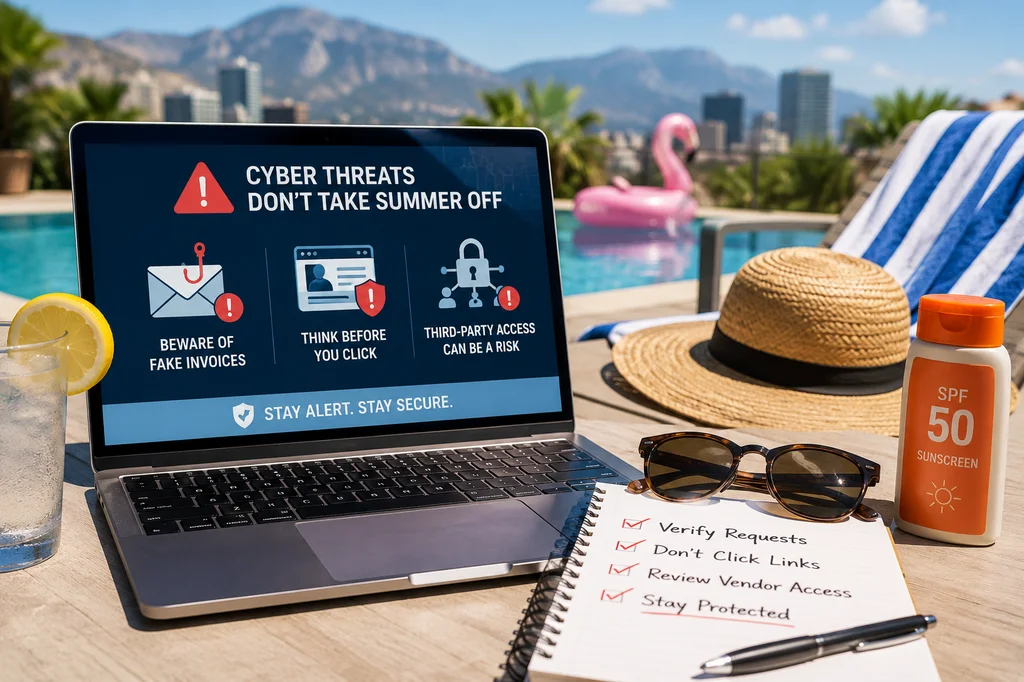
July 2026 | Law Firm Cybersecurity Salt Lake City | Summer Threat Awareness | Wire Fraud & BEC
On the surface, a quiet summer looks like time to catch up on casework. That's exactly what makes it dangerous.
Cybercriminals targeting Salt Lake City law firms operate like predators who've studied their prey: they know when attorneys are traveling, when paralegals are covering for partners, and when reduced oversight makes a firm more vulnerable to a wire transfer fraud that could cost a client hundreds of thousands of dollars — and cost the firm its reputation.
Law firms are among the highest-value targets for cybercrime. They hold confidential case documents, client financial data, trust account information, and matter files that attackers can weaponize or ransom at peak leverage. During summer months, when schedules shift, attorneys travel, and oversight gets thinner, the risk intensifies. Here are three ways attackers are targeting Salt Lake City law firms right now — and what to do about each.
1. Wire Fraud and BEC Targeting Law Firm Trust Accounts
Business email compromise — BEC — is the number one cybersecurity risk facing law firms today, and the consequences for attorneys go beyond financial loss. A successful wire fraud attack involving client funds or trust accounts can result in bar association complaints, malpractice claims, and professional discipline.
Here's how it works: attackers impersonate a client, opposing counsel, a title company, or a managing partner. The email arrives looking completely legitimate — an urgent wire transfer instruction, a change to payment routing information, a request to release escrow funds. Someone on your team processes it. By the time anyone realizes the instruction wasn't authentic, the funds are gone.
These attacks spike during summer for a predictable reason: when the attorney who normally authorizes payments is traveling or out of the office, requests get rerouted to paralegals, associates, or office managers who are less familiar with what 'normal' looks like. Temporary stand-ins are less likely to question urgency — and attackers know it.
The fix is procedural, not technical — and it needs to be non-negotiable:
- Any change to wire transfer instructions must be verified by phone using a number already on file — never the number provided in the email
- Urgency in payment requests should trigger more scrutiny, not less
- Attorneys and staff handling trust account transactions should complete specific training on wire fraud red flags
This is a foundational element of law firm cybersecurity Salt Lake City practices must have in place before a real wire fraud attempt arrives.
2. Phishing Attacks Disguised as Court Filings, Client Requests, or Opposing Counsel
Phishing works against law firms because attackers have done their research. They know which courts your firm appears in. They know who your clients are. They craft emails that look like electronic filing notifications from PACER, urgent messages from a client whose matter is active, or correspondence that appears to come from opposing counsel.
A distracted attorney sees what looks like a court filing notice and clicks the link to download the attachment. A paralegal gets an urgent message appearing to be from a new client and opens the document. Someone receives what looks like a billing inquiry from a corporate client and enters credentials to 'verify' their account.
The most effective protection isn't a single software tool — it's a culture where attorneys and staff are empowered to slow down when something feels off:
- An unexpected request for credentials to access case documents or billing systems
- A payment or wire instruction that arrived out of sequence with the normal matter workflow
- A filing notification or client request that wasn't expected — especially if it includes an attachment or a link
Attorneys and staff need to feel comfortable pausing and verifying through a separate, trusted channel — even when the email looks legitimate and there's time pressure. Speed is the weapon attackers use. Slowing down and verifying is how your firm takes that weapon away. Employee security awareness training for legal teams is one of the most cost-effective cybersecurity investments a Salt Lake City law firm can make.
3. Vendor and E-Discovery Supply Chain Risk
Law firms work with a wide network of third parties: e-discovery vendors running Relativity platforms, court reporters with access to case documents, co-counsel with shared file access in iManage or NetDocuments, cloud-based legal research providers, and outside billing consultants who connect to TimeSolv or Bill4Time.
When any one of those vendors is compromised, the threat doesn't stay with them. It travels directly into your firm's environment through whatever connection they have — and that connection likely includes access to confidential client files, billing data, or matter communications that carry attorney-client privilege.
Most law firms have significantly more vendor exposure than they realize, because access granted for a specific matter or project often doesn't get revoked when that relationship ends. To understand your supply chain risk, your firm needs clear answers to three questions:
- Which vendors, co-counsel, and third parties can access your Clio, NetDocuments, iManage, or Relativity environments?
- What exactly are those parties connecting to — which client files, which matter documents, which billing data?
- Who internally is responsible for managing those access relationships and ensuring they're revoked when no longer needed?
Outsourcing e-discovery or document management doesn't outsource accountability for protecting client confidentiality. If your firm can't answer those three questions quickly, you have supply chain exposure you haven't mapped.
By the Time You See It, It's Already Moving
The most damaging cybersecurity incidents targeting law firms don't announce themselves. Wire fraud instructions look like routine client communications. Phishing emails look like court filings. Vendor compromise looks like normal system access — until a client's confidential matter data has already been exfiltrated.
Salt Lake City law firms that get hit aren't always the ones ignoring obvious warning signs. They're the ones operating under the assumption that things look fine on the surface. Summer is when schedules loosen, attorneys travel, and oversight thins. It's also when attackers targeting law firms are most active.
Proactive law firm cybersecurity in Salt Lake City means building the procedures, training, and access controls before the threat arrives — not managing bar association inquiries and client notification obligations after a breach.
Frequently Asked Questions
What is business email compromise and how do Salt Lake City law firms protect against it?
Business email compromise (BEC) is a cyberattack where criminals impersonate a trusted contact — a client, opposing counsel, title company, or executive — to trick attorneys or staff into wiring funds or sharing credentials. For law firms, where trust account transactions are common, the financial and professional consequences can be severe. Protection requires a verified phone confirmation process for any wire transfer request — using a number already on file, not the one in the email.
Do you offer cybersecurity services for law firms in Salt Lake City?
Yes. Qual IT provides cybersecurity services specifically for Salt Lake City law firms, including protection against wire fraud, phishing, and vendor supply chain risk. We help firms secure Clio, NetDocuments, and other legal platforms, and build the procedures and training that protect client confidentiality.
How do I know if my Salt Lake City law firm has third-party vendor risk?
If any vendor, co-counsel, e-discovery provider, or software platform has access to your firm's systems or client matter files — and you don't have a clear, current record of what they can access and who internally manages that relationship — you have vendor risk. A managed cybersecurity review can map your full exposure and flag access that should be revoked.
Don't Wait Until a Client's Confidential Matter Is Compromised
We work with Salt Lake City law firms to protect client confidentiality and meet bar association IT requirements. Qual IT helps law firms identify cybersecurity vulnerabilities, close vendor access gaps, and build the procedures and training that stop wire fraud and phishing attacks before they land.