
July 2026 | Property Management Cybersecurity Salt Lake City | Wire Fraud | Summer Threat Awareness | Business Email Compromise
On the surface, the water looks calm. That's what makes Shark Week fascinating every year — the danger is never visible on the surface. It's already moving underneath.
Cybercriminals targeting Salt Lake City property management companies operate the same way. The threats your leasing agents and property managers face right now are designed to blend in with normal operations — a routine-looking email about wire instructions, a password reset notification on an AppFolio account, a vendor message that arrives at exactly the right moment. Until the moment money moves, tenant data is compromised, or rent collection systems go down.
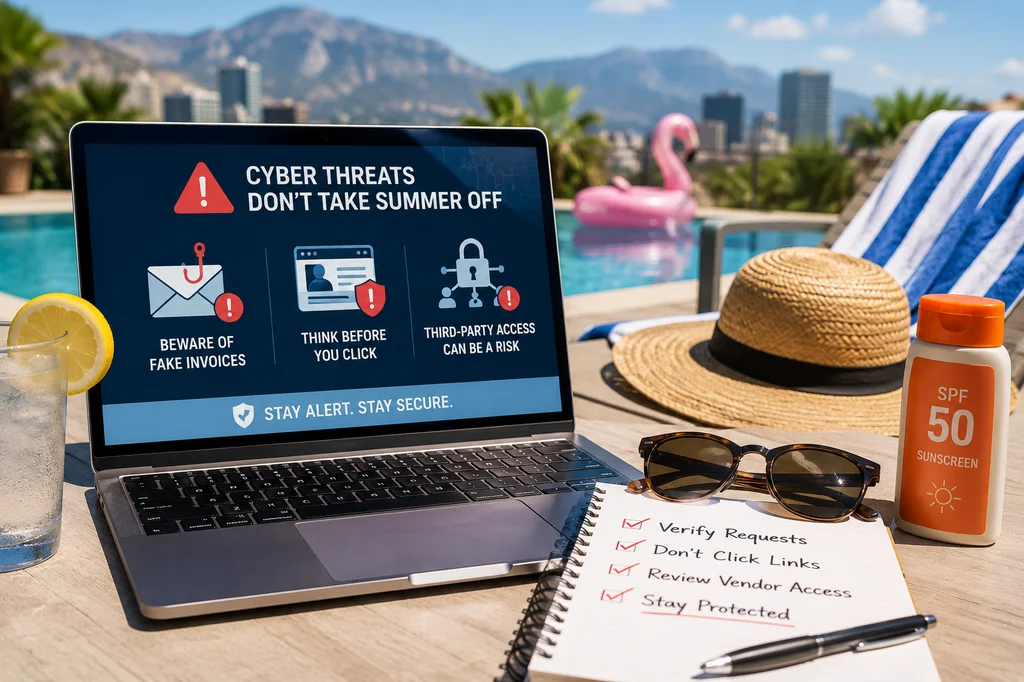
During the summer months, when leasing activity peaks, property managers are stretched thin managing move-ins and move-outs, and oversight gets thinner across a dispersed team of leasing agents working remotely — cybercriminals know this. Here are three ways they're circling Salt Lake City property management companies right now.
1. Wire Fraud via Fake Transaction Instructions — The #1 Financial Cyber Risk in Real Estate
Wire fraud is the single greatest financial cybersecurity threat facing property management companies and real estate firms. Criminals don't need to break through your firewall. They just need to intercept one email thread.
Here's how it happens: attackers monitor email communications between property managers, transaction coordinators, and buyers or sellers. At the right moment — often during a lease signing, a property closing, or an ACH setup for a new tenant — they insert a fake message that appears to come from a trusted party. The wire instructions look legitimate. The email looks real. By the time anyone realizes the instructions were fraudulent, the funds are gone.
These attacks spike during summer for a predictable reason: peak leasing season means high transaction volume, property managers and leasing agents are moving fast, and the person who normally double-checks wire instructions may be out or overwhelmed. Criminals know that urgency suppresses skepticism.
The fix requires both process and technology:
- Any wire instructions received by email — even from a known contact — must be verified by phone using a number you already have on file, not the one in the email
- Email security controls should flag impersonated sender addresses and lookalike domains used in wire fraud attempts
- Property managers and leasing agents should be trained to recognize the warning signs of BEC targeting transaction communications
- Multifactor authentication on email accounts used for transactions is non-negotiable
This is foundational cybersecurity for every Salt Lake City property management company and real estate firm operating in today's environment. Wire fraud horror stories are real — the protection starts with your team's process, backed by the right technical controls.
2. Phishing Attacks Targeting Leasing Agents Processing Tenant Applications
Phishing works because it's engineered around how people actually behave when they're busy — and during summer leasing season, your leasing agents are very busy.
Criminals design these moments deliberately. A leasing agent processing a stack of rental applications receives a fake AppFolio notification asking them to verify their credentials. A property manager gets a text that looks like it came from IT. An email arrives right before a showing asking for urgent approval on an ACH change for an existing tenant. Nobody stops to verify because stopping feels like losing time.
The attack surfaces multiply when leasing agents are accessing AppFolio and Buildium from personal devices, home networks, and coffee shops — a normal reality for a mobile property management team. Every unmanaged device is a potential entry point.
The most effective protection combines technology and culture:
- Unexpected login requests for AppFolio, Buildium, or Dotloop should trigger verification, not immediate action
- Requests to change ACH bank information for tenant rent payments should require in-person or phone verification
- Links in emails that weren't expected — even from known contacts — should be treated with skepticism
- Leasing agents need to feel comfortable slowing down when something seems off, without fear of being wrong
Speed is a weapon attackers use against your team. Building a culture where slowing down to verify is the norm — not the exception — is how you take that weapon away. Employee security awareness is one of the most cost-effective cybersecurity investments a Salt Lake City property management company can make.
3. Maintenance Vendor and HOA Portal Supply Chain Risk
When a vendor with access to your property management systems is compromised, the threat doesn't stay contained to them. It travels directly into your environment through whatever connection they have to your business.
Property management companies have extensive third-party exposure that most owners have never fully mapped: maintenance vendors with access to Propertyware or Yardi maintenance modules, HOA management portals with credentials into shared systems, transaction platforms where outside agents access Dotloop files, WFRMLS integrations that connect listing data across organizations.
This is supply chain exposure — and most property management companies have significantly more of it than they realize. Outsourcing a service doesn't outsource accountability. One compromised vendor credential is an open door into your tenant data and transaction documents.
To understand your supply chain exposure, your property management company needs to be able to answer three questions:
- Which vendors and outside agents can access your AppFolio, Buildium, Yardi, or Propertyware systems?
- What specifically are they connecting to — tenant records, financial data, transaction documents?
- Who is responsible internally for managing those vendor relationships and revoking access when it's no longer needed?
If those answers aren't clear, your cybersecurity posture has gaps you haven't seen yet — and attackers are looking for exactly those kinds of openings.
By the Time You See It, It's Already Moving
Sharks don't announce themselves — and neither do the cybercriminals targeting Salt Lake City property management companies right now.
The property management companies that get hit with wire fraud or data breaches aren't always the ones ignoring obvious warning signs. They're the ones who assumed everything was fine because nothing looked wrong on the surface. Summer is when your team is moving fast, leasing activity is high, and attention to security tends to drift. It's also when attackers are most active — targeting the exact moments when your property managers and leasing agents are least likely to pause and verify.
Proactive cybersecurity for Salt Lake City property management companies means building the defenses before the threat arrives — wire fraud prevention processes, secure access controls on AppFolio and Buildium, trained leasing agents who know how to spot a phishing attempt, and a clear picture of every vendor with access to your systems.
Frequently Asked Questions
Do you offer IT support and cybersecurity for property management companies in Salt Lake City?
Yes. Qual IT specializes in cybersecurity for Salt Lake City property management companies and real estate firms, including wire fraud prevention, tenant data protection, secure access controls for AppFolio and Buildium, and employee security awareness training for leasing agents and property managers.
What is business email compromise and how do Salt Lake City property management companies protect against it?
Business email compromise (BEC) in real estate and property management involves criminals impersonating a trusted contact — often in a transaction thread — to redirect wire funds or intercept ACH payment changes. Protection starts with verification: any wire instruction or banking change received via email must be confirmed by phone using a number you already have on file before any action is taken.
Why does wire fraud target property management companies specifically?
Real estate and property management transactions involve large dollar amounts, multiple parties communicating by email, and time pressure that discourages pausing to verify. Wire fraud criminals specifically target these dynamics — monitoring transaction emails, waiting for the right moment, and inserting fake instructions that look completely legitimate.
How do I know if my Salt Lake City property management company has third-party vendor risk?
If any maintenance vendor, HOA portal, transaction platform, or outside agent has access to your AppFolio, Buildium, Yardi, Propertyware, or Dotloop systems — and you don't have a clear record of what they can access and who manages that relationship — you have vendor risk. A managed cybersecurity review can map your full exposure and flag access that should be revoked.
Don't Wait Until You See the Fin
We work with Salt Lake City property management companies to protect tenant data and secure real estate transactions.
Schedule your free discovery call today — Qual IT helps Salt Lake City property management companies identify cybersecurity vulnerabilities, close wire fraud exposure, and build the processes that protect transactions and tenant data before an attack lands.