
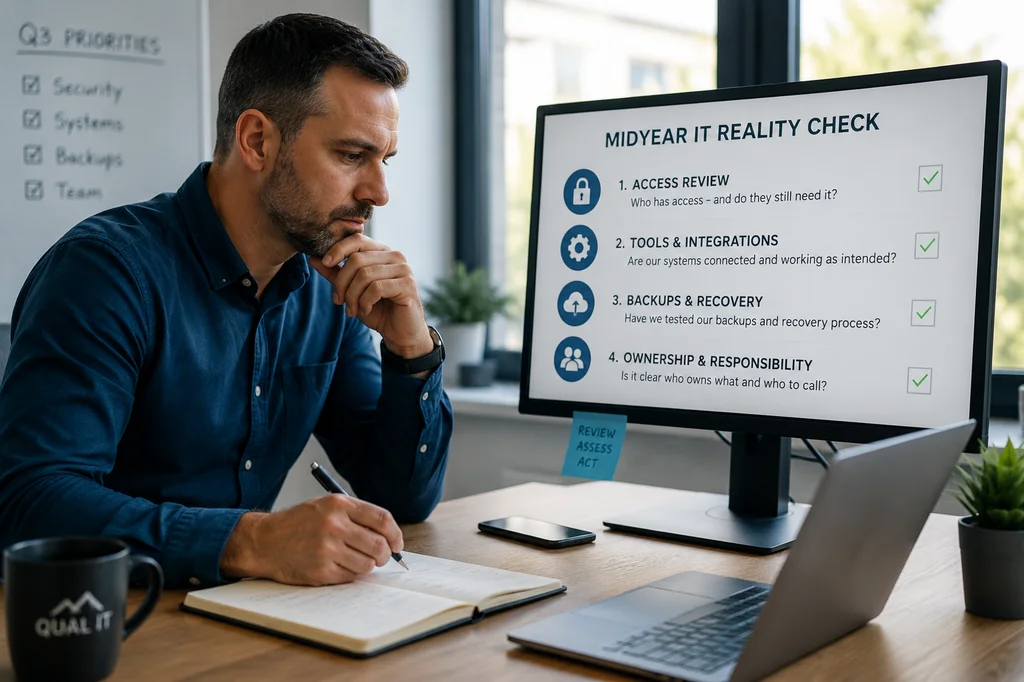
July 2026 | Insurance Firm IT Services Utah | Midyear Security & Agency Systems Review
Your Salt Lake City insurance agency hasn't stood still since January — and your agency systems haven't either.
You've added agents and staff, connected to new carriers, adopted new tools, and made fast calls to keep quoting and servicing running. What's hard to track is the trail those decisions leave behind: who still has access to Applied Epic or AMS360 when they no longer need it, where policyholder data ended up, and who's actually responsible for what when something goes wrong.
By July, most insurance agencies are running on assumptions about how their systems work. Here are four things every Salt Lake City agency owner should examine before those assumptions become expensive — or expose client insurance records to the wrong people.
1. Access to Agency Systems Was Expanded. Was It Ever Revisited?
New agents needed to get onto Applied Epic or AMS360 quickly. Other staff moved into new roles and picked up permissions along the way. Temporary access was granted to cover for someone who was out during a busy renewal period.
But access to agency management systems almost never gets revisited after it's no longer needed. Inside most agencies, the picture looks like this:
- Agents have more access to client insurance records than their current role requires
- Former agents or staff may still carry active credentials into Applied Epic or carrier portals
- There's no clean view of who can actually reach which policyholder data
Do the right people have the correct access to your agency systems today? If that answer takes longer than a few seconds, it's worth a closer look. Reviewing user access to Applied Epic, AMS360, HawkSoft, and carrier portals is one of the most impactful — and most overlooked — steps in IT security for Salt Lake City insurance agencies.
A former agent who left your agency three months ago but still has access to your book of business in Applied Epic is not just an IT problem — it's a liability your errors and omissions policy may not fully cover.
2. Your Agency Tools Solved Problems While Creating New Ones
Your agents needed a better way to track client conversations, so a CRM like Salesforce or HubSpot was added. Your team adopted AgencyZoom to manage pipelines and renewals. Operations brought on EZLynx or TurboRater for faster rating across carriers. Someone signed up for a document portal like ShareFile or Applied CSR24 that seemed lightweight at the time.
Every one of those was a reasonable decision. Collectively, they created something messier: policyholder data now lives in more places, integrations between your agency management system and CRM were set up quickly and may not be working as intended, and visibility across systems has fragmented.
When agency tools coexist without anyone owning the full picture, risk doesn't announce itself. It shows up later in slower decisions, inconsistent client records, and gaps in policyholder data that belong to nobody. Proactive IT services for Salt Lake City insurance agencies can audit this before it becomes a problem — and before a carrier audit or state insurance department inquiry makes it urgent.
App sprawl across carrier portals, rating tools, CRM platforms, and document management systems is one of the defining IT challenges facing independent insurance agencies today. Every connection is a potential exposure point.
3. Your Backup of Client Policy Files Is Probably Assumed, Not Verified
Most Salt Lake City insurance agencies have backups in place and operate under a false sense of security. Recovery of client files in Applied Epic or AMS360 is rarely tested, the realistic timeline to restore quoting and servicing operations is unclear, and ownership of the recovery process often isn't defined.
When something goes wrong — ransomware that encrypts your agency management system, a server failure, or an accidental deletion of a client file in AMS360 — the conversation too often starts with: 'Wait, who handles this?'
Having backups is not the same as being able to recover. The difference between them only becomes clear at the worst possible time — like when a client calls for a certificate of insurance and your system is down. A midyear IT review is the right moment to test that process before you need it. The cost of an untested backup isn't just technical — it's the clients you lose when you can't service them.
Ransomware attacks targeting insurance agency management systems like Applied Epic and AMS360 are not hypothetical. Agencies that have experienced this describe days or weeks of being unable to quote, bind, or service existing policyholders.
4. IT Responsibility Has Blurred as Your Agency Has Grown
Early on, who owned what was clear. Your internal team handled certain systems, vendors handled others, and responsibilities were roughly defined — even if nobody had formally documented them.
Then your agency expanded, new carriers came on board, internal roles shifted, and somewhere in the middle of that growth, ownership got blurry. Now when something breaks across Applied Epic, a carrier portal, or your CRM, the question of who takes the lead gets answered in real time. Issues bounce between your internal staff and your IT vendor, small problems sit unresolved longer than they should, and nobody's sure whose job it is.
This ambiguity creates real risk for policyholder data. When a carrier portal stops syncing with AMS360, or when client documents in ShareFile become inaccessible, delayed resolution isn't just an inconvenience — it's a service failure your clients will remember.
Outsourced IT support for Salt Lake City insurance agencies can solve this by establishing clear ownership and documented escalation paths — so when something alarming happens, everyone knows exactly what to do and your agents can keep servicing clients without interruption.
Most Risk Comes From What's Changed, Not What's Broken
The vulnerabilities that hurt insurance agencies most aren't usually dramatic failures. They're the slow drift — access to Applied Epic that was never revoked, carrier portal integrations that were never properly secured, client policy file backups that were never actually tested, and IT responsibilities that were never formally handed off as the agency grew.
A midyear IT review with your Salt Lake City IT services team is the right time to close those gaps before Q3 opens new ones — and before a state insurance department inquiry, carrier audit, or policyholder breach makes those gaps impossible to ignore.
Frequently Asked Questions
Do you offer IT support and cybersecurity for insurance agencies in Salt Lake City?
Yes. Qual IT works with independent insurance agencies throughout the Salt Lake City area, providing IT support tailored to agency management systems, carrier portal security, and policyholder data protection.
Why should Salt Lake City insurance agencies do a midyear IT review?
By July, most agencies have made enough changes — new agents, new carriers, new software like AgencyZoom or EZLynx — that their IT environment looks different than it did in January. A midyear review helps confirm that access to Applied Epic and AMS360, backups of client insurance records, and security controls still match how the agency actually operates today.
What does a midyear IT security review typically cover for an insurance agency?
A thorough review covers agent and staff access to agency management systems, backup and recovery testing for client policy files, software integrations between your AMS and CRM, carrier portal access management, state insurance department compliance alignment, and any new risks introduced by business changes in the first half of the year.
How long does a midyear IT assessment take for a small insurance agency?
For most independent insurance agencies in the Salt Lake Valley, a focused IT review can be completed within a few hours. Qual IT offers a free 10-minute discovery call to help identify where to start.
Ready to Clear the Assumptions Before They Cost You?
We work with Salt Lake City insurance agencies to protect policyholder data and keep agency systems running.