
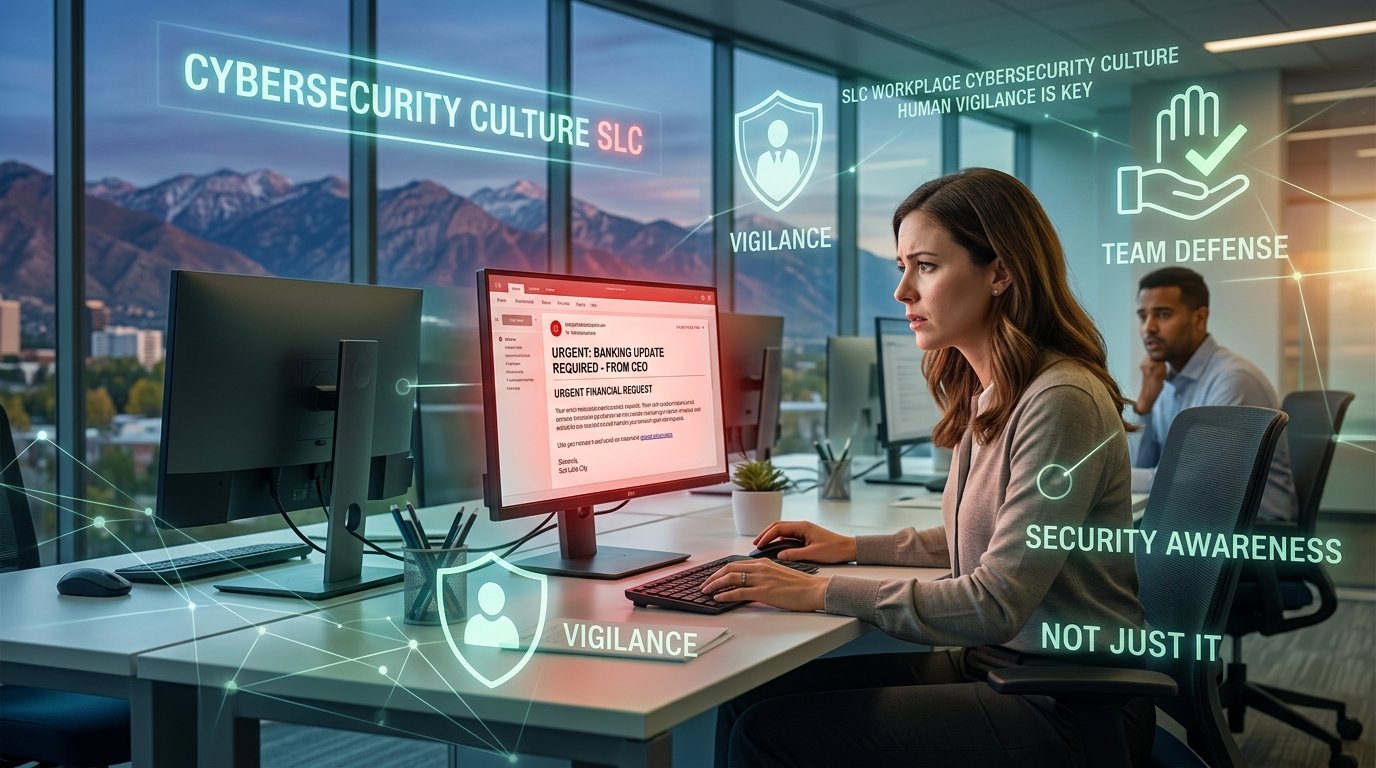
October 2026 | IT Support for Financial Advisors Salt Lake City | Security Culture | Wire Fraud Prevention
It's 4:17 on a Friday afternoon at a Salt Lake City advisory firm.
An operations associate receives an email that appears to be from a longtime client: "I just closed on a property. Can you wire $85,000 from my brokerage account to the new account below before the weekend?"
The name is right. The tone sounds like the client. The signature matches. And with everyone trying to wrap up the week, the easiest thing to do is start the paperwork. There's only one problem: the client never sent it.
Client impersonation wire fraud is the advisory firm's nightmare scenario - and it's one of the most common ways firms lose client money. Your IT security tools can put strong protections in place, but they can't stop every rushed reply or split-second decision to process a request. Some decisions still come down to whether a member of your advisory team knows what to do when something feels off.
The Assumption That Leaves Advisory Firms Exposed
Most firm principals believe cybersecurity lives somewhere behind the scenes. The IT provider has tools. The computers have protection. Compliance handles the policies. Cybersecurity is "handled."
In reality, your defenses are tested every time someone at your firm decides whether to trust an email, a link or a money movement request. Those decisions happen every day - in the inbox, in Redtail or Wealthbox, in the custodian portal. To truly protect client financial data, your advisory team must know what to do when something doesn't look right. And because the firm carries the fiduciary responsibility and the regulatory liability, "handled" has to mean more than software.
Technology Can't Make Every Call
Good security tools block a lot of attack attempts before your team ever sees them. But no technology can eliminate every questionable request or make every decision on an associate's behalf.
Today's attacks aren't obvious. They're built to mimic a client's writing style, reference real account details scraped from a compromised inbox and mirror the rhythm of normal client conversations. When a distribution request arrives with a new bank account, when a "custodian notice" asks someone to re-verify credentials, when a colleague seems to need access to a client file they've never touched - someone must decide what happens next. The person at the keyboard has to determine in an instant whether they're looking at fraud or a legitimate request.
"Be Careful" Isn't a Cybersecurity Plan - or a Compliance Program
Most firms tell staff to watch out for suspicious emails. But what should they do when they find one? Everyone on your advisory team should know:
- Who to contact - internally and at the custodian
- How to verify a money movement request: a callback to the client at a number already on file, never one supplied in the email
- Not to click links or download attachments from suspicious messages, even ones dressed up as custodian or FINRA notices
- What to do if they already clicked a link or entered credentials
- How to report the issue quickly, without fear of blame
Telling everyone to simply "be careful" without a clear next step puts the full weight of a high-stakes decision - potentially a client's life savings - on the person least equipped to handle it in the moment.
Assuming staff know what to do is a liability in every sense. An associate who isn't sure whether they're bothering someone may stay quiet. Someone who fears getting blamed may wait before reporting. Hesitation is costly: the time lost while someone decides whether to speak up can turn a recoverable wire into an unrecoverable one, and a manageable incident into a reportable event.
Leadership Sets the Tone
Responsibility starts at the top, because your team takes its cues from the firm's principals. If a partner routinely skips callback verification because a client is "in a hurry," staff learn that speed matters more than process. If flagging a suspicious request feels like an accusation, people stay quiet. If someone clicks something they shouldn't and gets publicly reprimanded, everyone learns to hide mistakes - exactly the behavior that turns small incidents into large ones.
Fortunately, the opposite is also true. When leadership treats verification as non-negotiable - for every client, every time - the team takes it seriously. When an associate who questions an unusual request is backed up rather than brushed off, the whole firm operates more carefully. When your team trusts leadership, they speak up before a situation becomes a crisis. Regulators notice the difference too: a firm whose culture matches its written policies has a far easier conversation during an SEC exam.
Cybersecurity Works Better When Everyone Knows Their Role
Back to that operations associate at 4:17 on a Friday afternoon.
The goal isn't to make your team paranoid about every client email. It's to make sure that when something feels off, they know exactly what to do: pause the request, call the client at the number on file, and loop in the right people. Speaking up should always feel like the right move - because for a fiduciary, it is.
Your advisors and staff don't need to become cybersecurity experts to protect client financial data. They need clear expectations, good habits and the confidence to flag anything that doesn't look right.
Creating that kind of security culture takes more than an annual compliance training session. It requires the right safeguards, practical verification processes and ongoing guidance to keep your firm prepared as threats - and SEC and FINRA expectations - evolve.
Frequently Asked Questions
What is employee security awareness training for advisory firms?
It's structured, ongoing education that teaches your advisory team to recognize phishing, client impersonation and social engineering - and gives them a clear process for verifying money movement requests and reporting suspicious activity. Done well, it turns your team into an active layer of defense and strengthens your regulatory posture at the same time.
How does an IT partner help prevent wire fraud at an advisory firm?
A partner like Qual IT hardens the email environment where impersonation starts, implements MFA and access controls across your CRM, portfolio and document systems, helps establish callback verification procedures, and provides ongoing training so every request gets the scrutiny a fiduciary owes clients.
Do you offer SEC and FINRA-compliant IT services for financial advisory firms in Salt Lake City?
Yes. Qual IT delivers IT support for financial advisors in Salt Lake City and across the Wasatch Front, including SEC-compliant IT services: email security, phishing protection, employee training, support for archiving and supervision requirements, and incident response planning built around SEC and FINRA cybersecurity expectations.
You Don't Have to Manage It Alone
That's where the right IT partner comes in. Qual IT helps advisory firms take the guesswork out of cybersecurity by identifying gaps, strengthening protections around client financial data and helping every member of the team understand the role they play in keeping the firm - and its clients - secure.
We work with Salt Lake City financial advisors to meet SEC/FINRA requirements and protect client data. Cybersecurity is everyone's responsibility - but you don't have to manage it alone.
Schedule a 10-minute discovery call with Qual IT to find the gaps in your current approach and how to address them. Book your discovery call here.