
August 2026 | Law Firm Cybersecurity Salt Lake City | Legal IT Services Utah | Business Continuity
Mike Tyson once said, "Everyone has a plan until they get punched in the mouth."
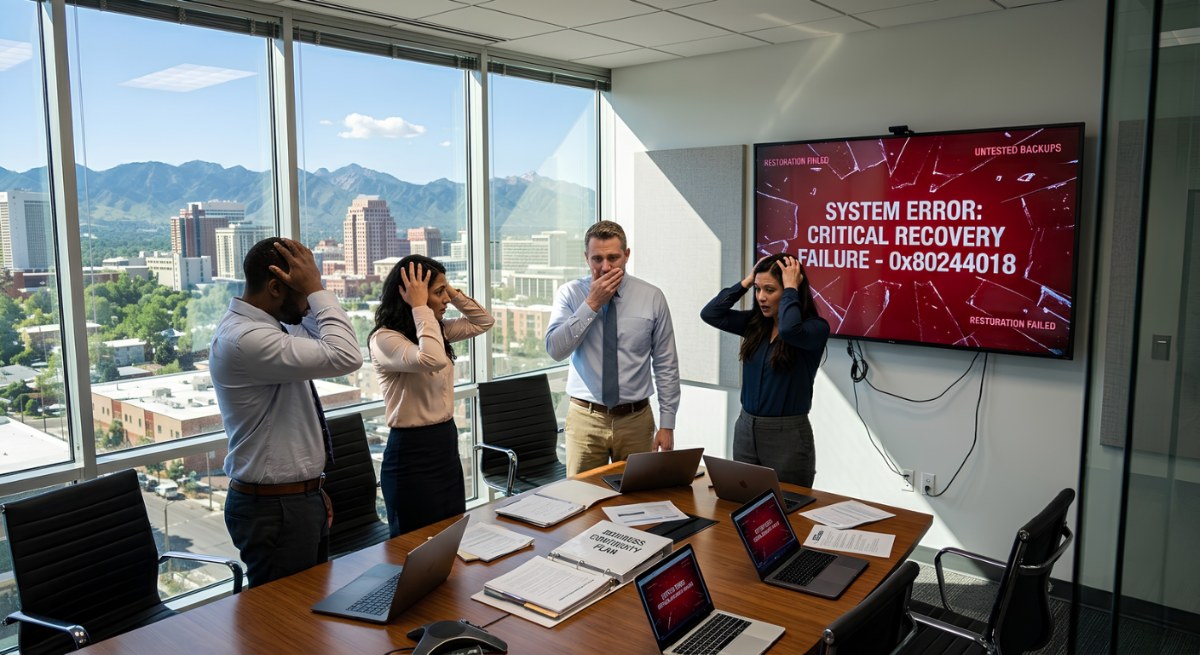
For Salt Lake City law firms, that punch usually arrives as a disruption you assumed you were ready for — a failed restore of client matter files, an unexpected system outage before a court deadline or a security incident that exposes a weakness no one in the firm knew existed.
That is the nature of assumptions. They feel like facts right up until they are tested. For law firms relying on Clio, NetDocuments or iManage to house client matter files, these are the four assumptions that most often cause the real damage — to client relationships, to bar compliance standing and to the firm's professional reputation.
Assumption #1: "Our Clio Environment Handles Our Backups"
Relying on your practice management platform to be your complete backup strategy is like carrying a spare tire you have never checked — and discovering it is flat when you are stranded on the side of the road the morning of a major hearing.
Law firms using Clio, MyCase or PracticePanther know that client matter files, notes and billing records live in those platforms. But cloud platforms back up data on their own schedules and in formats designed for their own recovery purposes — not necessarily for yours.
If your Clio environment becomes unavailable, corrupted or subject to a ransomware incident that locks your data, the platform's native recovery process may not match the urgency of an active matter or an approaching filing deadline. Your backup of client matter files has to be yours — separate, tested and recoverable on your timeline.
A backup proves its value only when it actually restores your client matter files completely and within an acceptable window. The most dangerous backup is the one you have never tested.
Assumption #2: "Someone Would Tell Us If There Was a Problem"
Monitoring tools are valuable. But confusing detection with protection is a costly mistake — particularly in a law firm environment where the data involved is subject to attorney-client privilege.
A weather alert can tell you a hurricane is coming. It does not board up the windows or move your family to safety. The alert is useful only if you know what to do next.
Your IT monitoring works the same way. It can tell you something is wrong. What happens after that alert fires is entirely up to whether your attorneys and staff have a documented response plan — and whether your IT support for law firms in Salt Lake City includes a partner who can execute it.
Bar associations increasingly expect law firms to have documented incident response plans. An alert that generates no organized action does not satisfy that requirement. Without a response plan and a capable IT partner who understands legal industry compliance, alerts become noise instead of protection.
Assumption #3: "Our Attorneys and Staff Know What to Do"
Every team looks prepared — until the moment they actually have to perform.
Picture this: It is a Friday afternoon. A senior partner is preparing for Monday's trial. The firm's document management system goes offline. Suddenly no one can agree on who is responsible for calling IT, what gets restored first or whether the backup of client matter files even covers the documents needed for Monday.
When there is no documented plan and no practice run, even a capable and experienced team is starting from zero. You do not run a fire drill because you expect the building to burn down tomorrow. You do it so that if there ever is a fire, no one is standing in the hallway asking which way to run.
A law firm recovery plan works exactly the same way. When something goes wrong — a Westlaw outage, a NetDocuments failure, a ransomware incident locking access to client matter files — you want your attorneys and staff executing a plan they already know, not working through it for the first time under pressure.
The chaos rarely comes from the disruption itself. It comes from not knowing what to do next. In a law firm environment, that uncertainty also creates potential malpractice exposure if deadlines are missed as a result.
Assumption #4: "Law Firms Don't Get Targeted"
No one thinks they will be the one — until they are.
Law firms are among the most targeted sectors in cybersecurity precisely because of the value of what they hold. Client matter files contain confidential business strategies, personal financial information, protected health information, privileged communications and proprietary legal work product. That is exactly what cybercriminals look for.
Business email compromise targeting wire transfers — a particular threat in real estate transactions and settlements — is one of the most damaging attacks law firms face. Phishing emails disguised as court filings or opposing counsel correspondence are specifically designed to bypass legal professionals who are trained to trust those communication channels.
The question is not whether your Salt Lake City law firm will face a cyber threat. It is whether you will be ready when it happens. Law firms that recover fastest from incidents are not the ones that somehow avoided being targeted — they are the ones who had a documented response plan, a tested backup of client matter files and an IT partner with legal industry experience already in place.
Frequently Asked Questions
What is the difference between backup and disaster recovery for law firms?
Backup is the process of copying and storing your client matter files and firm data. Disaster recovery is the plan for restoring those files and getting systems — including Clio, NetDocuments or iManage — back online after an incident. You need both, and both need to be tested to be reliable under the pressure of an active legal matter.
How often should Salt Lake City law firms test their backups of client matter files?
At minimum, quarterly. Firms with active litigation practices, compliance requirements or high volumes of document activity should test more frequently. The goal is to verify that the backup of client matter files restores completely and within a timeframe that does not affect your attorneys and staff or your clients before an actual incident occurs.
Do you offer cybersecurity services for law firms in Salt Lake City?
Yes. Qual IT provides law firm cybersecurity, backup and disaster recovery, incident response planning and managed IT services for law firms across Salt Lake City and the Wasatch Front. We work with firms to protect client confidentiality and meet bar association IT requirements.
You Cannot Block a Punch You Did Not Prepare For
It is rarely the dramatic event that catches law firms off guard. It is the ordinary ones — a corrupt file, a failed restore, a phishing email that looked like it came from opposing counsel — that hit on a Wednesday when no one is expecting it.
Most of these risks can be identified and addressed before they become client-facing problems or bar compliance issues. That is exactly what Qual IT helps Salt Lake City law firms do.
We work with Salt Lake City law firms to protect client confidentiality and meet bar association IT requirements. Schedule a 10-minute discovery call to walk through your backup of client matter files, recovery process and business continuity plan. We will identify what has been tested, what has not and where gaps may exist.