
August 2026 | HIPAA-Compliant IT Services Salt Lake City | Medical Practice Cybersecurity | EHR Backup & Recovery
Medical practices run on uninterrupted access to patient records. Whether your clinical staff relies on Epic, Cerner, Athenahealth or eClinicalWorks, your EHR is the backbone of every patient encounter — from documenting vitals and reviewing lab results to managing prescriptions and coordinating referrals. Most Salt Lake City medical practices believe they are covered because they have backups in place. But having a backup of patient records and being able to recover those records within HIPAA’s breach notification window are two very different things — and the gap between them almost always shows up at the worst possible moment.
Think about a hospital fire drill. When the alarm sounds, nurses, front desk staff and providers don’t stop to figure out what to do. They move patients, secure medication carts and evacuate through predetermined routes — because they have practiced. Nobody reads the evacuation plan for the first time during the emergency.
Your backup and recovery strategy for patient records should work the same way. But most Salt Lake City medical practices have never actually tested whether their EHR restoration process will hold up when it matters most.
Why Fire Drills Save Practices, Not Just Schools
Fire drills don’t exist because anyone expects a fire tomorrow. They exist because an emergency is the worst possible time to figure out the plan. When clinical staff knows the route — who leads, what gets secured, where patients go — panic doesn’t take over. And if the plan has a flaw, the drill reveals it during a controlled test, not during an active breach or outage.
That’s the value of practice. It removes guesswork before the pressure hits. IT support for medical practices in Salt Lake City works the same way: the preparation happens in advance so that when something goes wrong with your EHR or network, your team is executing a documented plan — not improvising with patient care on the line.
Healthcare is the number one ransomware target in the United States. When an attack locks clinical staff out of patient records, every hour without access is an hour of disrupted care, postponed appointments and documented harm potential. A practice that has tested its EHR recovery process can respond in hours. One that hasn’t may be down for days.
The Medical Practice Version of an EHR Recovery Drill
Your practice probably has backups in place. But when did you last test whether they actually work — and whether patient records restore completely and correctly?
Most medical practices haven’t tested their backups. They rarely find out until something goes wrong — and by then, clinical staff are scrambling to determine whether the backup will restore, how long recovery will take and which systems need to come back online first to safely resume patient care.
HIPAA’s Breach Notification Rule requires practices to notify affected patients of a breach within 60 calendar days of discovery. Breaches affecting 500 or more individuals also trigger mandatory reporting to the U.S. Department of Health and Human Services. If your recovery process has never been tested, those timelines become extremely difficult to meet — because the first priority becomes getting systems back up, not documenting what happened to whom and when.
That’s when the real cost becomes apparent. A multi-hour EHR outage isn’t just downtime. It’s postponed procedures, clinical staff unable to access medication lists, providers working from incomplete records and front desk teams that can’t verify insurance eligibility or schedule follow-up appointments. For practices that have never rehearsed recovery, those hours stretch into days — with PHI potentially exposed throughout.
What EHR Recovery Testing Actually Looks Like
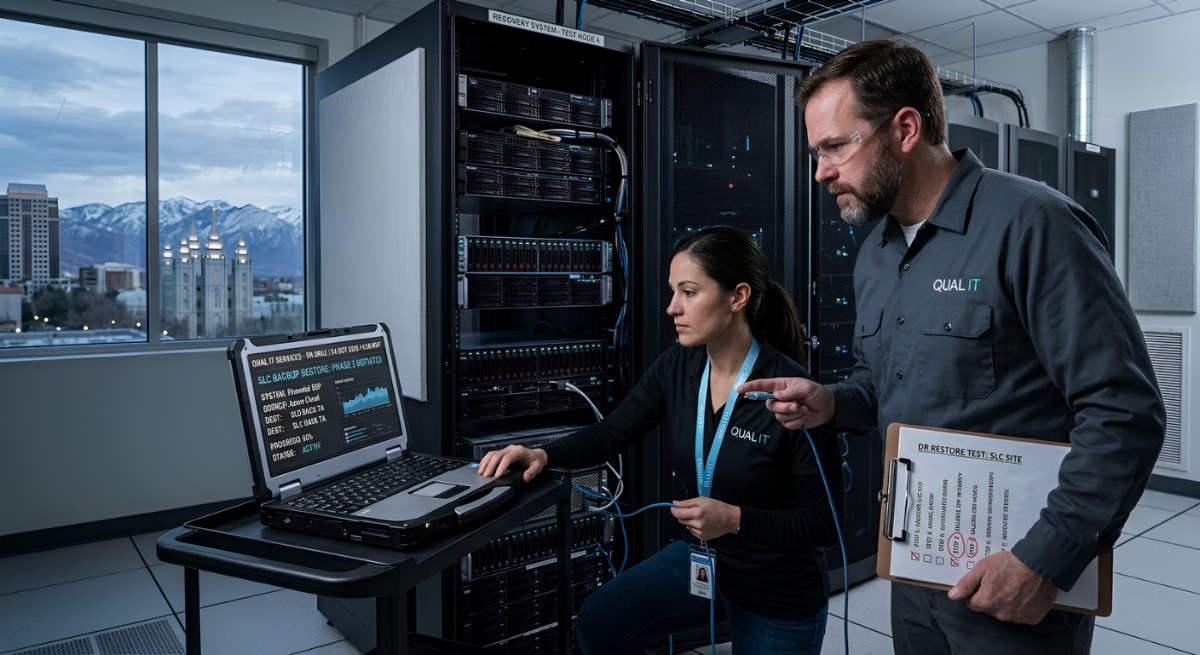
Recovery testing isn’t theoretical. Qual IT works with Salt Lake City medical practices to run real restore tests — pulling from your actual backups, timing the recovery process and identifying which systems come back cleanly and which ones don’t.
The test answers the questions most practices don’t face until everything is already down:
- Will the restore of patient records work the way you think it will?
- How many hours will EHR recovery actually take?
- Which clinical systems need to come back first to safely resume patient care?
- Can your clinical staff continue working during recovery, or does everything stop?
- Are there gaps in your backup of PHI that you haven’t discovered yet?
- Does your current recovery process meet HIPAA’s documentation requirements for breach response?
That’s the difference between having a backup of patient records and being genuinely ready to recover — and maintain HIPAA compliance — when an incident occurs.
What Happens When You Skip the Drill
When EHR recovery has never been tested, even a routine disruption can spiral. Clinical staff lose access and sit idle. Providers can’t pull up patient histories before appointments. Nurses document by hand on paper forms that may not integrate back into the EHR correctly once systems come back online.
Leadership demands updates that no one can provide. HIPAA breach notification timelines begin ticking from the moment of discovery. Meanwhile, your IT team — or the EHR vendor support line — is working through troubleshooting steps for the first time under real pressure.
What should have taken two hours to fix stretches to six or longer — because nobody practiced the steps. The cost isn’t just the lost time or the disrupted appointments. It’s the patient trust that gets damaged, the potential HIPAA penalties that follow an uncontrolled breach and the scrambling that could have been avoided entirely with a tested recovery plan.
The practices that come through these incidents fastest aren’t necessarily the ones with the most sophisticated technology. They’re the ones who practiced their response before they needed it.
Frequently Asked Questions
What does IT support for medical practices in Salt Lake City include?
IT support for medical practices typically covers EHR connectivity and uptime, HIPAA-compliant network security, backup of patient records, help desk support for clinical staff, endpoint protection for workstations and mobile devices, and strategic IT planning for technology like telehealth platforms such as Doxy.me and billing software such as AdvancedMD. A managed IT provider handles these proactively so issues are caught before they affect patient care.
How do I know if my backup of patient records will hold up in a real emergency?
The only way to know for certain is to test it. A recovery test restores from your actual backups, times the process and identifies gaps in coverage or documentation — before an EHR outage or breach exposes them under pressure. Testing also helps confirm that your recovery process meets HIPAA’s documentation and notification requirements, so your practice isn’t reconstructing a timeline after the fact.
Do you offer HIPAA-compliant IT services for medical practices in Salt Lake City?
Yes. Qual IT works with Salt Lake City medical practices to implement and maintain HIPAA-compliant IT environments — including secure EHR connectivity, backup of PHI, endpoint protection, risk assessments and documented incident response plans. We understand that patient data protection is non-negotiable, and we build every engagement around that foundation.
Don’t Wait for the Emergency to Learn the Plan
Most medical practices discover they’re not as prepared as they thought — and that discovery is far better during a controlled test than during an active EHR outage or breach. Testing your recovery plan today means your clinical staff won’t be improvising with patient care on the line tomorrow.
Schedule a 10-minute discovery call with Qual IT to walk through your backup of patient records, find out what’s been tested and what hasn’t, and get a clear picture of whether your EHR recovery plan will hold up when it really matters.
We work with Salt Lake City medical practices to protect patient data and maintain HIPAA compliance. Book your discovery call here.