
August 2026 | IT Support for Construction Companies Salt Lake City | Backup & Disaster Recovery | Construction IT Services Utah
Most Salt Lake City construction companies think they are ready for a disruption because they have backups. But having backups and being able to recover are two very different things — and that gap shows up at the worst possible moment. On a fixed-price contract, every hour of downtime costs money you cannot recover. If Procore goes offline, Sage 300 CRE becomes inaccessible, or ransomware locks your office and field teams out of project files, you need a recovery plan that has already been tested — not one you are inventing while a job site sits idle.
Think about a job site safety drill. When the alarm sounds, nobody stops to figure out the evacuation route. Foremen move crews to muster points, supervisors account for every worker, and everyone knows exactly where to go — because they have practiced. Your IT recovery strategy needs to work exactly the same way.
Why Drills Save Construction Companies, Not Just Job Sites
Job site drills do not exist because anyone expects an emergency tomorrow. They exist because an emergency is the worst possible time to figure out the plan. When every crew member knows the route, who leads and what happens next, panic does not take over. And if the plan has a flaw, the drill reveals it — not the real emergency.
That is the value of practice. It removes guesswork before the pressure hits. IT support for construction companies in Salt Lake City works the same way: preparation happens in advance so that when Procore goes down or ransomware hits Sage 300 CRE, your office and field teams are executing a plan, not inventing one on the fly while subcontractors are waiting for approvals and billing is on hold.
Construction companies run on tight schedules and tighter margins. A disruption that stretches from two hours to two days because nobody tested the recovery process is not just an IT problem — it is a project management problem, a billing problem, and a client relationship problem all at once.
The Business Version of a Backup Fire Drill
Your office and field teams are probably running some form of backup today. But when did you last test whether that backup will actually restore Procore project files, Sage 300 CRE accounting records, or Bluebeam Revu markup sets — and how long that restoration will take?
Most construction companies have never run that test. They find out the answer only when something goes wrong — and by then they are scrambling to figure out whether the backup will restore, which systems come back first, and how to keep the field running while the office is down.
That is when the cost becomes real. A multi-hour outage during a critical project phase is not just downtime. It is halted billing on a fixed-price contract, delayed submittals, subcontractors who cannot access shared project files, and field teams waiting on approvals that require systems that are not working. For office and field teams that have never practiced recovery, those hours can stretch into days.
A ransomware attack on a mid-project Sage 300 CRE database is one of the most damaging scenarios a construction company can face. Payroll processing stops. AIA billing cannot go out. Subcontractor payments fall behind. Lien deadlines loom. Every hour the system is down is an hour your project managers and accounting team are fielding calls they cannot answer.
What Recovery Testing Actually Looks Like
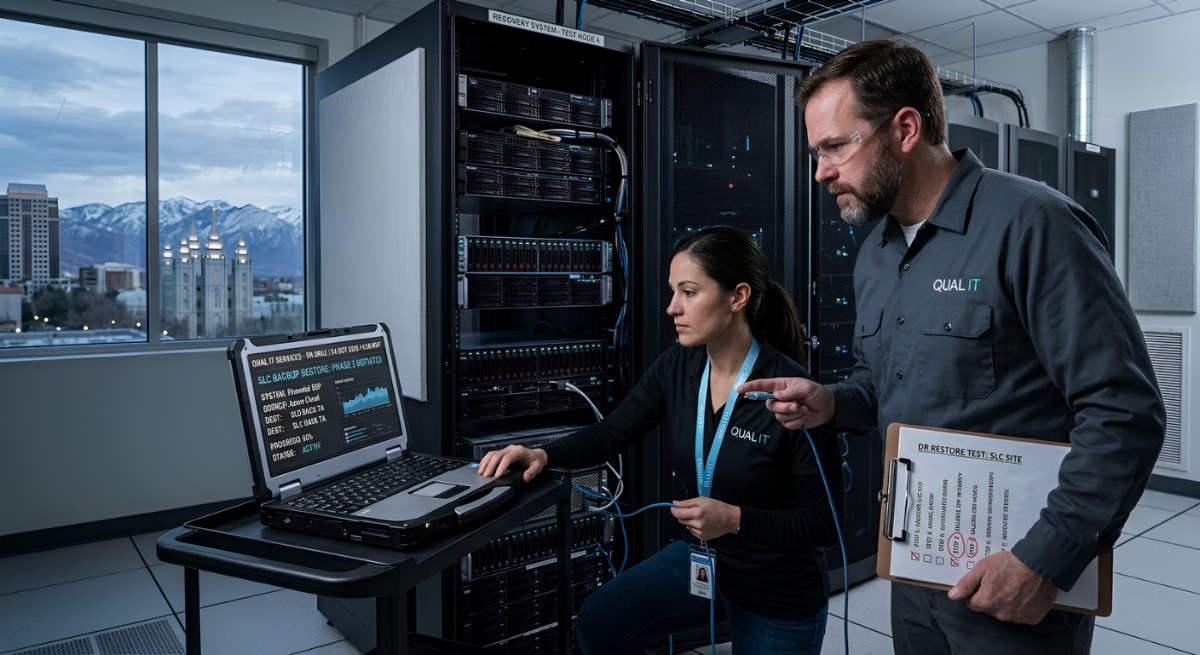
Recovery testing is not theoretical. Qual IT works with Salt Lake City construction companies to run real restore tests — pulling from your actual backups of Sage and Procore data, timing the recovery, and identifying which systems come back cleanly and which do not.
The test answers the questions most construction companies never face until everything is already down:
- Will the restore of Procore project files and Sage 300 CRE data work the way you think it will?
- How many hours will recovery actually take — and can you hold your project schedule during that window?
- Which systems need to come back first to keep billing, payroll, and field coordination functional?
- Can your office and field teams keep working during recovery, or does everything stop?
- Are there gaps in your backup of Sage and Procore data that you have not discovered yet?
- Do subcontractors have alternative ways to access shared project files, or does your outage become their outage?
That is the difference between having backups and being genuinely ready to recover — two things that look identical from the outside until the day they are not.
The Job Site Connectivity Problem Nobody Plans For
Construction companies face a challenge that most other industries do not: your team is split between the office and multiple active job sites, and those job sites depend on reliable connectivity to access Procore, eSUB field management, and BuilderTREND project tracking in real time. When an IT disruption hits the office, the field does not automatically stay operational.
A recovery plan that only accounts for office systems is half a plan. Your construction IT services provider needs to understand how field connectivity ties into your overall infrastructure — and how a disruption at the office level ripples out to superintendents and crews who depend on cloud access to do their jobs.
What Happens When You Skip the Drill
When recovery has never been tested, even a routine disruption can spiral quickly. Estimators lose access to AutoCAD drawings and cannot respond to RFIs. Project managers cannot pull up Procore submittals. Accounting cannot process payroll or AIA billing. Subcontractors are calling for approval on change orders that require access to systems that are not responding.
Leadership is demanding status updates that nobody can provide. Field supervisors are making decisions without the project data they need. What should have taken two hours to fix stretches to six or longer — because nobody practiced the steps.
The cost is not just lost time. It is the revenue that stalls when billing cannot go out, the subcontractor relationships strained by delays, and the project schedule that slips because the office could not support the field. Every one of those costs was avoidable. That is what a backup fire drill exists to prevent.
We work with Salt Lake City construction companies to keep office and field systems running securely. If you have never tested your recovery plan against a real-world scenario involving Procore, Sage, or your field management tools, now is the right time to find out what you would actually be dealing with.
Frequently Asked Questions
Do you offer IT support for construction companies and contractors in Salt Lake City?
Yes. Qual IT provides IT support for construction companies and contractors across Salt Lake City and the greater Wasatch Front. We understand the software your office and field teams depend on — including Procore, Sage 300 CRE, Bluebeam Revu, BuilderTREND, and eSUB — and we build recovery plans around the systems that matter most to your operations.
How do I know if my backup of Sage and Procore data will hold up in a real emergency?
The only way to know for certain is to test it. A recovery test restores from your actual backups, times the process, and identifies gaps — before a ransomware attack or hardware failure exposes them under pressure. Most construction companies are surprised by what a recovery test reveals.
What construction IT services does Qual IT offer in Salt Lake City?
Qual IT offers managed IT services, cybersecurity, backup and disaster recovery, and business continuity planning for construction companies in Salt Lake City and across Utah. We support the office and field technology environments that keep projects moving — from estimating and project management software to job site connectivity and subcontractor file sharing.
Do Not Wait for the Emergency to Learn the Plan
Most construction companies discover they are not as prepared as they thought — and that discovery is far better during a controlled test than during an actual crisis with a project on the line and subcontractors waiting.
Schedule a 10-minute discovery call with Qual IT to walk through your backup strategy, find out what has been tested and what has not, and get a clear picture of whether your recovery plan will hold up when it really matters.