
72-Hour Attacks, Procore Downtime, and Why Your Office and Field Teams Need 24/7 IT Coverage
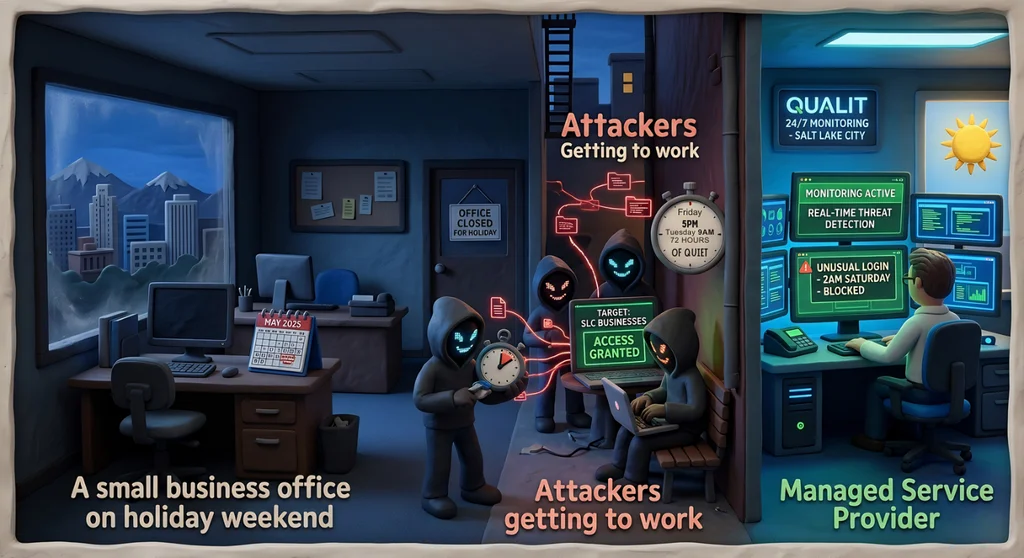
Ransomware attackers study how organizations work — and they have learned that construction companies are most vulnerable on holiday weekends. Research from Semperis (2025) found that 52% of ransomware attacks occur on holidays and weekends, and that 78% of organizations reduce security staffing during those periods. For a Salt Lake City construction company, a ransomware attack that locks your Procore environment, encrypts your Sage 300 CRE accounting data, and takes your Autodesk Construction Cloud files offline at 6 PM on a Friday evening can halt your billing operations, freeze your project data, and leave your project managers and field crews without access to the systems they need — for the entire weekend and potentially beyond. Time is money in construction, and that window costs both.
How Ransomware Operators Exploit the 72-Hour Window
The period from Friday afternoon through Tuesday morning is ransomware's prime hunting ground. When your office team leaves for a holiday weekend and your IT monitoring is reduced, attackers have an extended window to move through your network undetected. The Semperis research found that 78% of organizations cut security staffing on holidays — meaning the people who would normally detect and respond to an intrusion are unavailable.
Ransomware operators do not encrypt files the moment they gain access. They take time — often 24 to 72 hours — to map your network, identify your most valuable data, compromise your backups if possible, and position themselves for maximum impact before triggering the encryption. By the time your project managers arrive Monday morning to find Procore inaccessible and Sage 300 CRE locked behind a ransom note, attackers have had the entire weekend to ensure you have no easy path to recovery.
For construction companies, the cascading effects are immediate and measurable. Locked Procore access means project teams cannot access RFIs, submittals, or project schedules. Encrypted Sage 300 CRE data means billing stops — pay applications cannot be processed, subcontractor payments cannot be issued, and financial reporting for project owners becomes impossible. Blueprint files in Bluebeam Revu or Autodesk Construction Cloud become inaccessible, potentially halting field work for crews who need updated drawings. Every day of downtime in construction has a real dollar cost.
Why Construction Companies Are High-Value Ransomware Targets
Construction companies are attractive ransomware targets for several reasons beyond their holiday vulnerability. Project-based billing creates concentrated financial pressure — a ransomware attack timed to coincide with a monthly pay application deadline maximizes leverage. Thin margins mean that a few days of billing disruption can create genuine cash flow problems. And the interconnected nature of construction projects — involving owners, architects, GCs, and dozens of subcontractors — means that a single company's downtime ripples through an entire project supply chain.
Attackers also know that construction companies often have inconsistent backup practices and less mature cybersecurity infrastructure than regulated industries. A small GC with a lean operations team and no dedicated IT security staff is an attractive target precisely because recovery is likely to be difficult and the pressure to pay is high.
The Reactive Model Fails on Job Sites
Most construction companies manage IT reactively: something breaks, someone calls for help. That model works for routine issues — a Procore login that needs to be reset, a printer on the job site trailer that stops responding. It fails completely against ransomware, which is specifically designed to operate undetected until the damage is done.
The critical intervention window in a ransomware attack is during the reconnaissance and lateral movement phase — before encryption begins. Detecting an attacker moving through your network at 2 AM Saturday morning requires active, continuous monitoring. A reactive model that waits for someone to notice something wrong Monday morning is too late. By then, the encryption has run, the backups may be compromised, and the only options are ransom payment or painful recovery.
For construction companies managing multiple active job sites, the reactive model creates an additional gap: field teams may not immediately recognize that a system problem is a ransomware incident rather than a routine technical issue. A superintendent who cannot access Procore on Monday morning may spend hours troubleshooting connectivity before anyone realizes the company has been hit. Every hour of delayed recognition is an hour of delayed response.
What a Proactive Security Model Looks Like for Construction
A proactive security model for a construction company includes 24/7 monitoring of your network and platforms for anomalous behavior — unusual access patterns, large data movements, connections from unexpected locations. It includes tested, isolated backups that are not reachable by ransomware on your primary network. It includes a documented incident response plan that your project managers and office team understand, with clear escalation paths for after-hours events. And it includes an MSP that is actively watching your environment even when your office is closed for a three-day weekend.
For construction-specific platforms, proactive monitoring means watching for access anomalies in Procore (a mass download of project files at 3 AM), unusual activity in Sage 300 CRE (bulk export of financial records from an unfamiliar location), and off-hours access to Autodesk Construction Cloud or Bluebeam Revu. These anomalies are detectable before encryption begins — but only if someone is watching.
Backup Strategy: Protecting Billing and Project Data
Ransomware recovery depends entirely on the quality of your backups. For a construction company, the critical data requiring backup is not just files — it is the operational continuity of your project management and accounting platforms. Restoring Sage 300 CRE to a functional state after ransomware requires more than raw data recovery; it requires a tested restoration plan that gets your billing environment operational again quickly.
The 3-2-1 backup strategy is the baseline: three copies of critical data, on two different media types, with one copy offsite or in an isolated cloud environment. Critically, backups must be isolated from your primary network so ransomware cannot reach them during an attack. And backups must be regularly tested — a backup that has never been restored is a backup you cannot trust when you need it.
For construction companies, the practical test is simple: if your Procore environment were unavailable for three days, could you continue operating? If your Sage 300 CRE database were encrypted, how long would billing be stopped? Answering those questions honestly tells you where your backup and recovery strategy has gaps.
What Your Construction Company Should Do Before the Next Holiday Weekend
- Confirm your backup strategy covers Procore data, Sage 300 CRE, Autodesk files, and Bluebeam projects
- Verify backups are isolated from your primary network and have been recently tested
- Enable 24/7 monitoring on your project management and accounting platforms
- Establish an after-hours incident response contact — someone reachable on a Friday evening when your office is closed
- Brief your project managers and field supervisors on what to do if they cannot access systems on a Monday morning
- Document and test your ransomware response plan before an attack forces you to improvise
The Real Cost of Downtime in Construction
In construction, every day of downtime has a visible cost. Subcontractor payments delayed by an encrypted billing system create downstream cash flow problems throughout your project supply chain. Pay applications that cannot be submitted on time create owner disputes and delay your company's receivables. Field crews unable to access updated drawings face work stoppages that affect project schedules and penalty clauses. And the reputational damage of a ransomware incident — with owners, architects, and subcontractor partners who depend on your systems — is difficult to quantify but real.
The investment in ransomware prevention — 24/7 monitoring, tested backups, incident response planning — is measured in thousands of dollars annually. The cost of a ransomware incident for a mid-sized construction company is measured in tens or hundreds of thousands of dollars, plus the operational disruption to every active project. For a company where margins are already tight, that math makes prevention an easy case.
Qual IT works with Salt Lake City construction companies to keep office and field systems running securely. Schedule a free discovery call to assess your company's ransomware readiness before the next holiday weekend.
Frequently Asked Questions
Q: How do we maintain IT security across multiple active job sites?
Multi-site security in construction requires a centralized approach: all job site devices managed through a single MDM (mobile device management) platform, remote monitoring that covers job site networks as well as the main office, and clear policies for what devices and connections are used to access company platforms. Qual IT designs construction-specific IT security architectures that provide centralized visibility across all job sites — so an anomalous event on a job site trailer's network is visible in the same monitoring dashboard as an event at your main office. We also provision job site connectivity solutions that bring project sites into your managed security environment rather than leaving them on unmonitored consumer connections.
Q: What if ransomware encrypts our Procore data — can we recover it?
Procore as a platform is hosted by Procore and maintains its own data redundancy — a ransomware attack on your company typically affects your local systems and any data synced or downloaded to your network, not Procore's hosted data directly. However, ransomware can also target credentials that access Procore, and attackers with valid credentials can delete project data within the platform. The critical protections are: enable MFA on Procore accounts to prevent credential-based access, maintain local backups of critical project documents outside the platform, and ensure your incident response plan addresses credential compromise as well as file encryption.
Q: Should we pay the ransom if we get hit?
Law enforcement and cybersecurity professionals generally advise against paying ransoms for several reasons: payment does not guarantee decryption, it funds further criminal activity, and paying may make your company a repeat target. Practical recovery advice is: engage a reputable cybersecurity incident response firm immediately, contact your cyber insurer, notify law enforcement (FBI recommends reporting to IC3.gov), and assess your backup situation before making any payment decisions. The better your backups and the faster your incident response, the less leverage attackers have to demand payment. This is why investing in tested backups and an incident response plan before an attack is so much more effective than negotiating after one.