
August 2026 | HIPAA-Compliant IT Services Salt Lake City | Medical Practice Cybersecurity | EHR Downtime Response
When your flight hits turbulence, the last thing you want to hear from the pilot is, “Give me a minute — I’ve never handled this before.”
Aviation feels safe not because problems never happen, but because pilots train thousands of hours for scenarios they hope they will never face. When something unexpected happens, the response is already built. All they have to do is execute it.
The same principle holds across every profession where mistakes carry serious consequences — surgery, emergency medicine, pharmacy. A surgeon doesn’t figure out how to manage a complication mid-procedure. The response has been rehearsed and the steps are clear before the first incision. For Salt Lake City medical practices, that same distinction — between having a plan and building one under pressure — is the difference between a manageable disruption and a documented HIPAA crisis.
The Emergencies Medical Practices Don’t Practice For
Disruptions in a clinical setting arrive without warning and force immediate decisions when patient care is already underway.
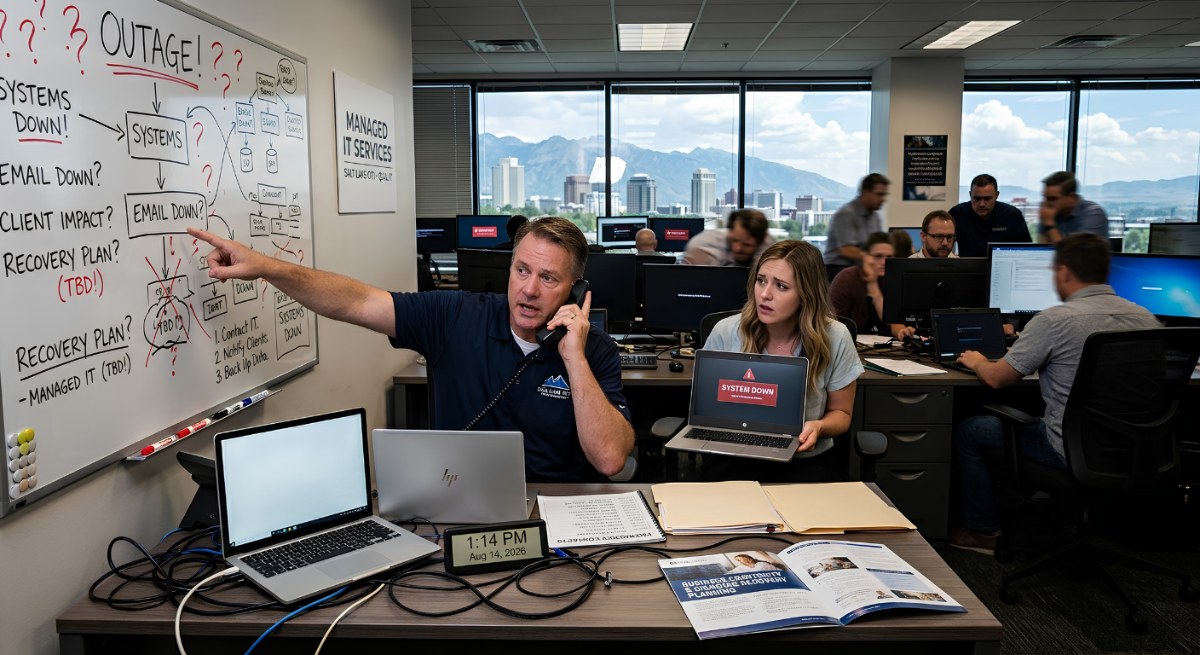
Your EHR goes down in the middle of morning appointments. A ransomware attack encrypts your network and locks clinical staff out of patient records in Epic or Athenahealth. Your billing system through AdvancedMD becomes inaccessible during a high-volume claims day. A phishing email disguised as a referral from a hospital system installs malware on a front desk workstation and begins spreading across the network.
Most medical practices invest in security tools, EHR platforms and backup of patient records to reduce these risks. But preparation often stops at setup — without ever defining how clinical staff responds in the moment when something actually breaks.
That gap stays invisible until something breaks. Then, all at once, questions that should be easy to answer become complicated:
- Who is in charge of the incident response?
- Does the EHR vendor get called first, or IT support?
- Which patient appointments get postponed, and how do you notify affected patients?
- What gets documented immediately for HIPAA breach notification purposes?
- How long before clinical operations can safely resume?
Clinical staff ends up working through those answers in real time — slowing decisions, creating confusion and extending EHR downtime that a HIPAA-compliant IT services partner in Salt Lake City could have helped prevent with a tested plan.
The Hidden Cost of Improvising During a Clinical Crisis
When a medical practice is figuring things out during a disruption, the impact spreads quickly — because every step requires a decision that nobody made in advance.
Providers pause mid-appointment to evaluate options instead of seeing the next patient. Clinical staff waits for direction before moving forward with care documentation. Progress stalls across the practice as each action depends on a decision that hasn’t been made yet.
Front desk staff can’t verify insurance eligibility or schedule follow-up appointments without EHR access. Patients waiting for morning appointments experience delays, cancellations and incomplete communication about rescheduling. Confidence in your practice erodes with every unanswered question.
HIPAA’s Breach Notification Rule requires that affected patients be notified within 60 calendar days of discovering a breach. If your clinical staff is still improvising the incident response two days after discovery, meeting that requirement becomes extremely difficult — and the documentation required to demonstrate compliance throughout the response hasn’t been started.
Recovery takes longer because clinical staff must simultaneously prioritize patient care continuity and try to understand the scope of what happened — which stretches EHR downtime and increases the overall exposure of PHI.
Now picture two Salt Lake City medical practices facing the exact same EHR outage. Same systems down. Same number of patients affected. Same starting point.
One practice has prepared for this. Ownership of the incident response is clear, the IT support partner was already briefed on priority systems, and clinical staff moves through defined steps while keeping patients informed about delays. The other practice is building the response as it goes — every decision about which systems to restore first triggers three more questions, hours pass and what could have been a contained disruption becomes a documented HIPAA breach investigation.
The difference between a disruption and a crisis in a medical practice is almost always preparation.
The Value of Being Ready Before the EHR Goes Down
No patient expects their provider to improvise during a clinical emergency. No pilot improvises during turbulence. The expectation across every high-stakes environment is the same: preparation happens before anything goes wrong, so that when something does, the response is already there.
Medical practices that operate this way respond faster, assign ownership clearly and move through EHR recovery without hesitation. Clinical staff doesn’t stop to figure out the next step — they execute it. Patients experience less disruption because the practice doesn’t have to stop providing care to figure out how to keep providing care.
HIPAA compliance during an incident isn’t just about what happened — it’s about what was documented and when. Practices with a tested incident response plan can demonstrate to HHS exactly how they responded, what PHI was potentially affected and what steps were taken to contain the breach. Practices without a plan are reconstructing a timeline after the fact, which is precisely what regulators look for in enforcement actions.
Preparation feels unnecessary until the moment it becomes critical. That moment almost always arrives without warning.
Qual IT has worked with medical practices through EHR outages, ransomware incidents and network failures that could have caused serious harm to both patient care and HIPAA compliance standing. The practices that came through with their operations and reputation intact weren’t the ones with the most sophisticated technology. They were the ones with a tested plan and a partner who knew how to execute it under pressure.
That’s what Qual IT does. We address issues when they arise and ensure your practice is never starting from scratch when it matters most for patient safety and regulatory compliance.
Frequently Asked Questions
What is IT incident response planning for Salt Lake City medical practices?
Incident response planning defines exactly how your practice will respond when your EHR goes down, a breach is detected or a ransomware incident locks clinical staff out of patient records. It covers who owns each response step, which systems get restored first, how patients get notified and what documentation is required throughout the process to demonstrate HIPAA compliance.
How does a HIPAA-compliant IT services provider help with EHR downtime?
A HIPAA-compliant IT provider like Qual IT builds, documents and tests your EHR recovery plan before anything goes wrong. When an outage or incident occurs, your clinical staff isn’t starting from zero — you have a defined process, clear ownership and a partner who knows how to execute the technical response while keeping your practice’s HIPAA obligations on track from the first hour.
Do you offer HIPAA-compliant IT services for medical practices in Salt Lake City?
Yes. Qual IT helps medical practices across Salt Lake City prepare for, respond to and recover from IT incidents — including EHR outages, ransomware attacks, phishing-related breaches and hardware failures. Every engagement is built around maintaining both clinical operations and HIPAA compliance, even under the pressure of an active incident.
Know Where Your Practice Stands
When your EHR goes down at 9 a.m. on a Wednesday, will your practice execute a documented plan — or be forced to build one in real time while patients wait and HIPAA timelines begin?
Most practices don’t know the answer until they’re already in the middle of it. That’s the wrong moment to find out.
We work with Salt Lake City medical practices to protect patient data and maintain HIPAA compliance. Book your discovery call here.