
August 2026 | IT Support for Manufacturers Salt Lake City | Manufacturing IT Services Utah | Industrial Cybersecurity Salt Lake City
When a production line goes down unexpectedly, the last thing your plant manager wants to hear from the IT team is, "Give us a minute — we've never dealt with this before."
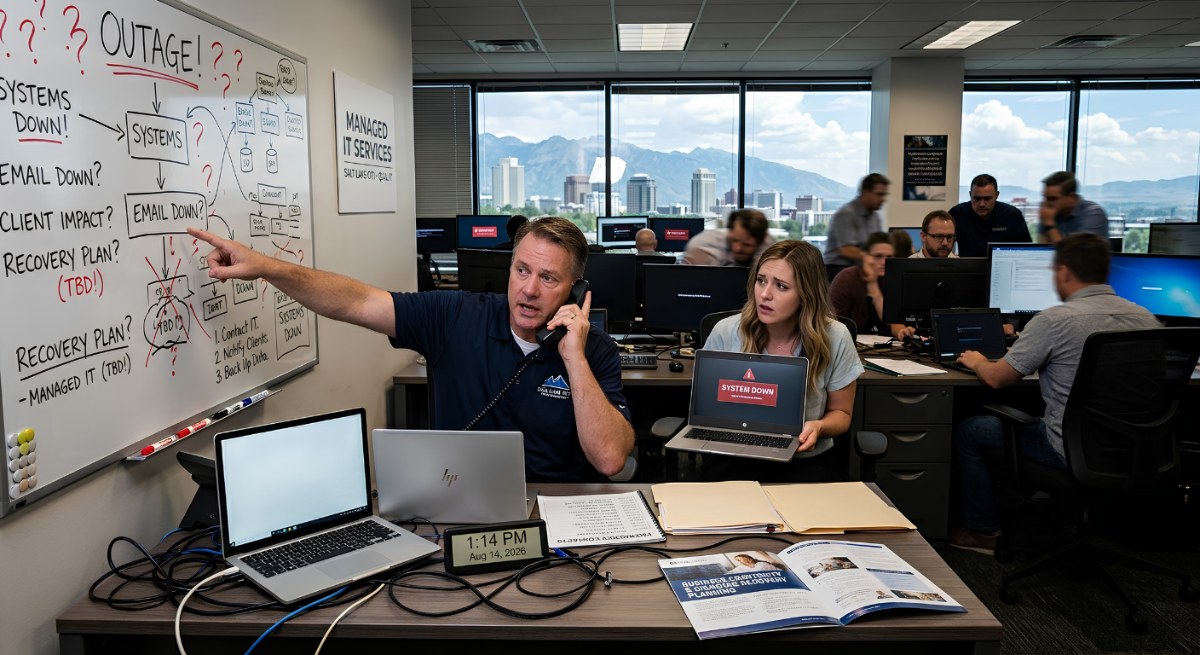
Safe, reliable manufacturing operations don't happen because problems never occur. They happen because your production and operations team spends time preparing for situations they hope they'll never face. When something does go wrong — when the ERP locks up, when the SCADA system goes offline, when ransomware hits mid-shift — the response should already be built. All your team should have to do is execute it.
The same principle that governs every high-stakes industry applies directly to manufacturing IT: the emergency is the time to execute the plan, not build it. For Salt Lake City manufacturers, the gap between those two approaches is often the difference between a two-hour disruption and a two-day production halt.
The Manufacturing Emergencies Nobody Practices For
Production disruptions arrive during normal operations and force immediate decisions under pressure — affecting multiple systems and multiple departments at once.
ERP systems fail mid-shift. CAD files disappear from shared storage. Internet outages cut off remote OT vendor access when it's needed most. Ransomware blocks access to SAP, Epicor, or Infor while the production floor waits for work orders. SCADA systems go offline without warning.
Most plant managers and operations directors understand these risks and invest in backups, security tools, and IT support to reduce them. But preparation often stops at setup instead of extending into how the production and operations team responds when something actually breaks.
That gap stays invisible until the line goes down. Then, all at once, questions that should be easy to answer become complicated:
- Who takes charge when the ERP goes offline?
- Which systems get restored first — SAP, the MES, or OT network connectivity?
- How long will recovery of production data actually take?
- What do we tell the customers waiting on shipments?
- Can shop floor staff keep working manually while systems recover, and for how long?
Your production and operations team ends up working through those answers during the disruption itself — slowing decisions, adding confusion, and extending downtime that a managed IT services partner who understands manufacturing could have helped prevent.
The Hidden Cost of Learning During the Crisis
When a manufacturing operation is figuring things out during a production halt, the impact spreads fast. Because every step requires a decision that hasn't been made before — while the line sits idle and the cost accumulates.
Plant leadership pauses to evaluate options instead of executing. The production and operations team waits for direction before moving forward. Progress slows as each action depends on the last decision. Shop floor staff lose access to work orders, production schedules, and inventory data. Quality teams can't retrieve inspection records. Shipping and logistics are paralyzed without ERP access.
Customers feel the impact through delayed shipments, missed delivery commitments, and erosion of the confidence they've placed in your operation. Recovery takes longer because the team must prioritize restoration decisions while systems are already down — which stretches downtime and compounds the operational cost.
Now picture two Salt Lake City manufacturers facing the exact same ransomware attack. Same systems locked. Same scope. Same starting point.
One has practiced for this. Ownership is clear, priorities were established in advance, and the production and operations team moves through defined steps while leadership keeps customers informed. The other is building the response in real time — every decision triggers three more questions, hours pass, and what could have been a contained disruption becomes something far more damaging to revenue, relationships, and reputation.
The difference between a disruption and a disaster in manufacturing is almost always preparation.
What an OT and ERP Incident Response Plan Actually Looks Like
No plant manager expects the maintenance engineer to improvise during a critical system failure. No operations director expects the shop floor team to figure out ERP recovery procedures mid-crisis. The expectation across every disciplined manufacturing operation is the same: preparation happens before anything goes wrong, so when something does, the response is already there.
A documented recovery plan for Salt Lake City manufacturers covers:
- Who owns each recovery step when ERP, MES, or OT systems go offline
- The restoration sequence for SAP, Epicor, SCADA, and production-critical applications
- How shop floor staff communicate and maintain partial operations during downtime
- When and how to engage OT vendors for remote access and system recovery
- How customers and stakeholders get communicated with during a production halt
- How to verify that CAD files, production records, and ERP data restore completely
Manufacturers that operate this way respond faster, assign ownership clearly, and move through recovery without hesitation. The production and operations team doesn't stop to figure out the next step — they take it. Customers experience less impact because the operation doesn't have to stop working to figure out how to keep working.
Preparation feels unnecessary until the moment it becomes critical. By then, it's too late to build it.
What Qual IT Has Seen in Manufacturing Incident Response
We've worked with manufacturers through ERP failures, ransomware incidents, OT outages, and production-disrupting IT events that could have caused serious and lasting operational damage. The ones that came through it with their production schedules and customer relationships intact weren't necessarily the ones with the most sophisticated technology.
They were the ones with a plan and a partner who knew how to execute it. That's what Qual IT does for Salt Lake City manufacturers. We address incidents when they arise and make sure you're never starting from scratch when the production line stops and every minute costs money.
Frequently Asked Questions
Do you offer IT and cybersecurity support for manufacturing companies in Salt Lake City?
Yes. Qual IT helps Salt Lake City manufacturers prepare for, respond to, and recover from IT and OT incidents — including ransomware, ERP failures, SCADA outages, and hardware failures. We work with your production and operations team to build recovery plans that are tested before they're needed.
What is business continuity planning for Salt Lake City manufacturers?
Business continuity planning for manufacturers is the process of defining how your production operation will keep running — or recover quickly — when ERP systems, OT networks, or MES platforms go offline. It covers who owns each recovery step, how systems like SAP, Epicor, and SCADA get restored, and how customers get communicated with during a production halt.
How does a managed IT services provider help manufacturing operations with disaster recovery?
A managed IT provider like Qual IT builds, documents, and tests your recovery plan before anything goes wrong. When a production disruption occurs, your team isn't starting from zero — you have a defined process, a tested backup of ERP and production systems, and a partner who knows exactly how to execute the plan for your manufacturing environment.
Know Where Your Production Operation Stands
When a disruption hits your Salt Lake City manufacturing facility, will your production and operations team execute a plan — or be forced to build one in real time while the line sits idle?
We work with Salt Lake City manufacturers to protect production systems and reduce operational downtime. Schedule a 10-minute discovery call with Qual IT to evaluate how prepared your manufacturing operation is to respond, recover, and keep production moving when the unexpected happens.