
August 2026 | Construction IT Services Utah | Backup & Disaster Recovery | IT Support for Construction Companies Salt Lake City
Mike Tyson once said, "Everyone has a plan until they get punched in the mouth."
In construction, that punch usually arrives as a disruption you assumed you were ready for — a failed backup of Sage 300 CRE accounting data, Procore becoming inaccessible during a critical project phase, or a security incident that locks your office and field teams out of every system at once. On a fixed-price contract, that kind of disruption does not just cost time. It costs money, project schedule, and subcontractor trust you cannot easily recover.
That is the thing about assumptions. They feel like facts right up until they are tested. For Salt Lake City construction companies relying on Procore, Sage 300 CRE, Bluebeam Revu, and field management tools like eSUB or Raken, these are the four assumptions that most often cause the real damage.
Assumption #1: "Procore Is in the Cloud, So We Are Covered"
This is the most common assumption in the construction industry — and one of the most dangerous. Procore, BuilderTREND, and other cloud-based project management platforms do maintain their own infrastructure, but that does not mean your project data is protected the way you think it is.
Most cloud platforms are not a substitute for a backup strategy. They protect against platform-level failures, not against your own account being compromised, data being deleted by a user with the wrong permissions, or a ransomware attack that originates on your network and reaches your connected cloud systems through authenticated sessions.
Having cloud software is not the same as having a backup. A backup of Sage and Procore data proves its value only when it helps you recover from an incident the cloud platform itself cannot fix. The most dangerous backup is the one you have never tested — and the most dangerous assumption is that someone else is handling it for you.
Assumption #2: "Someone Would Tell Us If There Was a Problem"
Monitoring tools are valuable — but confusing detection with protection is a costly mistake in any industry. In construction, it is especially costly because problems in your IT systems do not stay confined to the office. They ripple out to every job site where your teams depend on cloud access to Procore, eSUB, or Raken for daily reporting.
A monitoring alert can tell you something is wrong. It does not board up your windows or move your crew to safety. The alert is only useful if you know what to do next.
Without a documented response plan and a construction IT services partner in Salt Lake City who understands your environment, alerts become noise instead of action. Your project manager sees a notification. They are not sure who owns the response. They call around. Thirty minutes pass. An hour passes. By the time IT is engaged, the disruption has already spread across the office and the field.
Detection is not the same as response. And response without a plan is just controlled panic.
Assumption #3: "Our Project Managers Know What to Do"
Every team looks prepared — until game day.
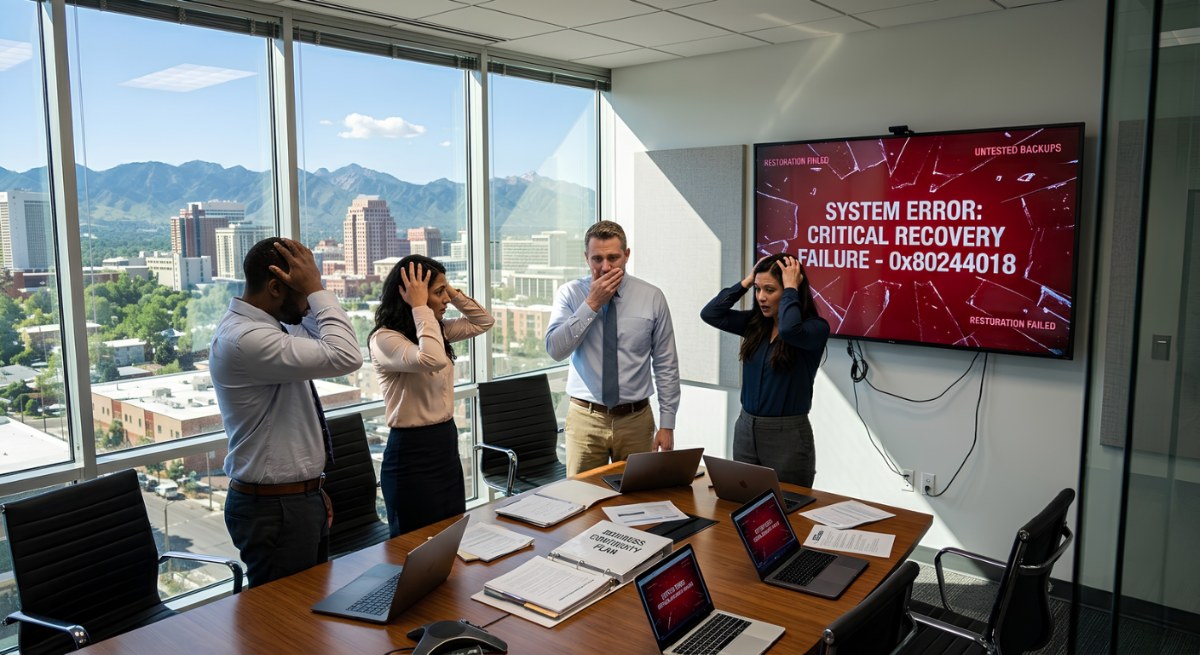
Picture this: It is Thursday afternoon, two weeks before a major project milestone. Sage 300 CRE goes offline. The office cannot process payroll. Billing cannot go out. Project managers cannot access submittals in Procore. Subcontractors are calling to confirm change order approvals that require access to systems that are not responding.
Suddenly nobody can agree on who is in charge of the IT response, what to fix first, or how long it will take. The superintendent on site is calling the office for project files. The accounting team is fielding payroll questions they cannot answer. Leadership is asking for an estimated recovery time that no one can provide.
When there is no documented plan and no practice run, even a capable team starts from zero. You do not run a job site safety drill because you expect an accident tomorrow. You do it so that if there ever is an emergency, nobody is standing around asking which way to run.
An IT recovery plan works exactly the same way. When Sage or Procore goes down, you want your office and field teams executing a plan they already know — not figuring things out under pressure while a job site sits idle and a fixed-price contract clock keeps running.
Assumption #4: "We Are a Construction Company, Not a Tech Target"
Nobody thinks they will be the one. Until they are.
This assumption is particularly common in the construction industry. Project managers, estimators, and superintendents are focused on getting the work done — managing subcontractors, hitting milestones, keeping projects on schedule and on budget. A cyberattack feels like something that happens to banks and hospitals, not to general contractors in Salt Lake City.
But construction companies are increasingly attractive targets precisely because of the data they hold. Procore contains contract details, subcontractor agreements, and project financials. Sage 300 CRE holds payroll data, AIA billing records, and banking information. Bluebeam Revu and AutoCAD files represent significant intellectual property — blueprint theft alone can expose your competitive position on future bids.
Most disruptions are not dramatic. An employee on a job site clicks a bad link in what looks like a supplier email. A phishing message impersonates a subcontractor requesting a payment update. A piece of hardware in the office finally gives out. The question is not whether something unexpected will happen. It is whether your office and field teams will be ready when it does.
The construction companies that recover fastest are not the ones that avoided the disruption. They are the ones that expected it.
Frequently Asked Questions
Do you offer IT support for construction companies and contractors in Salt Lake City?
Yes. Qual IT provides IT support for construction companies and contractors across Salt Lake City and the greater Wasatch Front. We understand the project management, accounting, and field management tools your teams depend on, and we build backup and recovery strategies around the systems that keep your projects moving.
What is the difference between backup and disaster recovery for a construction company?
Backup is the process of copying and storing your project files, Sage 300 CRE accounting data, Procore records, and other critical data. Disaster recovery is the plan for restoring that data and getting systems back online after an incident — in the right order, within an acceptable timeframe, without losing billing or payroll continuity. You need both, and both need to be tested to be reliable.
How often should Salt Lake City construction companies test their backups?
At minimum, quarterly. Construction companies with active projects, complex subcontractor relationships, or compliance requirements around certified payroll and financial records should test more frequently. The goal is to verify that your backup of Sage and Procore data restores completely — and within a timeframe your project schedule can absorb — before an actual incident occurs.
You Cannot Block a Punch You Did Not Prepare For
It is rarely the dramatic event that catches construction companies off guard. It is the ordinary disruption — on a Thursday afternoon, in the middle of a critical project phase — that exposes assumptions nobody knew were wrong.
The good news is that most of these risks can be addressed before they become project-stopping problems. That is exactly what Qual IT helps Salt Lake City construction companies do. We work with your office and field teams to close the gaps before a real disruption finds them.
Schedule a 10-minute discovery call to walk through your backup of Sage and Procore data, your recovery process, and your business continuity plan. We will identify what has been tested, what has not, and where gaps may exist.