
August 2026 | IT Support for Construction Companies Salt Lake City | Business Continuity | Construction IT Services Utah
When Sage 300 CRE goes down during payroll week, the last thing you want to hear from your IT contact is, "Give me a minute — I have never handled this before."
Construction feels manageable not because problems never happen, but because experienced teams spend years preparing for the situations they hope they will never face. A good superintendent does not figure out the emergency plan when the emergency arrives. The response is already built. All they have to do is execute it. For Salt Lake City construction companies, that same principle applies to your IT systems — and the gap between having a plan and not having one is measured in hours, in dollars, and in project schedule.
The Disruptions Nobody on a Job Site Plans For
Disruptions in construction IT show up during normal operations and force immediate decisions under pressure — affecting both office and field teams at once.
Sage 300 CRE goes offline on a Thursday with payroll due Friday. Procore becomes inaccessible during a critical submittal review. Ransomware locks every workstation in the office while three active job sites are waiting on approvals. A subcontractor file-sharing vulnerability exposes your project files to an outside actor. Internet goes down at the office and field teams lose cloud access to eSUB and Raken for daily reporting.
Most construction company owners understand these risks and invest in backups, security tools, and software to reduce them. Procore gets configured. Sage gets installed. Bluebeam Revu is on every estimator's machine. But preparation often stops at setup rather than extending into how the team responds in the moment.
That gap stays invisible until something breaks. Then, all at once, questions that should have easy answers become complicated:
- Who takes charge of the IT response — the project manager, the office manager, or someone else?
- What gets restored first — payroll data, project files, or billing records?
- How long will recovery take, and can the field keep working while the office is down?
- What do we tell subcontractors who are waiting on change order approvals?
- How do we keep the job site moving if Procore is inaccessible for six hours?
Office and field teams end up working through those answers during the disruption itself — slowing decisions, adding confusion, and extending downtime that a construction IT services partner in Salt Lake City could have helped prevent.
The Hidden Cost of Learning During the Crisis
When a construction company is figuring things out during a disruption, the impact spreads quickly — because every step requires a decision that has never been made before.
Leadership pauses to evaluate options instead of acting. The project manager is trying to run the job site without Procore access while also fielding calls from accounting about payroll. The estimating team cannot open AutoCAD or Bluebeam Revu files. Subcontractors are waiting for submittals and RFI responses that require system access nobody currently has.
Progress slows because each action depends on the last decision. Employees lose time waiting for access or guidance. Work stalls across the office and the field simultaneously. Subcontractors feel the impact through delayed approvals, inconsistent communication, and eroding confidence in the general contractor's ability to run the project.
Recovery takes longer because your team is prioritizing on the fly while also trying to restore systems — which stretches downtime and increases the overall cost of the disruption. On a fixed-price contract, that cost does not get passed to the owner. It comes out of your margin.
What a Tale of Two Construction Companies Looks Like
Picture two Salt Lake City construction companies facing the exact same scenario: Sage 300 CRE goes down on Thursday afternoon. Payroll is due Friday morning. Active projects are in the middle of submittal reviews in Procore. Office and field teams are both affected.
The first company has practiced for this. The response owner is identified. The sequence for restoring accounting data, then project management access, then field connectivity is already documented. The accounting team knows which payroll records are backed up and where. The project manager knows how to keep field teams productive using offline-capable tools while Procore is being restored. Subcontractors get a clear communication within the first hour. Payroll goes out on time.
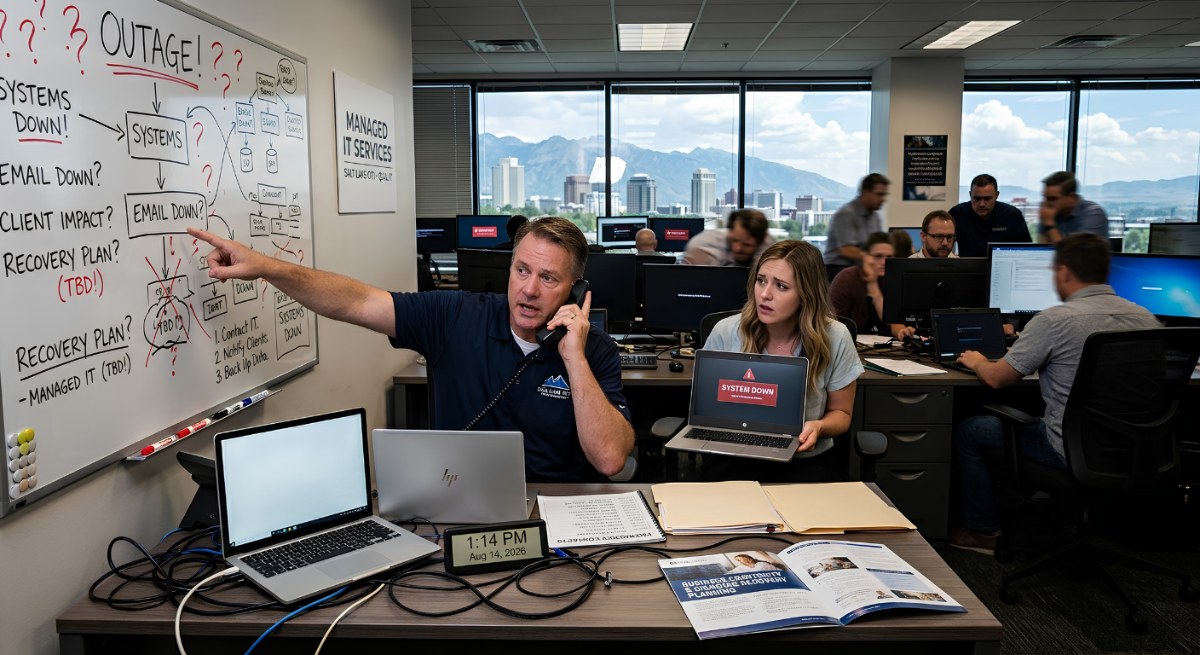
The second company is building the response as it goes. Every decision triggers three more questions. The office manager calls IT. IT calls a vendor. The vendor needs access credentials nobody can find. Meanwhile, the superintendent on site is making calls to the office that are not being answered because everyone is dealing with the crisis. Hours pass. What could have been a three-hour disruption becomes a two-day operational problem.
Same disruption. Same starting point. Completely different outcomes. The difference is almost always preparation.
The Job Site Dimension That Makes Construction Different
Most industries can compartmentalize an IT disruption to the office. Construction cannot. When office systems go down, the impact extends immediately to every active job site.
Field supervisors using Procore for daily logs and issue tracking lose access. Crews waiting on material delivery confirmations tied to BuilderTREND cannot get answers. Subcontractors relying on shared project files through Bluebeam Studio cannot access the latest markup sets. The office cannot process change orders that require Sage 300 CRE approvals. Everything that connects the office to the field runs through the same systems — and when those systems are down, the connection breaks.
A recovery plan that only addresses office restoration is a half-plan. IT support for construction companies in Salt Lake City needs to account for the field dimension: which tools field teams can work with offline, how to communicate status to job sites during an outage, and in what order systems need to come back online to restore office-to-field coordination as quickly as possible.
The Value of Being Ready Before It Matters
No project owner expects a superintendent to improvise during a structural problem. No project manager expects an estimator to figure out bid strategy in the middle of a negotiation. The expectation in construction — as in every high-stakes profession — is that preparation happens before anything goes wrong so that when something does, the response is already there.
Construction companies that operate this way respond faster, assign ownership clearly, and move through recovery without hesitation. Office and field teams do not stop to figure out the next step. They simply take it. Subcontractors experience less disruption because the general contractor does not have to stop operating to figure out how to keep operating.
We have seen what happens when construction companies are ready — and when they are not. We have worked with contractors through Sage database failures during payroll week, ransomware that locked Procore access during critical project phases, and outages that could have caused serious damage to project schedules and subcontractor relationships.
The ones that came through with their operations and reputations intact were not necessarily the ones with the most sophisticated technology. They were the ones who had a plan and a partner who knew how to execute it. That is what Qual IT does. We work with Salt Lake City construction companies to keep office and field systems running securely — and to make sure you are never starting from scratch when it matters most.
Frequently Asked Questions
Do you offer IT support for construction companies and contractors in Salt Lake City?
Yes. Qual IT provides IT support for construction companies and general contractors across Salt Lake City and the greater Wasatch Front. We understand the systems your office and field teams depend on — from Procore and Sage 300 CRE to Bluebeam Revu and eSUB — and we build recovery plans around the technology that keeps your projects moving.
What is business continuity planning for a Salt Lake City construction company?
Business continuity planning is the process of identifying how your office and field teams will keep operating — or recover quickly — during a disruption. For construction companies, that means documenting who owns the IT response, in what order systems like Sage 300 CRE and Procore get restored, how field teams stay productive during an outage, and how subcontractors get communicated with while recovery is underway.
How does a construction IT services provider help with disaster recovery?
Qual IT builds, documents, and tests your recovery plan before anything goes wrong. When a disruption occurs — whether that is ransomware, a Sage database failure, or a hardware outage — your office and field teams are not starting from zero. You have a defined process and a partner who knows how to execute it alongside your team.
Know Where You Stand Before the Emergency Arrives
When a disruption hits, will your construction company execute a plan or be forced to create one in real time — while the job site is waiting, payroll is due, and subcontractors are calling for answers?
Schedule a 10-minute discovery call with Qual IT to evaluate how prepared your office and field teams are to respond, recover, and keep projects moving when the unexpected happens.