
August 2026 | Managed IT Services Salt Lake City | Backup & Disaster Recovery | Business Continuity
Mike Tyson once said, "Everyone has a plan until they get punched in the mouth."
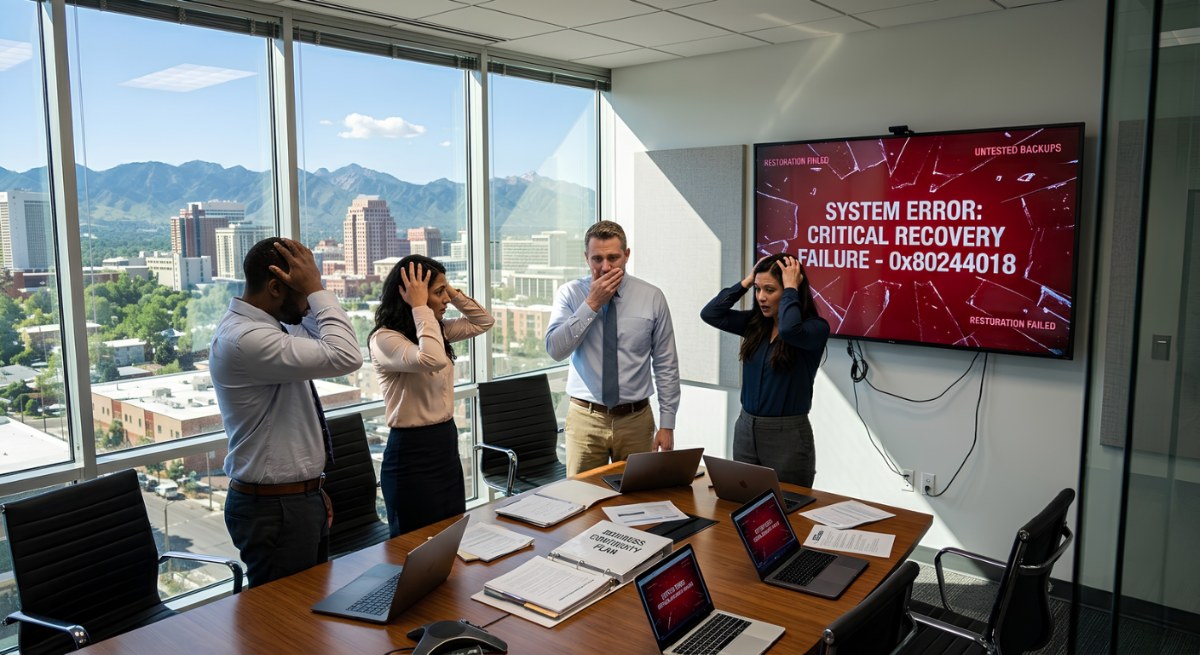
In business, that punch usually arrives as a disruption you assumed you were ready for — a failed backup, an unexpected outage or a security incident that exposes a weakness nobody knew existed.
That's the thing about assumptions. They feel like facts right up until they're tested. For Salt Lake City businesses relying on managed IT services or self-managed infrastructure, these are the four that most often cause the real damage.
Assumption #1: "We're Backed Up"
Having an untested backup is like carrying a spare tire in your trunk and discovering it's flat when you're stranded on the side of the road.
Most businesses know backups exist. They've seen the reports, the notifications and the green checkmarks. But few can confidently say when they last tested a restore, how long recovery would actually take or whether every critical application and file is included.
A backup proves its value only when it helps you recover. The most dangerous backup is the one you've never tested.
Assumption #2: "Someone Would Tell Us If There Was a Problem"
Monitoring tools are valuable — but confusing detection with protection is a costly mistake.
A weather alert can tell you a hurricane is coming. It doesn't board up your windows or move your family to safety. The alert is only useful if you know what to do next.
Your monitoring tool works the same way. It tells you something is wrong. What happens after that alert fires is entirely up to you. Without a documented response plan and a capable IT support partner in Salt Lake City, alerts become noise instead of action.
Assumption #3: "Our Team Knows What to Do"
Every team looks prepared — until game day.
Picture this: Late on a Friday afternoon, a critical system goes offline. Suddenly nobody can agree on who's in charge, what to fix first or how long it will take.
When there's no documented plan and no practice run, even a capable team is starting from zero. You don't run a fire drill because you expect the building to burn down tomorrow. You do it so that if there ever is a fire, nobody is standing around asking which way to run.
A recovery plan works exactly the same way. When something goes wrong, you want your team executing a plan they already know — not figuring things out under pressure.
Chaos rarely comes from the disruption itself. It comes from not knowing what to do next.
Assumption #4: "It Won't Happen to Us"
Nobody thinks they'll be the one. Until they are.
When you're focused on growth, customers and keeping things moving, disruption feels like something that happens to other companies. But most disruptions are completely ordinary: an employee clicks a bad link in a phishing email, a power outage hits or a piece of hardware finally gives out.
The question isn't whether something unexpected will happen. It's whether you'll be ready when it does. The businesses that recover fastest aren't the ones that avoided the disruption — they're the ones that expected it.
Frequently Asked Questions
What's the difference between backup and disaster recovery?
Backup is the process of copying and storing your data. Disaster recovery is the plan for restoring that data and getting systems back online after an incident. You need both — and both need to be tested to be reliable.
How often should Salt Lake City businesses test their backups?
At minimum, quarterly. High-risk environments or businesses with compliance requirements should test more frequently. The goal is to verify that backups restore completely and within an acceptable time frame before an actual incident occurs.
Does Qual IT offer managed IT services for businesses in Salt Lake City?
Yes. Qual IT provides managed IT services, cybersecurity, backup and disaster recovery planning, and business continuity support for businesses across Salt Lake City and the greater Wasatch Front.
You Can't Block a Punch You Didn't Prepare For
It's rarely the dramatic event that catches businesses off guard — it's the ordinary ones that hit on a Wednesday when nobody is expecting it.
The good news is that most of these risks can be addressed before they become business problems. That's exactly what Qual IT helps Salt Lake City businesses do.
Schedule a 10-minute discovery call to walk through your backups, recovery process and business continuity plan. We'll identify what's been tested, what hasn't and where gaps may exist. Book your discovery call here.