
August 2026 | IT Support for Dental Offices Salt Lake City | HIPAA IT Support for Dentists | Backup & Disaster Recovery
Most Salt Lake City dental practices think they are ready for a disruption because they have some form of backup. But having a backup and being able to recover patient records, X-ray archives, and a full appointment schedule are two very different things — and the gap between them usually shows up at the worst possible moment.
Think about a school fire drill. When the alarm goes off, nobody stops to figure out what to do. Students line up, teachers move them through the exits, and everyone knows exactly where they are supposed to go — because they have practiced.
Your backup and recovery strategy for Dentrix, your imaging system, and your patient records should work the same way. But most dental offices have never actually tested whether it will. That untested assumption is exactly where disruptions turn into disasters.
Why Fire Drills Save Dental Practices, Not Just Schools
Fire drills do not exist because anyone expects a fire tomorrow. They exist because an emergency is the worst possible time to figure out the plan.
When everyone knows the route, who leads, and what happens next, panic does not take over. And if the plan has a flaw, the drill reveals it — not the real emergency. That is the value of practice: it removes guesswork before the pressure hits.
IT support for dental offices in Salt Lake City works the same way. The preparation happens in advance so that when something goes wrong — whether that is ransomware locking your Dentrix database, a server failure wiping out your Carestream imaging files, or a hardware failure taking your scheduling system offline — your front desk and dental team are executing a plan, not inventing one on the spot.
Managed IT providers who specialize in dental office cybersecurity in Salt Lake City build that plan with you before an incident occurs. That is the difference between a practice that recovers in two hours and one that is still scrambling at the end of the day.
The Dental Practice Version of a Backup Fire Drill
You probably have some form of backup in place. But when did you last test whether it actually works?
Most dental practices have not. They rarely find out until something goes wrong — and by then the front desk is fielding calls from patients, appointments are being cancelled, and the entire team is scrambling to figure out whether the backup will restore, how long recovery will take, and which systems come back first.
For a dental office, downtime is not just an inconvenience. It is empty chairs, rescheduled procedures, and lost revenue for every hour your team cannot access Dentrix or pull up a patient’s imaging history in Dexis or Planmeca. When schedule is revenue and every chair-hour has value, the cost of an untested backup compounds fast.
A backup fire drill changes that dynamic. Instead of discovering your gaps during an actual crisis, you discover them during a controlled test when the stakes are low and the pressure is off. That is exactly what recovery testing is designed to do.
What Recovery Testing Actually Looks Like for Dental Offices
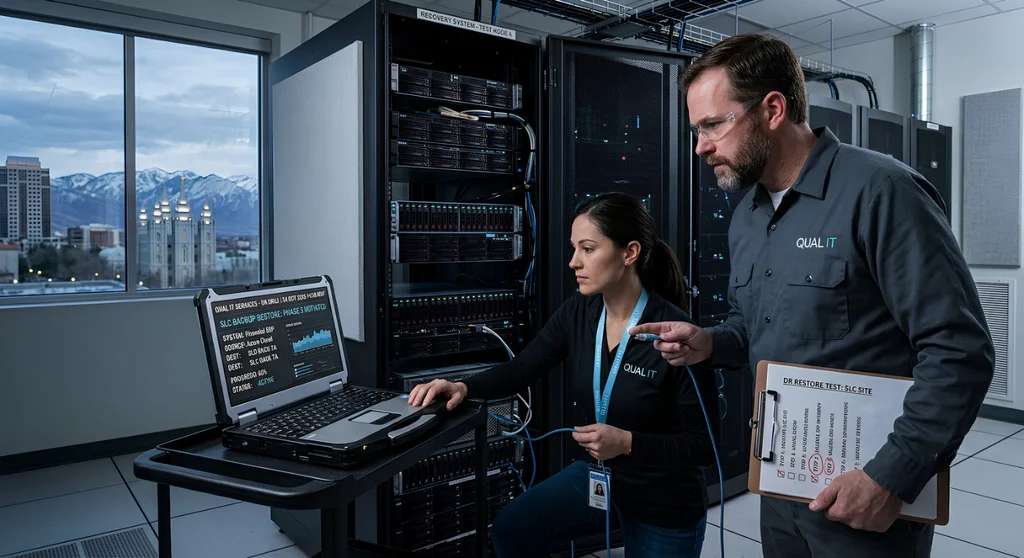
Recovery testing is not theoretical. We work with Salt Lake City dental practices to run real restore tests — pulling from your actual backups of patient records and X-ray archives, timing the recovery, and identifying which systems come back cleanly and which ones do not.
The test answers the questions most dental offices do not face until Dentrix is already offline and the waiting room is full:
- Will the restore of your X-ray archives and patient records work the way you think it will?
- How many hours will recovery actually take — and how many appointments will need to be rescheduled?
- Which systems need to come back first to keep your practice functional: scheduling, imaging, or billing?
- Can your front desk and dental team keep working during recovery, or does everything stop?
- Are there gaps in your backup of patient records and imaging that you have not discovered yet?
- If a ransomware attack locks your Dentrix database, does your backup strategy meet HIPAA breach notification requirements?
That is the difference between having a backup and being genuinely ready to recover. Knowing the answer to those questions before the emergency is what separates a dental practice that weathers a disruption from one that is still counting the cost weeks later.
What Happens When You Skip the Drill
When recovery has never been tested, even a routine disruption can spiral quickly in a dental practice. The front desk loses access to the appointment schedule and cannot tell patients whether their appointment is happening. The dentist cannot pull up a patient’s treatment history or X-rays mid-appointment. Leadership is fielding calls with no accurate answers to give and no timeline to share.
What should have taken two hours to fix stretches to six or longer — because nobody practiced the steps. Patients who cannot be seen get rescheduled, and some do not return. Revenue walks out the door. And if patient records and imaging were affected, HIPAA breach notification requirements add an entirely new layer of urgency with strict timelines that cannot wait for the systems to come back up.
For a practice where every chair-hour has direct revenue value, the compounding cost of an untested recovery is almost always far higher than the cost of running the drill in the first place.
The HIPAA Layer Nobody Practices For
In a dental office, a data disruption is not just an operational problem — it is potentially a compliance event. HIPAA requires dental practices to have documented procedures for protecting and recovering patient records and imaging. If a ransomware attack locks your Dentrix database or corrupts your X-ray archives, the question is not just whether you can recover. It is whether you are required to notify patients — and how quickly.
Most dental offices have never walked through that question in a controlled setting. The answer needs to be ready before an incident occurs, not assembled on the fly while the phones are ringing and the appointment schedule is in pieces. HIPAA-compliant IT support for dental offices in Salt Lake City includes documented breach response procedures, not just backup software.
A practice that has tested its recovery plan knows the answer to that question before it needs it. A practice that has not will be figuring it out under pressure — with patient trust and regulatory compliance both on the line at the same time.
Frequently Asked Questions
Do you offer HIPAA-compliant IT services for dental offices in Salt Lake City?
Yes. Qual IT works with Salt Lake City dental practices to ensure backup and recovery processes meet HIPAA requirements — including documented procedures for protecting patient records and imaging, breach notification protocols, and regular testing to verify that backups restore completely. We work with dental offices running Dentrix, Eaglesoft, Curve Dental, Dexis, Planmeca, and other practice management and imaging systems.
How do I know if my Dentrix backup will hold up in a real emergency?
The only way to know for certain is to test it. A recovery test restores from your actual backups of patient records and X-ray archives, times the process, and identifies any gaps — before a ransomware attack or hardware failure exposes them under pressure with a full appointment schedule at stake. Most dental practices are surprised by what recovery testing reveals.
What dental IT services does Qual IT offer in Salt Lake City?
Qual IT provides IT support for dental offices across Salt Lake City, including HIPAA-compliant backup and disaster recovery, cybersecurity to protect patient records and imaging against ransomware and phishing, help desk support for your front desk and dental team, and managed IT services so your practice has a reliable technology partner when something goes wrong. We serve dental practices throughout Salt Lake City and the greater Wasatch Front.
Do Not Wait for the Emergency to Learn the Plan
Most dental practices discover they are not as prepared as they thought — and that discovery is far better during a controlled test than during an actual crisis with the waiting room full, Dentrix offline, and your front desk fielding questions nobody can answer.
We work with Salt Lake City dental practices to keep systems running and patient data secure.
Schedule a 10-minute discovery call with Qual IT to walk through your backup strategy for X-ray archives and patient records, find out what has been tested and what has not, and get a clear picture of whether your recovery plan will hold up when it really matters. Book your discovery call here.