
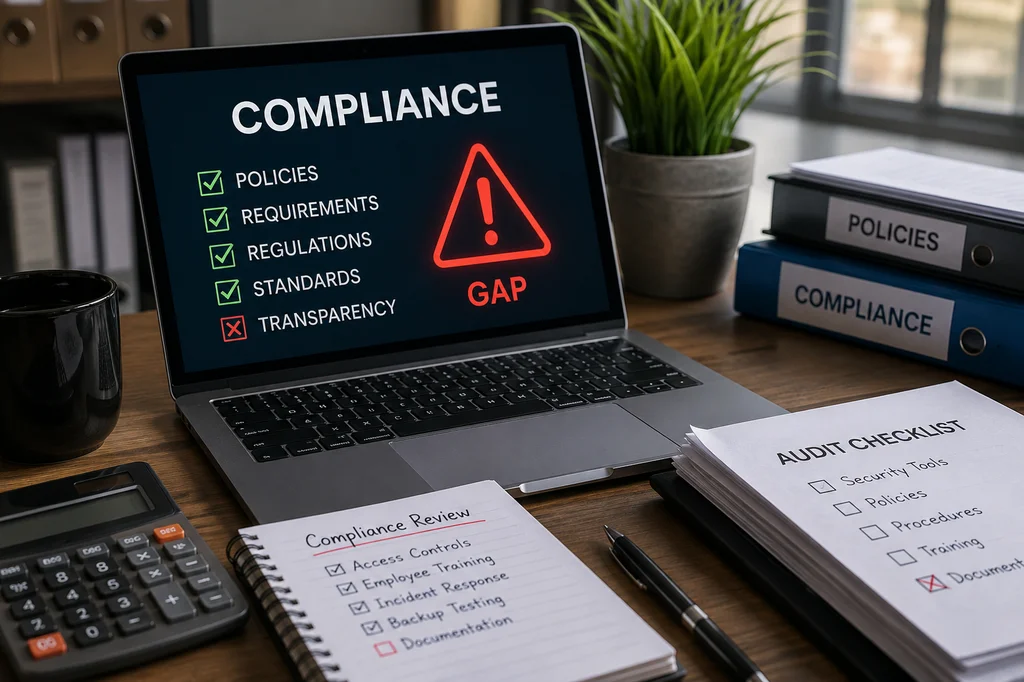
July 2026 | SEC-Compliant IT Services Salt Lake City | RIA Cybersecurity Services Utah | Financial Services IT Support Salt Lake City
Not all compliance failures start with a breach — but they all start with assumptions.
A Salt Lake City advisory firm can have the right tools in place — Redtail or Wealthbox for client relationships, Orion or Black Diamond for portfolio management, ComplySci for compliance tracking, Smarsh or Global Relay for email archiving — and still be unclear on what's actually working, what's configured correctly, and what would hold up under scrutiny from an SEC examiner. For RIAs and wealth managers, that gap between what you think you have and what you can actually demonstrate is where regulatory exposure lives.
Unfortunately, most advisory firms don't discover their IT compliance gaps during normal operations. They discover them under pressure — during an SEC examination, after a client complaint, or following a cyber incident when every system and decision gets scrutinized. At that point, compliance stops being a checklist item and starts becoming a significant cost — financial, reputational, and regulatory. Here are four IT compliance gaps that can cost Salt Lake City financial advisors thousands when left unchecked.
Gap 1: SEC-Required Security Tools Nobody Actually Monitors
Most Salt Lake City advisory firms already pay for security tools: endpoint protection on advisor workstations, multifactor authentication for Schwab and Fidelity portal access, email filtering that routes through Smarsh or Global Relay for archiving compliance, firewalls protecting the office network. On paper, the firm looks covered.
The problem is ownership and active management — the exact thing SEC examiners probe.
Who confirms those tools are configured correctly across every advisor's device — including the ones working remotely or using personal laptops? Who checks that MFA is actually enforced on every system that touches client financial data, not just the ones that were easy to configure? Who reviews the alerts that your endpoint protection generates? Who catches failed updates on an advisor's workstation that hasn't been in the office in three months? Who responds when your email archiving system through Smarsh flags a gap that could be a regulatory problem?
Security software can't protect what it doesn't see. It can't respond to alerts nobody reads. It can't close gaps left open by weak setup on a remote advisor's home device or warning signs that got ignored during a busy quarter.
From a distance, your IT security looks solid — but under SEC examination scrutiny, the picture often changes. Buying the tool is step one. The protection comes from how that tool gets managed, monitored, and maintained month after month. SEC examiners don't just want to know you have security tools — they want evidence of active management, documented reviews, and response procedures. A checkbox answer gets noticed. Proof of ongoing oversight earns trust.
Gap 2: Advisor Behavior With Client Financial Data No One Has Revisited
Advisors and staff aren't usually trying to create compliance risk — they're trying to serve clients efficiently. That's precisely why many compliance issues come from routine behavior that nobody has reviewed or corrected.
An advisor emails a client financial plan from their personal account because their work email was having issues. A support staff member saves a client document from ShareFile to their personal laptop to work on it at home. An advisor reuses their Redtail password across multiple platforms because managing multiple passwords feels like an administrative burden. A remote advisor accesses client portfolios through Orion on a personal device that has never been reviewed or enrolled in your firm's device management program.
These aren't reckless decisions. They're the predictable result of a practice that has grown without revisiting its guidance on how client financial data should be handled in a world where work happens everywhere, on every device.
SEC cybersecurity rules and FINRA guidance both expect written supervisory procedures governing how advisors handle client data — including remote access, personal device use, email practices, and password management. For Salt Lake City RIAs operating under these frameworks, unreviewed advisor behavior with client financial data is one of the most common sources of compliance exposure that surfaces during examinations.
Gap 3: Documentation Built After the SEC Asks for It
Your firm may be doing everything right operationally — MFA is enforced, client data is backed up, access to Orion and Redtail is reviewed periodically, and advisors understand the firm's security expectations. But if the evidence is scattered, undated, or missing, that becomes a compliance problem the moment an SEC examiner or a client's attorney asks for proof.
Scrambling to reconstruct documentation after the fact creates inconsistencies and makes your firm look less prepared than it may actually be. It can also raise questions about whether proper controls were being followed in the first place — which is exactly the conversation you don't want to have during an examination.
Strong IT compliance for a financial advisory firm means:
- Written cybersecurity policies are reviewed before examinations, not drafted because an examiner requested them
- Access control records showing who has permissions to Redtail, Orion, Black Diamond, and custodian portals are maintained before a dispute arises about a departed advisor
- Vendor due diligence documentation for your portfolio management software, CRM, and compliance technology providers is tracked before a client asks whether their data is protected
- Incident response plans are written, tested, and documented before an incident happens — because SEC cybersecurity rules require them, and because a plan that exists only in someone's head isn't a plan
- Email archiving compliance through Smarsh or Global Relay is verified regularly, not confirmed retroactively when an examiner requests correspondence
Documentation needs to be current, clear, and producible on demand. If your IT provider isn't helping you maintain this kind of audit trail, they don't understand what it means to serve a regulated financial advisory firm.
Gap 4: Your Security Posture Hasn't Kept Pace With Your Firm's Growth
This gap matters especially during a midyear review, because your Salt Lake City advisory firm may have changed significantly more than your security posture has in the first half of this year.
Maybe you added three new advisors, each of whom brought their own preferred tools and work habits. Maybe you onboarded a new custodian relationship that created new portal access and data flows nobody fully documented. Maybe you moved to a new financial planning platform — adding RightCapital alongside the eMoney and MoneyGuidePro you were already running — without formally reviewing how client data would be handled across all three. Maybe you expanded the number of remote advisors without updating your policies on BYOD access to Redtail and client portfolios.
A security setup built for a 4-person boutique firm doesn't automatically scale to a 15-advisor practice with remote staff and multiple custodian relationships. A backup plan that covered your original server environment may not cover the cloud-based tools you've added. Access rules that made sense when you knew every person in the office may be dangerously loose now that your team has grown.
That's how advisory firms outgrow their protection — not through negligence, but through growth that IT security didn't keep pace with. And when an SEC examiner asks whether your cybersecurity practices are appropriate for the size and complexity of your firm, 'we set this up three years ago and haven't revisited it' is not the answer you want to give. A midyear IT compliance review helps confirm whether your current controls align with how your firm actually operates today — and what your regulatory obligations require of a firm at your current stage of growth.
The Real Cost of Finding Out During an Examination
IT compliance gaps for financial advisors usually surface at the worst possible moments: during an SEC examination, after a client complaint reaches your broker-dealer or custodian, or following a cybersecurity incident when every decision your firm made gets scrutinized in hindsight.
At that point, you're doing damage control — not fixing a gap. The cost isn't just remediation. It's the reputational impact with clients who expected you to protect their financial data as carefully as you manage their portfolios. It's the regulatory cost of a deficiency letter or enforcement action. It's the insurance cost of a claim that might have been prevented with controls that were available and simply weren't implemented.
The time to identify these issues is before an SEC examiner finds them for you. A focused IT compliance review for your Salt Lake City advisory firm can surface where you're exposed, where security has drifted from your written policies, and whether your current cybersecurity posture meets what SEC and FINRA require of a firm your size.
Frequently Asked Questions
Do you offer SEC and FINRA-compliant IT services for financial advisory firms in Salt Lake City?
Yes. Qual IT works with Salt Lake City RIAs and wealth management firms to build IT programs that align with SEC cybersecurity rules and FINRA guidance — including written security policies, incident response documentation, access control reviews, employee training records, vendor due diligence, and ongoing monitoring of the tools that touch client financial data.
What are the most common IT compliance gaps for Salt Lake City financial advisors?
The most common gaps for RIAs and wealth managers include unmonitored security tools that lack documented management records, unreviewed advisor behavior with client financial data including personal device and remote access risks, compliance documentation that gets assembled after an examiner requests it rather than maintained continuously, and security postures that haven't been updated to reflect firm growth — new advisors, new custodian relationships, new software platforms.
How does IT compliance affect cybersecurity insurance for Utah financial advisors?
Cybersecurity insurers increasingly require documented evidence of active controls — not just installed tools. For advisory firms, this means proof of MFA enforcement across all systems touching client financial data, documented backup testing, employee training records, and written incident response plans. Firms without this documentation may face higher premiums, claim denials, or coverage gaps at renewal. The same documentation your insurance carrier wants is what SEC examiners want to see.
How often should Salt Lake City financial advisors review their IT compliance posture?
SEC cybersecurity rules require at minimum an annual review — but a midyear check-in is strongly recommended, particularly after significant changes like hiring new advisors, adding software platforms, expanding remote work, or onboarding new custodian relationships. Quarterly reviews are ideal for firms in active growth phases or firms that have recently received SEC examination notices.
Close the Gaps Before an SEC Examiner Finds Them
We work with Salt Lake City financial advisors to meet SEC/FINRA requirements and protect client data. Qual IT helps RIAs and wealth management firms identify IT compliance blind spots, strengthen cybersecurity controls, build the documentation that SEC examiners expect, and confirm that today's security posture still aligns with today's regulatory requirements and the firm's current size and complexity.