July 2026 | Insurance Agency Cybersecurity Salt Lake City | Summer Threat Awareness | Business Email Compromise
On the surface, the water looks calm. That's what makes Shark Week fascinating every year — the danger is never visible on the surface. It's already moving underneath.
Cybercriminals targeting Salt Lake City insurance agencies operate the same way. The threats your agency faces right now are designed to blend in with normal operations — carrier renewal notices, vendor invoices, policy communications — until the moment money moves, policyholder data is exposed, or your agency management system goes offline.
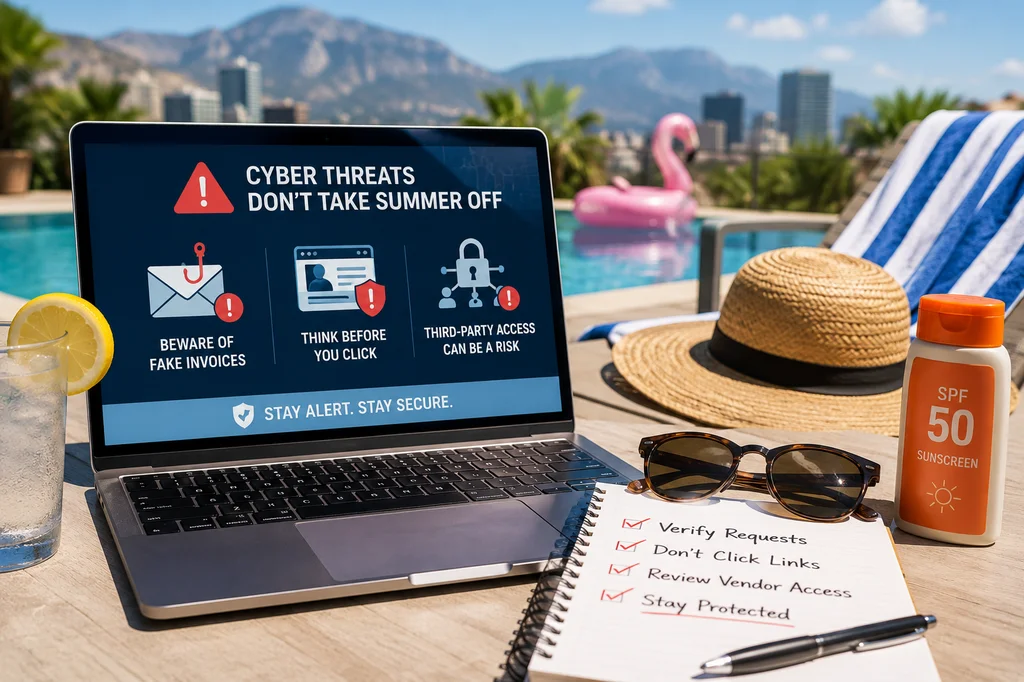
During the summer months, when agents travel, schedules shift, and oversight gets thinner, cybercriminals know agencies are often paying less attention. Here are three ways they're circling Salt Lake City insurance agencies right now.
1. Fake Carrier Invoices, Premium Payment Fraud, and Vendor Impersonation
Attackers don't always need to hack anything. In many cases, they just need to send one believable email that looks like it came from a carrier, a premium finance company, or a vendor your agency already trusts.
This is called business email compromise (BEC), and it works by impersonating a known contact — a carrier representative, a wholesaler, or even an internal agency principal. The email arrives looking completely normal — an agent or office manager processes the 'payment' — and by the time anyone realizes the request wasn't legitimate, premium funds have moved to a fraudster's account.
These attacks spike during vacation season for a predictable reason: when the principal who normally approves wire transfers is out, requests get rerouted to agents and staff who don't always know what normal looks like. Temporary stand-ins are less likely to question urgency — and cybercriminals know it.
The fix is straightforward to implement: build a verification process for any financial request received via email, including premium payment instructions or requests to update carrier payment details. A quick confirmation call to a known number — not the number listed in the suspicious email — is enough to stop most of these before they go anywhere. Wire fraud on premium payments is one of the most financially damaging threats facing insurance agencies today.
This is a foundational element of cybersecurity for Salt Lake City insurance agencies of any size, and it costs nothing beyond a changed process.
2. Phishing Disguised as Carrier Renewal Notices and Policy Communications
Phishing works because it's engineered around how people actually behave when they're busy. And insurance agents are among the busiest professionals in any market during summer renewal season.
Cybercriminals design these moments deliberately. An agent sees what looks like a carrier renewal notice and clicks the link to review the policy. Someone gets a text that looks like it came from a carrier portal about a policy requiring immediate attention. An email lands right before a client meeting asking for urgent login credentials to access a time-sensitive certificate request. Nobody stops to verify because stopping feels like losing time — and in insurance, delays cost client relationships.
The most effective protection isn't a software solution — it's culture. Your agents and staff need to feel comfortable slowing down when something seems off:
- An unexpected login request for Applied Epic or a carrier portal
- A renewal notice or payment instruction that came through an unusual channel
- A link in an email they weren't expecting from a carrier or vendor
Speed is a weapon attackers use against your agency. Slowing down — and having a clear process for flagging suspicious carrier communications and policy renewal notices — is how you take it away from them. Employee security awareness training is one of the most cost-effective cybersecurity investments a Salt Lake City insurance agency can make.
Your clients chose your agency because they trust you to handle their most sensitive information. A successful phishing attack that compromises your Applied Epic credentials doesn't just affect your operations — it potentially exposes your entire book of business.
3. Carrier Portal Credential Compromise and Supply Chain Risk
When a vendor or carrier portal connected to your agency is compromised, the threat doesn't stay contained to them. It travels directly into your environment through whatever connection they have to your agency — and potentially into your entire book of business.
This is supply chain exposure, and most insurance agencies have significantly more of it than they realize. Carrier portals, rating platforms like EZLynx or TurboRater, document portals like ShareFile or Applied CSR24, and CRM integrations — all of these create connections that most agency owners have never fully mapped out. A single compromised carrier portal credential can expose policyholder data across multiple carriers and clients.
Compromised carrier portal credentials represent one of the most serious threats to insurance agencies today. Unlike a direct attack on your agency systems, a carrier portal compromise can be difficult to detect — and your clients' policyholder data may be at risk before you even know anything is wrong.
Outsourcing a carrier relationship doesn't outsource your liability. To understand your agency's supply chain exposure, you need to be able to answer three questions:
- Which carriers and vendors have access to your policyholder data or agency management systems?
- What exactly are they connecting to — and how are those credentials managed?
- Who is responsible internally for monitoring those relationships and revoking access when it's no longer needed?
If those answers aren't clear, your agency's IT security posture has gaps your errors and omissions coverage may not protect you from.
By the Time You See It, It's Already Moving
Sharks don't announce themselves — and neither do the cybercriminals targeting Salt Lake City insurance agencies right now.
The agencies that get hit aren't always the ones that ignore obvious warning signs. They're the ones who assume everything is fine because nothing looks wrong on the surface. Summer is when schedules get loose, agents are traveling, and the water looks the calmest. It's also when attackers are most active — because they know renewal season creates urgency and distraction that works in their favor.
Proactive cybersecurity for Salt Lake City insurance agencies means building the defenses before the threat arrives — not scrambling after a breach has exposed policyholder PII and triggered state insurance department notification requirements.
Frequently Asked Questions
Do you offer IT support and cybersecurity for insurance agencies in Salt Lake City?
Yes. Qual IT provides cybersecurity services specifically designed for Salt Lake City insurance agencies, including protection for agency management systems, carrier portal credential security, and policyholder data breach prevention.
What is business email compromise and how do Salt Lake City insurance agencies protect against it?
Business email compromise (BEC) is a cyberattack where criminals impersonate a trusted contact — often a carrier representative, premium finance company, or agency principal — to trick agents and staff into wiring money or changing payment details. Protection starts with verification: any financial request received via email should be confirmed by phone using a known contact number before action is taken.
Why do cyberattacks on insurance agencies increase during summer months?
Attackers look for moments when oversight is thinner. During summer, more agency principals and senior staff are on vacation, approval processes get rerouted to agents who may not recognize unusual requests, and security awareness tends to dip. Cybercriminals also know that renewal season creates urgency that discourages verification.
How do I know if my Salt Lake City insurance agency has carrier portal risk?
If any carrier portal, rating platform, or vendor has access to your policyholder data or agency management systems — and you don't have a clear record of what credentials are active and who manages those relationships — you have exposure. A managed cybersecurity review can map your full exposure and flag any access that should be revoked or secured with stronger authentication.
Don't Wait Until You See the Fin
We work with Salt Lake City insurance agencies to protect policyholder data and keep agency systems running.