
Engineering Company IT Services Utah | Civil Engineering IT Support Salt Lake City | Proactive IT
Taking a reactive approach to IT might not feel like a problem in the moment — and for engineering firms, the instinct to defer non-critical issues is entirely rational. Triage is a professional discipline.
Most IT issues start small: a simulation workload takes longer than expected, a warning appears in the Deltek Vantagepoint dashboard, or a project file sync in Newforma feels slightly off but still functions. Because nothing is actually broken, it gets deprioritized in favor of active project deliverables. Work continues. Everything seems fine.
But those small issues don't stay small, and when they surface, they rarely show up one at a time.
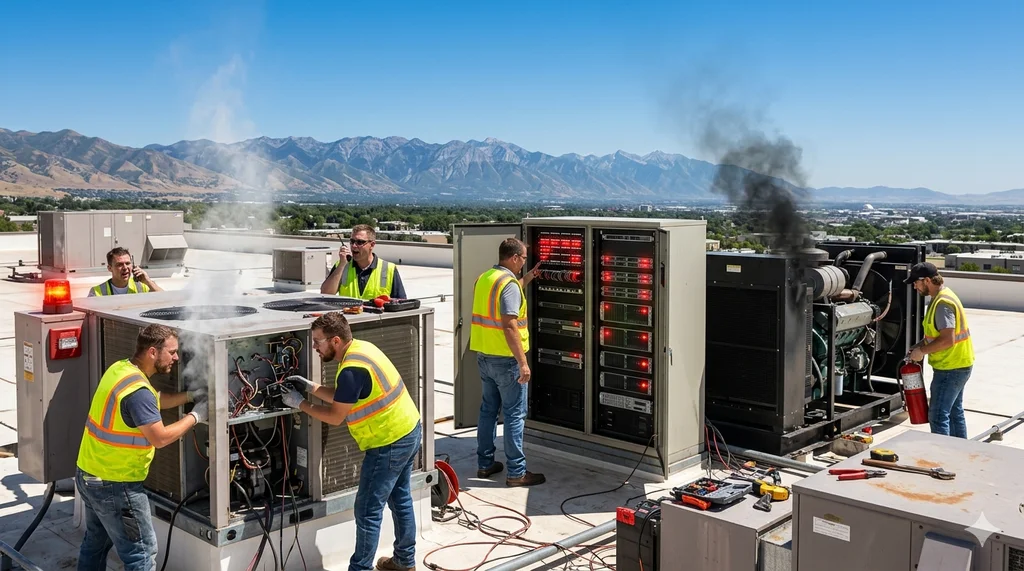
That's what turns a normal project day into a fire drill. And for Salt Lake City engineering firms in the summer, those fire drills hit harder.
With key project staff out of the office and schedules less predictable, even routine IT issues take longer to diagnose and fix, affecting more of your engineering team in the process. What could have been handled quietly in the background turns into a disruption the entire firm feels — and one that can cascade into missed submittals and delayed deliverables.
Here are a few of the most common scenarios we see:
1. The 'It's Just a Little Slow' Workstation
It usually starts with a workstation that's slightly slower than it should be — particularly noticeable when running AutoCAD Civil 3D, ANSYS simulations, or processing large Bentley MicroStation files.
Nothing stops working, so no one reports it. Engineers adjust by waiting a few extra seconds, saving more frequently, or running smaller model iterations. Over time, that slowdown becomes part of the routine.
Until one day, the workstation stops working altogether — typically in the middle of a critical design session.
Now your project team can't access what they need, and work stalls. Engineers start troubleshooting on their own, restarting workstations, guessing at the issue, or looking for temporary workarounds.
If the person who normally handles IT isn't available — and in summer, they often aren't — it takes even longer to diagnose. What could have been a quick fix when the issue first appeared now turns into downtime that affects the entire project schedule.
2. The Update That Keeps Getting Postponed
There's always an update that needs to be done — a firmware patch on the server, a software update for Procore or Newforma, a security patch flagged weeks ago. But it's rarely a good time. There's a project deadline, an active design phase, or a subconsultant review in progress. The update gets pushed to next week, then pushed again.
Because everything seems to be working, it doesn't feel like a risk.
Eventually something changes. A system becomes incompatible with a recently updated project platform, a known vulnerability is exploited, or a critical tool stops functioning correctly after an unplanned forced update.
Instead of a planned, controlled maintenance window, your project team is dealing with an unplanned disruption. During the summer, when fewer staff are available, that disruption takes longer to resolve and has a larger impact on project delivery timelines.
3. The Untested Backup
Backups tend to run quietly in the background, so they're easy to deprioritize. Maybe there was a warning at some point, or a notification that didn't seem urgent. Since nothing failed at the time, it was reasonable to assume everything was fine.
That assumption holds until something actually goes wrong — a ransomware incident encrypts project files, a server failure takes down the Newforma repository, or a workstation failure means a week of engineering calculations needs to be reconstructed.
When a project file is lost or a system fails and data needs to be restored, the backup is what matters. In that moment, you find out whether it's working or not.
If it hasn't been running properly, is incomplete, or hasn't been tested against actual recovery scenarios, the process becomes far slower and more complicated than expected. Your engineering team waits, billable hours stop, and project schedules slip while recovery proceeds.
How Proactive IT Support Prevents This
The difference isn't luck — it's approach. Engineering firms apply systematic risk mitigation to project design; the same methodology applies to IT infrastructure.
Instead of waiting for something to break, proactive managed IT services focus on identifying and resolving issues before they affect your project team. For Salt Lake City engineering firms, that means:
- Workstation and server performance issues are addressed before they turn into outages that halt design work
- Updates are handled on a consistent, scheduled basis instead of being postponed until a forced interruption
- Backups are monitored and tested against real recovery scenarios so they work when you actually need them
It doesn't eliminate every issue, but it keeps small problems from turning into disruptions that pull your entire engineering team off technical work.
What to Do Before the Next Issue Becomes Urgent
If your firm has a few deferred IT items sitting in the background right now, you're not alone. The problem is, those issues tend to surface at the worst possible time — deadline week, during a critical design phase, or when key staff are out.
That's where Qual IT comes in. As your Salt Lake City IT partner for engineering firms, we make sure deferred items don't turn into project-impacting problems by:
- Keeping your engineering systems monitored so issues don't go unnoticed during busy project phases
- Handling updates and maintenance on a planned schedule so nothing gets pushed off indefinitely
- Making sure your backups are verified and recovery actually works before you need it
- Giving your project team a clear, fast path to technical support when something isn't right
Instead of pushing things off and hoping they hold, you know they're handled — and your project schedules reflect that.
Frequently Asked Questions
Do you offer IT support for engineering firms and technical consultancies in Salt Lake City?
Yes. Qual IT provides proactive managed IT services to civil, structural, mechanical, and specialty engineering firms across Salt Lake City. We monitor, maintain, and support the technical infrastructure your project teams depend on — so deferred issues don't become project delays.
How do I know if my engineering firm's backups are actually working?
In most cases, you don't — until something goes wrong. That's precisely the risk. A proactive IT partner tests your backups regularly and verifies that recovery actually works against real project data scenarios, so you're not finding out at the worst possible moment — mid-project.
Do you offer managed IT services for engineering firms in Salt Lake City?
Yes. Qual IT works with engineering firms across the Salt Lake Valley. We monitor, maintain, and support your technology on an ongoing basis — including workstations running AutoCAD Civil 3D, ANSYS, and SolidWorks, as well as project management platforms like Newforma and Deltek Vantagepoint.
We work with Salt Lake City engineering firms to protect project data and support technical workflows.
Let's take a look at what's been deferred on your IT list — and make sure it doesn't become your firm's next fire drill. Book a quick discovery call and we'll get started.
And if this sounds like something another principal or project manager you know is dealing with, send this their way. They're probably closer to a fire drill than they think.