
Manufacturing IT Services Utah | Salt Lake City | IT Support for Manufacturers
Every year around late June, we get the longest day of the year — more daylight, more usable hours, and at least in theory, more time to get production done.
But most Salt Lake City plant managers and operations directors don't experience it that way.
Even with extra daylight, the shift fills up just as fast as any other. Machine issues surface, scheduling gaps appear, and before you know it, you're at the end of the day wondering how output fell short again.
It raises an uncomfortable question: If even the longest day of the year doesn't feel like enough time, is time really the problem?
In most cases, it isn't.
The Shift Doesn't Fall Apart All at Once
Very few production days start off chaotic. You typically begin with a clear run schedule — maybe even a plan to finally catch up on backlog. Then something small interrupts the operation.
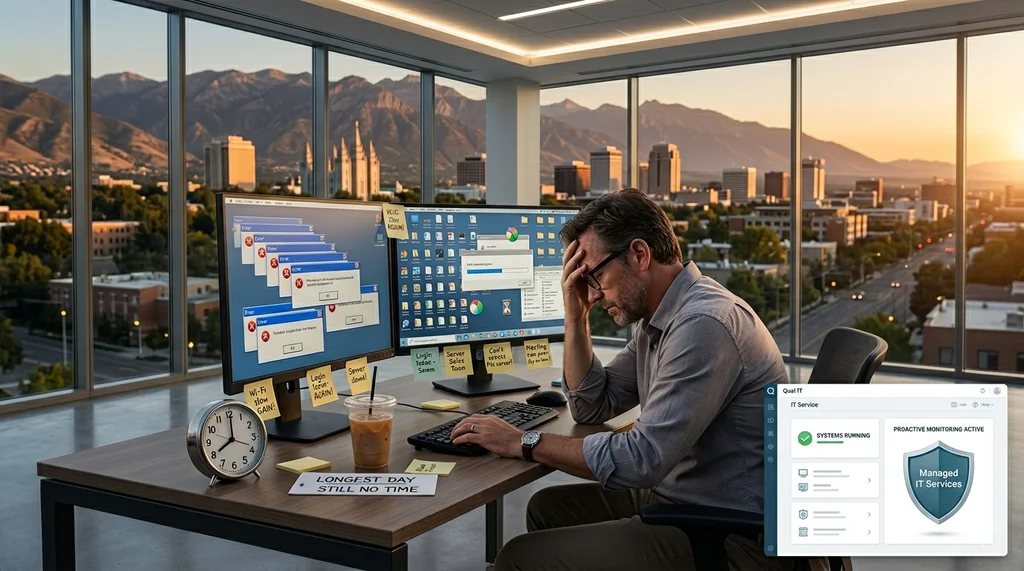
An operator can't log into the ERP. The network connection to the SCADA system slows down for no clear reason. A job file isn't where it's supposed to be in shared storage, or Microsoft Dynamics takes longer than expected to pull up a work order.
None of these issues are major on their own, but each one forces your operations staff to stop what they're doing and shift their attention.
That shift is where production time starts to slip away.
By the time the issue is resolved and the operator gets back to the task, momentum is lost — and it takes longer to recover than it should. When this happens repeatedly throughout a shift, it becomes almost impossible to hit your daily targets.
It's Not About Having More Time — It's About Losing Less of It
Most Salt Lake City manufacturers don't lose hours all at once. They lose production time in small, constant interruptions: ERP systems that lag, job files that aren't where they should be, quick issues that pull operators off the line and take longer than expected to resolve.
Individually, none of it seems significant. But over the course of a shift, it adds up. Output slows down, focus gets broken, and simple tasks take longer than they should.
You can feel the difference on days when your IT systems run the way they're supposed to. Work orders move through the system without unnecessary stops, your production team stays on task, and jobs get done without dragging out.
It doesn't feel like you suddenly have more time. It just feels like the floor finally runs the way it should.
More Hours Won't Fix a Broken Production Workflow
If your operation is constantly losing time to slow systems, ERP access issues, and recurring IT interruptions, adding more hours to the shift won't solve the problem.
Running longer shifts might help you keep up short term, but it doesn't address the inefficiency at its root. The same is true for adding more headcount. If the underlying systems are unreliable or unsupported, those inefficiencies just scale with your team.
At a certain point, it becomes clear that the issue isn't capacity. It's how your production environment operates day to day — and that starts with your technology.
What Managed IT Services Actually Change for Manufacturers
Salt Lake City manufacturers that run efficiently aren't just better at managing their time. They're set up to avoid losing it in the first place.
Their production systems are monitored proactively so issues can be caught early, before they interrupt a shift. Recurring problems are addressed at the root rather than worked around. And when something does go wrong, there's a clear, efficient path to getting it resolved without derailing the entire floor.
That kind of manufacturing IT support doesn't just reduce frustration — it protects production output, your operations staff's focus, and your ability to hit targets without constant disruption.
Frequently Asked Questions
Do you offer IT and cybersecurity support for manufacturing companies in Salt Lake City?
Yes. Qual IT works with Salt Lake City manufacturers to protect production systems and reduce operational downtime. We provide proactive monitoring, help desk support, patch management, and strategic IT planning so your ERP, MES, and production networks stay up and your team stays productive.
Why should a Salt Lake City manufacturer use managed IT services?
Because small IT interruptions add up to real production losses. Managed IT removes the daily friction — slow ERP access, login issues, job files in the wrong place — so your operations staff can focus on the floor instead of troubleshooting. It also means problems are caught before they escalate into unplanned downtime.
How quickly can Qual IT resolve issues when something goes wrong on the production floor?
We monitor your systems around the clock, which means we often catch problems before your team notices them. When a ticket does come in, we resolve it quickly so the disruption stays small and your shift can keep moving.
Tired of losing production time every day? We work with Salt Lake City manufacturers to protect production systems and reduce operational downtime — by taking responsibility for the technology, monitoring it, maintaining it, and keeping it from becoming a daily drain on output.
So instead of reacting to problems, your operation runs the way it's supposed to and shifts stop falling short of where they should be.
Book a quick discovery call to make this your new normal. Schedule your discovery call here.
If you know another Salt Lake City manufacturer dealing with the same IT friction, send this their way.