
May 2026 | Qual IT Managed IT | Engineering Firms | Ransomware & Business Continuity
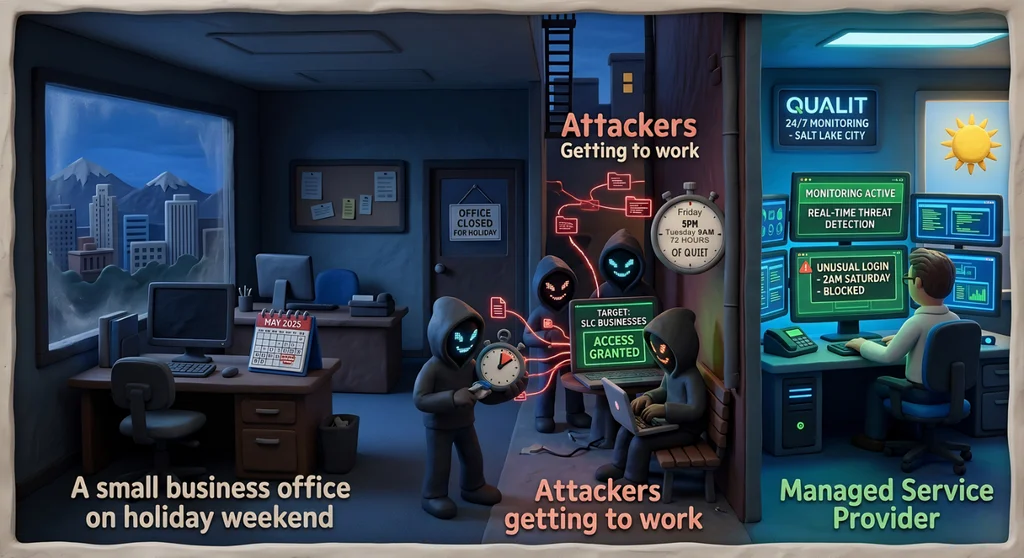
Ransomware groups do not respect project deadlines. But they do pay close attention to business hours — specifically, to the hours when no one is watching. A 2025 Semperis report found that 52% of ransomware attacks occur on holidays or weekends, and the pattern is deliberate. Attackers know that engineering firms reduce or eliminate IT coverage after Friday afternoon, that high-performance workstations running simulation jobs are often left unattended overnight, and that the 72-hour window between Friday evening and Tuesday morning provides maximum time for an attack to propagate before anyone notices. If your engineering firm's CAD environments, simulation data, and project file servers are sitting unmonitored over a long weekend, you have a meaningful and predictable window of undetected exposure.
The Research Behind the Weekend Attack Pattern
The same Semperis 2025 report found that 78% of organizations reduce their security staffing on holidays and weekends. Combined with the 52% attack timing statistic, this creates a clear picture: the hours when your engineering team is away from the office are the hours when attackers prefer to operate. Incident response is slower, decision-makers are unavailable, and the attack has more time to spread before containment begins.
For engineering firms specifically, the risk is compounded by the nature of the technical environment. HPC workstations running simulation jobs in ANSYS or MATLAB may be unattended for 12-16 hours at a stretch. CAD environments with large project files are left accessible on the network. Backup jobs run overnight without anyone verifying they completed successfully. Each of these conditions extends the window in which an attack can progress undetected.
What Ransomware Looks Like in an Engineering Environment
Ransomware in an engineering firm does not arrive with obvious warning signs. It looks like a Monday morning where AutoCAD Civil 3D files will not open. Project documentation in Newforma returns errors. SharePoint shows corrupted files. The ETABS or RISA structural analysis database that your team was going to use for a Monday morning deliverable is encrypted and inaccessible. And there is a ransom demand on the screen.
High-performance simulation workstations — left running overnight with ANSYS or MATLAB jobs — are a particularly attractive entry point. These machines are powerful, often connected directly to the firm's file server network, and rarely monitored after hours. A successful attack that begins on an HPC workstation Friday night can spread across the firm's technical environment before the weekend is over, encrypting project files, CAD data, and simulation outputs across multiple active projects.
The Reactive IT Model Fails Engineering Firms
Most small and mid-size engineering firms operate on a reactive IT model: something breaks, someone calls for help. This approach works adequately for routine IT issues. It fails structurally for ransomware, because by the time anyone calls, the encryption is complete, backups may have been targeted, and the recovery timeline is measured in days or weeks rather than hours.
For engineering firms, the cost of even 48-72 hours of downtime is not abstract. If the affected systems include active CAD environments for a DOT project with a submission deadline, a structural analysis database for a project in construction documents phase, or a project management system tracking billing across multiple active clients, the business impact accumulates rapidly — independent of whether a ransom is paid.
The Proactive Model: 24/7 Monitoring and Defined Response
Continuous Monitoring Without In-House Staff
The alternative to reactive IT is partnering with a managed IT provider that delivers 24/7 monitoring as part of the service model. Continuous monitoring means that if ransomware begins executing on a simulation workstation at midnight on Saturday, an alert fires immediately — automated containment can isolate the affected machine from the network, and a response process begins before the attack reaches the firm's file servers or project systems.
For engineering firms, monitoring coverage should include: primary and HPC workstations, the file server where CAD and project files are stored, project management platforms, SharePoint environments, and backup systems — because ransomware groups routinely target backups first to eliminate the fastest recovery path.
Tested, Versioned Backups Are a Technical Requirement
Engineering firms frequently have large data environments — CAD files, simulation outputs, and project documentation that accumulates over years. Backup strategy needs to account for that scale with automated, versioned backups stored in a location not directly accessible from the main network, regular restoration testing to verify that backups can actually be recovered, and recovery time objectives defined in advance for critical project systems.
A backup that has not been tested under realistic conditions is not a reliable recovery option. Test restores — actually recovering files from backup and verifying their integrity — should be part of your routine IT maintenance, not a procedure you discover has never been done in the middle of a ransomware incident.
Incident Response: Define the Plan Before You Need It
Every engineering firm should have a documented incident response plan that covers: Who is the first call when an incident is detected? What is the priority order for restoring project systems? Are there government or client notification obligations triggered by a data breach? What is the acceptable recovery time for active project environments? Working through these questions in advance — with your IT partner, when the environment is stable — produces a plan that can actually be executed under pressure. A plan that does not exist yet is not a plan; it is a decision you are deferring until the worst possible moment.
Your Project Data Is the Core of the Business — Protect It Accordingly
The calculations in ETABS, the infrastructure designs in AutoCAD Civil 3D, the simulation outputs in ANSYS — these are the commercial and intellectual core of what your firm produces. Protecting that data with the same rigor applied to technical quality means continuous monitoring, tested backups, and a defined response process that does not depend on business hours.
We work with Salt Lake City engineering firms to protect project data and support technical workflows — including through weekends and holidays when the risk of attack is highest.
Schedule a free discovery call with Qualit to assess your firm's ransomware readiness.
Frequently Asked Questions
Q: Our HPC workstations run simulation jobs overnight. Does that increase our ransomware risk?
Yes. Unattended high-performance workstations are a preferred entry point for ransomware because they provide extended windows with no human oversight and are typically connected to the firm's core network. Apply the same endpoint protection, monitoring, and patching standards to HPC workstations as to primary workstations. Where possible, segment HPC machines from the core file server network so that a compromise on a simulation workstation does not automatically propagate to your project data environment.
Q: We have a government DOT project with active deadlines. What happens to our contract obligations if we get hit by ransomware over a weekend?
Ransomware is increasingly recognized as a force majeure event in contract discussions, but that recognition is not universal and does not eliminate the practical problem of a missed submission deadline. The better approach is proactive: ensure that government project data is backed up with a verified recovery time objective short enough to meet your submission windows, and that your incident response plan specifically addresses the notification and continuity requirements in your government contracts. Review those contract terms before an incident — not after.
Q: We back up our project files every Friday. Is that sufficient protection against weekend ransomware?
A Friday backup provides a recovery point — but it leaves an entire week's work at risk for an attack that hits on a weekend. More importantly, a Friday backup that has not been tested may not be recoverable at all. The issues to address are backup frequency (daily incremental at minimum for active project data), backup isolation (the backup storage must not be accessible from the main network where ransomware can reach it), and regular test restores (verify that recovery actually works before you depend on it). A managed IT partner can help you assess whether your current backup configuration meets these standards.