Healthcare Cybersecurity | Ransomware Protection | HIPAA IT Support Salt Lake City
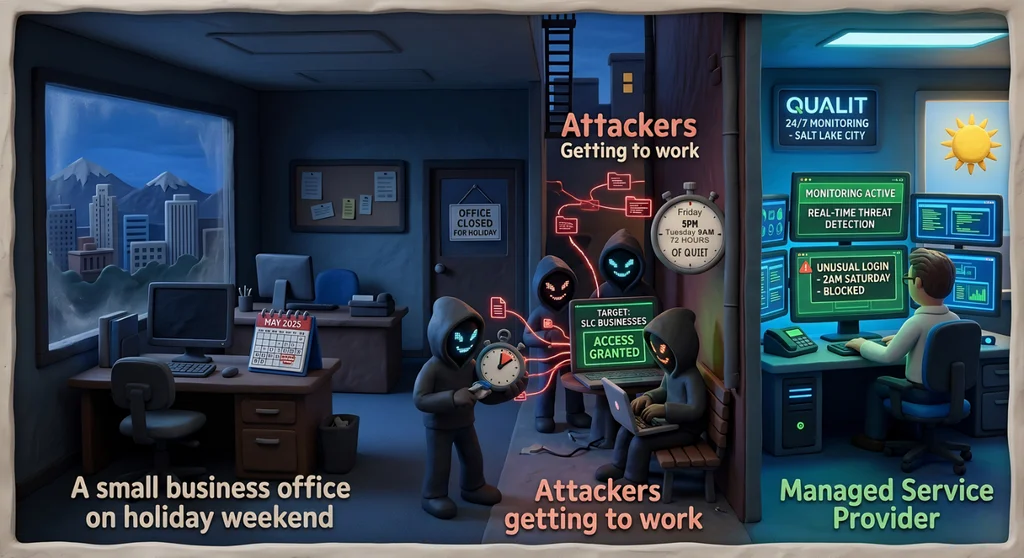
While your clinical team is enjoying a long weekend, someone else is getting to work. They've been planning for this. They know which Salt Lake City medical practices will be running on skeleton crews, which EHR alerts will go unchecked, and which on-call staff won't be monitoring anything beyond patient calls. Healthcare is the number one ransomware target — not despite the fact that practices can't afford downtime, but because of it. Attackers know that a clinic that can't access Epic or Cerner on a Monday morning will pay to get it back. They know the holiday weekend is when your defenses are thinnest.
According to Semperis's 2025 Ransomware Holiday Risk Report, 52% of organizations hit by ransomware were attacked on a holiday or weekend. In healthcare, that number is even more alarming — because the consequences aren't just financial. They affect patient care.
The question isn't whether someone is targeting medical practices like yours on a holiday weekend. The question is: who's watching when it happens?
The 48-Hour Window
The vulnerability doesn't start when the weekend begins. It starts Wednesday, when people start mentally winding down.
By Thursday afternoon, shortcuts begin. A physician logs in from a personal device because their work laptop is at the office. A staff member shares login credentials with a temp covering the weekend because there wasn't time to set up a proper account. A billing vendor's temporary access from last month was never revoked. A contractor finished their work, but nobody removed their credentials from the patient portal because the person responsible left early for the holiday.
None of this feels reckless. It feels like keeping the practice running through a busy stretch. But those decisions don't get revisited until Tuesday morning — after 72 hours of reduced monitoring, open sessions, and unreviewed access logs. The practice didn't close for the weekend. The attention did.
Who's Working While Your Practice Is Closed
Here's the mismatch most Salt Lake City practices don't think about until a breach notification is sitting on their desk.
On one side: a criminal operation that has already researched your EHR system, probed your login pages, and identified the quietest window to move. Healthcare attackers are specialists. They know Epic's login interface, they know how to disguise lateral movement in a clinical network, and they know that a practice that can't access patient records on a Monday morning is highly motivated to pay a ransom. Semperis found that 78% of organizations reduce security staffing by at least half during weekends and holidays. Healthcare attackers have built their entire strategy around this.
On the other side: who's watching your EHR environment at 2 AM on a Saturday? For most small practices, the honest answer is no one. There's a phone number for the IT vendor you call when something breaks. But they're not monitoring your network traffic. They're not seeing the login attempt from an unusual location. They're not flagging the file transfer that doesn't match normal patterns. They're waiting for you to call. And if ransomware locks your EHR before you know anything is wrong, Tuesday morning becomes a very different kind of day.
What It Looks Like When the Match Is Even
A managed IT provider that understands healthcare doesn't just fix things when they break. In a stronger model, monitoring runs continuously — whether it's a Thursday afternoon or midnight on Memorial Day. Systems flag unusual behavior early: an EHR login from an unrecognized location, a bulk download of patient records outside of normal hours, an access attempt on your billing system from a device that's never connected before. Those alerts go to a team that knows what to do with them — not to a voicemail that won't be checked until Tuesday.
It also means preparing before the weekend starts. Reviewing who has active access to your EHR and patient portal. Revoking credentials that should have been removed. Making sure your backup and recovery systems are tested and current. Not because something is wrong — but because in healthcare, if something is, you need to know before your clinical team arrives for Monday morning appointments.
HIPAA's breach notification clock doesn't pause for holidays. Your security coverage shouldn't either.
Is Your Salt Lake City Practice Protected When the Office Is Closed?
You may already have this covered. If your systems are monitored around the clock by a team that understands clinical environments, you're in a better position than most practices your size.
But if your approach is to wait for something to break and then make a call, it's worth rethinking before the next long weekend.
Qual IT provides HIPAA-focused managed IT services and 24/7 monitoring for Salt Lake City medical practices — so your EHR, patient data, and clinical systems are protected whether your team is in the office or out of town.
Schedule a 10-minute discovery call to talk about what your current monitoring and security coverage looks like during holidays and weekends.
And if you know a practice owner heading into a long weekend with no one watching their systems — send this their way. Because healthcare attackers don't take days off. And your patients' records deserve protection that doesn't either.
Frequently Asked Questions
Why do ransomware attacks on medical practices spike during holiday weekends?
Healthcare attackers deliberately time attacks for periods when clinical staff are reduced and IT monitoring is minimal. A practice that can't access its EHR on a Monday morning — with a full patient schedule — is under enormous pressure to restore access quickly, making ransom payment more likely. Holiday weekends create exactly this combination: reduced vigilance, delayed detection, and high stakes for rapid recovery.
What HIPAA obligations apply if a ransomware attack occurs over a holiday weekend?
HIPAA's breach notification requirements don't have holiday exceptions. If PHI is accessed or exfiltrated during an attack, the clock starts immediately — 60 days to notify affected individuals and HHS, with media notification required if more than 500 patients are affected in your state. Delayed detection (because no one was monitoring) doesn't extend the deadline. It just shortens your response window.
Does Qual IT provide 24/7 IT monitoring for Salt Lake City medical practices?
Yes. We provide continuous network monitoring, EHR access oversight, and threat detection for Salt Lake City medical practices — including holidays and weekends. Our team is watching for unusual activity so your clinical staff can focus on patients, not security dashboards.