
Ransomware property management | Holiday cyberattacks | AppFolio security | 24/7 monitoring | Salt Lake City
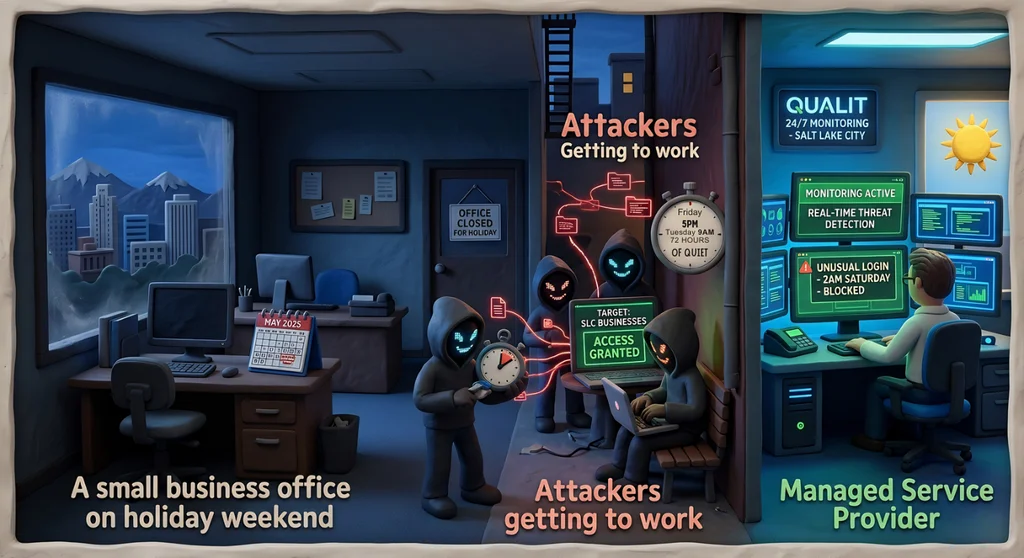
It's Saturday morning. Your maintenance team is handling weekend requests. Your leasing agents aren't in until Monday. Nobody is watching the back-end of your property management systems — and that's exactly when a ransomware group chooses to strike. A 2025 Semperis study found that 52% of ransomware attacks occur on holidays and weekends. For property management companies that operate on thin administrative margins with small teams and distributed staff, the weekend coverage gap is a real vulnerability. And the consequences of a weekend ransomware attack — AppFolio offline, Buildium encrypted, QuickBooks inaccessible — can shut down your operations for days at exactly the moments when tenants need rent receipts and owners expect disbursement statements.
The 72-Hour Window Your Attackers Are Counting On
Modern ransomware attacks are not impulsive. They're planned. Attackers typically gain initial access to a network days or weeks before they deploy ransomware. They spend that time exploring the environment, identifying valuable data, escalating privileges, and positioning themselves to maximize damage and leverage. When they're ready, they choose the deployment moment carefully — and the Friday afternoon to Tuesday morning window is their favorite.
A 2025 Semperis study found that 78% of organizations have reduced security staffing on holidays and weekends. Attackers know this. A ransomware deployment at 9 PM on a Friday night gives them a 60+ hour window to complete their work before anyone with the authority and knowledge to respond is likely to notice. By Monday morning, your property management systems may be fully encrypted, your backups may have been deleted or compromised, and the attacker may have already exfiltrated a copy of your tenant database to use as additional leverage.
For property management companies, the damage isn't just operational. Your tenant records contain Social Security numbers, banking information, and lease details. Your transaction files in Dotloop and Skyslope contain buyer and seller personal information and financial records. Your owner management agreements contain financial details that property owners share with you in confidence. All of that data is potential ransom leverage — and potential regulatory liability if it's exposed.
What a Ransomware Attack Looks Like for a Property Management Company
The Monday morning discovery is the nightmare scenario. Your property manager tries to open AppFolio. Error. Tries Buildium. Encrypted. QuickBooks — same. The maintenance request system is down. Email may or may not be working, depending on whether the attacker targeted your Microsoft 365 environment as well. You have tenants trying to pay rent. Owners expecting disbursement statements. Vendors waiting for payment. And none of your systems are accessible.
The ransom demand arrives in a text file on the desktop of an affected machine, or via email, or both. It typically demands payment in cryptocurrency within a specific time window — often 72 hours — before the price doubles or the attackers begin releasing your tenant data publicly. The amounts demanded from small and mid-sized property management companies typically range from tens of thousands to hundreds of thousands of dollars.
Even if you decide to pay — which security experts and law enforcement generally recommend against — payment doesn't guarantee full recovery. Decryption tools provided by attackers are often slow, incomplete, or buggy. The operational disruption continues. And paying once marks your company as willing to pay, making you a target again.
Wire Fraud: The Weekend Attack That Doesn't Need Ransomware
Ransomware isn't the only weekend threat property management companies face. Business email compromise and wire fraud — where attackers intercept or redirect payment instructions — are equally dangerous and can happen without any malware being deployed at all.
Property management companies handle large financial transactions regularly: owner disbursements, security deposit transfers, vendor payments, and earnest money handling. Attackers who have compromised your email through credential stuffing or phishing monitor those transactions patiently. On a Friday afternoon, when the property manager who normally processes payments has just left for the weekend and a new or junior staff member is handling the phones, the attacker strikes — sending spoofed wire instructions that redirect a payment to an account they control.
By Monday morning, the funds are gone. International wire transactions are often irreversible. The property management company is left trying to explain to an owner why their disbursement went to an account in a foreign jurisdiction.
The Reactive Model Fails on Weekends
Most property management companies rely on a reactive IT model: something breaks, you call someone, they fix it. This model is adequate for routine technical issues. It fails completely when a ransomware attack deploys at 9 PM on Friday night. Your IT contact's voicemail picks up. By the time anyone responds Monday morning, the attack has been running for 60+ hours and the damage is done.
What works for weekend attacks is a proactive monitoring model — continuous automated surveillance of your network and systems, with alert escalation protocols that reach a human responder at any hour. Not a Monday-morning callback. An actual response, in real time, to stop an attack that's in progress.
For property management companies, this means partnering with a managed IT services provider that genuinely monitors around the clock — not just during business hours with an after-hours line that goes to the same technician's voicemail. Ask the direct question: 'If ransomware starts deploying in our systems at 10 PM on a Saturday, what exactly happens?' The answer will tell you whether you have real coverage or just the appearance of it.
Three Things Property Management Companies Can Do Right Now
Verify Your Backups Are Real — and Tested
Many property management companies assume their AppFolio, Buildium, or QuickBooks data is backed up somewhere. The question is whether those backups are current, whether they're stored in a location that ransomware can't reach, and whether your team has actually tested restoring from them. Cloud-based software like AppFolio maintains some redundancy, but that's not the same as a recoverable backup of your data in a configuration that can be restored quickly after an attack.
Schedule a backup verification exercise. Identify what data you have, where it's stored, and how long a recovery would take. If the answer to any of those questions is 'I'm not sure,' that's the starting point for your next conversation with your IT provider.
Implement Network Segmentation
If all of your systems — your property management software, your financial platforms, your leasing agent devices, and your general office network — are on the same flat network, ransomware that gets in anywhere can spread everywhere. Basic segmentation keeps your tenant data systems on a separate network segment from general office devices. It limits the blast radius of an attack and gives your response team more options when something is compromised.
Establish an After-Hours Incident Contact Protocol
Your team should know exactly what to do and who to call if they notice something wrong on a weekend — a system that won't load, an email that looks suspicious, a device that's behaving strangely. Post the protocol visibly at each property location. Make it part of onboarding. The fastest way to contain a weekend attack is for the person who first notices something wrong to take the right action immediately — not wait until Monday to mention it to someone.
Your Tenants and Owners Are Counting on Continuity
Property management is a continuity business. Tenants need to know maintenance will be handled. Owners need to know disbursements will arrive. Vendors need to know invoices will be paid. A successful ransomware attack breaks all of those promises simultaneously. The reputational cost of telling your owners that their disbursements are delayed because of a cyberattack — and that you don't know when systems will be back up — is significant and lasting.
24/7 monitoring isn't a luxury for enterprise companies. It's the minimum viable security posture for a property management company that operates seven days a week, that processes financial transactions regularly, and that holds sensitive data for hundreds or thousands of tenants. The cost of monitoring is a fraction of the cost of a single ransomware incident — and it means that the attack that would have ruined your Monday morning gets stopped before anyone was even aware it started.
Your properties don't stop being at risk on weekends — and neither should your security monitoring.
We work with Salt Lake City property management companies to protect tenant data and secure real estate transactions. Schedule a free discovery call to find out how 24/7 monitoring can close your weekend coverage gap.
Frequently Asked Questions
If ransomware encrypts our AppFolio data, can we recover it from AppFolio's own backups?
AppFolio and similar SaaS platforms maintain their own infrastructure redundancy, but this is different from a data backup that you control and can recover from in a targeted attack. If ransomware compromises your access credentials or your organizational account, the attacker's ability to affect your data depends on the specifics of the attack and the platform's security architecture. The more important question is whether you have independent backups of your critical data — including exports of tenant records, lease documents, and financial data — stored in a location that an attacker who compromised your primary systems can't reach. Your IT provider can help you assess and close that gap.
We process owner disbursements on the 1st and 15th. How do we protect those transactions specifically?
High-value, predictable transactions are exactly what wire fraud attackers target. Key protections: require voice verification for any change to an owner's banking information (never act on email instructions alone); use MFA on all accounts involved in financial processing; implement a two-person authorization requirement for large disbursements where one person initiates and a different person confirms; and brief your team before each disbursement cycle on current wire fraud methods. These controls are most important in the days leading up to your payment dates, when attackers who have monitored your email patterns know a large transaction is imminent.
How do we know if we've already been compromised and don't know it yet?
The honest answer is that without active monitoring, you may not know. Many ransomware groups spend days or weeks inside a network before deploying their payload — during which time there may be no visible symptoms. Signs worth investigating include: user accounts logging in at unusual hours, unexpected changes to files or permissions, new email forwarding rules your team didn't set up, unusual outbound network traffic, or systems running slower than normal without an obvious cause. A managed IT services provider offering proactive monitoring will identify these indicators before they escalate. If you haven't had a security assessment recently, that's the right starting point.