Ransomware insurance agencies | Holiday weekend cyberattacks | 24/7 monitoring | Applied Epic | Salt Lake City
It's a Friday afternoon. Your agents have closed their last files in Applied Epic, updated a few policies in AMS360, and headed out for the weekend. Your carriers are closed for the holiday. Your phones are going to voicemail. And somewhere, a ransomware group has just launched an attack against your agency's systems — because they specifically chose this moment to do it. This isn't paranoia. A 2025 Semperis study found that 52% of ransomware attacks occur on holidays and weekends. For independent insurance agencies, where the staff is small, IT oversight is limited, and client data is everywhere, that timing is devastating.
Why Attackers Love Your Holiday Weekend
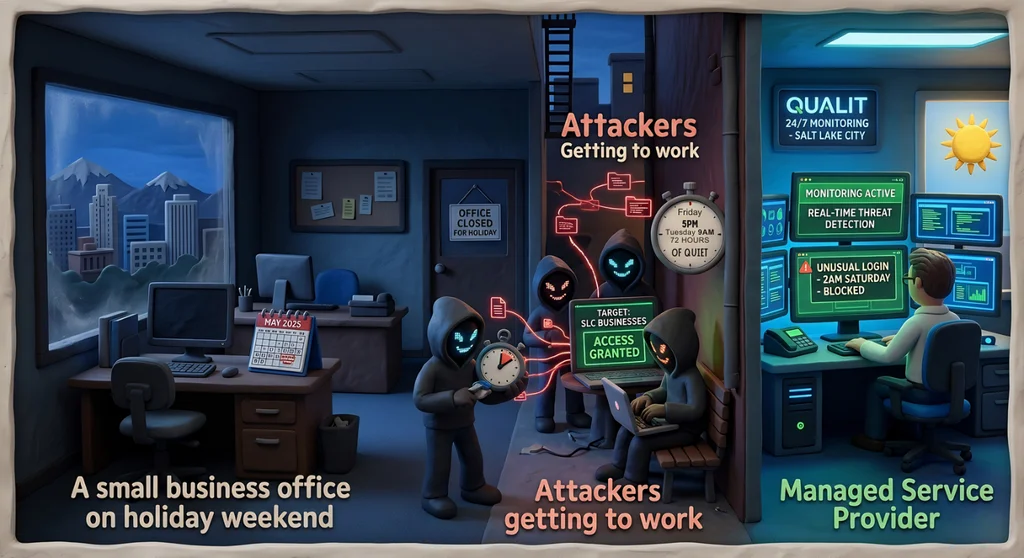
Cybercriminals are rational actors who optimize for success. They know that most small and mid-sized businesses — including independent insurance agencies — reduce their security staffing on holidays and weekends. The same Semperis study found that 78% of organizations have reduced security coverage during off-hours. With no one watching, attackers have a 72-hour window — from Friday afternoon to Tuesday morning — to move through your systems, encrypt your files, and position themselves to demand a ransom before you've even had your Monday morning coffee.
That 72-hour window is critical. Modern ransomware attacks don't just encrypt your files and demand immediate payment. Attackers first spend time inside your network exploring — identifying your most valuable data, escalating privileges, and ensuring they have maximum leverage before they make their presence known. By the time you discover the attack on Monday morning, they may have been inside your systems since Friday night.
What a Ransomware Attack Looks Like for an Insurance Agency
For an independent agency, a successful ransomware attack is an operational catastrophe. Applied Epic goes offline. Your AMS360 database is encrypted. The carrier portal credentials stored in your systems are compromised. Your client communication history in HubSpot or Salesforce is inaccessible. DocuSign workflows stop. Pending policy renewals, open claims, and in-progress applications are all locked behind a ransom demand.
The immediate financial cost is only part of the picture. Your agents can't access policyholder records. You can't respond to client inquiries. You can't process premium payments. You can't communicate with carriers. For every day your agency is offline, you're paying staff who can't work, missing renewal deadlines, and watching clients' trust erode.
And the recovery isn't fast. Even agencies that have backups — which not all do — typically experience days to weeks of disruption getting systems restored and verified. Agencies without proper backups may face a choice between paying the ransom and losing everything. Neither is a good option.
The Policyholder Data Problem
Beyond the operational disruption, there's the regulatory and legal dimension. Your agency's files contain nonpublic personal information — client Social Security numbers, health information, financial records, and more. When ransomware attackers encrypt your files, they almost always exfiltrate a copy first, using it as additional leverage. 'Pay us or we release your clients' personal information' is the double-extortion model that now dominates ransomware attacks.
Under Utah's insurance data security regulations, you likely have notification obligations if client information is exposed in a breach. Those obligations come with timelines. Discovering on Tuesday morning that your agency was breached on Friday night puts you immediately behind on compliance, even as you're trying to get systems back online and figure out what happened.
The Reactive Model Doesn't Work for Weekend Attacks
Most small agencies operate on a reactive security model: something goes wrong, you call someone, they help you fix it. That model fails completely when the attack happens Friday night and your IT support doesn't know until Monday morning. By Monday, the damage is done. The attacker has had 60+ hours inside your network.
What works for weekend and holiday attacks is a proactive monitoring model — systems that are watching your network continuously, automated alerts that fire the moment something anomalous is detected, and a response team that acts on those alerts at 11 PM on a Friday just as readily as at 2 PM on a Tuesday.
For most independent agencies, building that capability in-house isn't realistic. Your agency isn't in the IT business. But the threat doesn't care about that distinction. The solution is partnering with a managed IT services provider that offers genuine 24/7 monitoring — not just business-hours support with an emergency number that goes to voicemail.
What 24/7 Monitoring Actually Prevents
Continuous monitoring doesn't just detect ransomware after it's deployed. It catches the precursor activity that happens before encryption begins — the lateral movement, the privilege escalation, the unusual file access patterns that indicate an attacker is exploring your network. Catching an attacker in the reconnaissance phase means stopping the attack before any files are encrypted and before any data is exfiltrated. That's the difference between a security event that costs you a few hours and one that costs you weeks of downtime and a regulatory investigation.
Effective monitoring also means your applied security isn't just a set-and-forget firewall. It's active threat detection that adapts as attack methods evolve — because the techniques attackers use in 2026 are not the same ones they used in 2023, and static defenses don't keep up.
Three Steps to Reduce Your Agency's Holiday Weekend Exposure
Implement Regular, Tested Backups
Backups are your last line of defense against ransomware. But a backup that hasn't been tested is an untested assumption. Ensure your agency management systems — Applied Epic, AMS360, or whichever platform you use — are backed up regularly, that backups are stored in a location separate from your primary network (so ransomware can't encrypt them too), and that your team has actually practiced restoring from backup. An untested backup is not a backup you can rely on.
Segment Your Network
Network segmentation limits the blast radius of an attack. If your agency management systems, your carrier portal credentials, and your general office network are all on the same flat network, ransomware that gets in anywhere can spread everywhere. Basic segmentation — keeping your client data systems on a separate network segment from general office use — limits how far an attacker can move even if they get a foothold.
Partner With a Provider That Actually Monitors After Hours
Ask your current IT provider a direct question: 'If ransomware starts deploying in our systems at 10 PM on a Friday night, what happens?' If the answer involves a Monday morning call, you have an after-hours coverage gap that puts your agency at serious risk. A managed IT services provider that offers genuine 24/7 monitoring will have a real answer — automated detection, alert escalation protocols, and on-call response capability.
Your agency's clients don't stop being at risk on weekends — and neither should your security coverage.
We work with Salt Lake City insurance agencies to protect policyholder data and keep agency systems running. Schedule a free discovery call to learn how 24/7 monitoring can close your agency's weekend coverage gap.
Frequently Asked Questions
Does our agency's cyber liability insurance cover ransomware attacks?
It depends on your policy. Many cyber liability policies do cover ransomware — including ransom payments, business interruption losses, and breach notification costs — but coverage often has conditions. Insurers are increasingly requiring policyholders to demonstrate reasonable security controls (MFA, backups, employee training) as a condition of coverage. Some policies exclude attacks that exploit known vulnerabilities that weren't patched. Review your cyber policy carefully with your carrier, and make sure your security practices meet the requirements — since you're an insurance professional, you already understand why the policy language matters.
How do ransomware attackers typically get into an insurance agency's systems?
The most common entry points are phishing emails that deliver malware or steal credentials, compromised remote access (VPN or RDP exposed to the internet with weak credentials), and exploitation of unpatched software vulnerabilities. For insurance agencies, phishing disguised as carrier communications or policy renewal notices is a particularly effective vector because it looks legitimate to agency staff. Strong email security, MFA on all remote access, and a consistent patching schedule eliminate the majority of these entry points.
If we're attacked over a holiday weekend, what's the first thing we should do?
Isolate affected systems from the network immediately — disconnect devices from Wi-Fi and unplug ethernet cables. Do not shut down or reboot systems, as this can sometimes destroy forensic evidence or trigger additional encryption routines. Call your managed IT services provider or IT support contact right away, regardless of the time. If client data has been exposed, begin documenting the timeline of events immediately — you'll need it for regulatory notifications and insurance claims. Preserve all evidence: don't delete emails, don't wipe devices, and don't pay any ransom without consulting legal and IT security counsel first.