
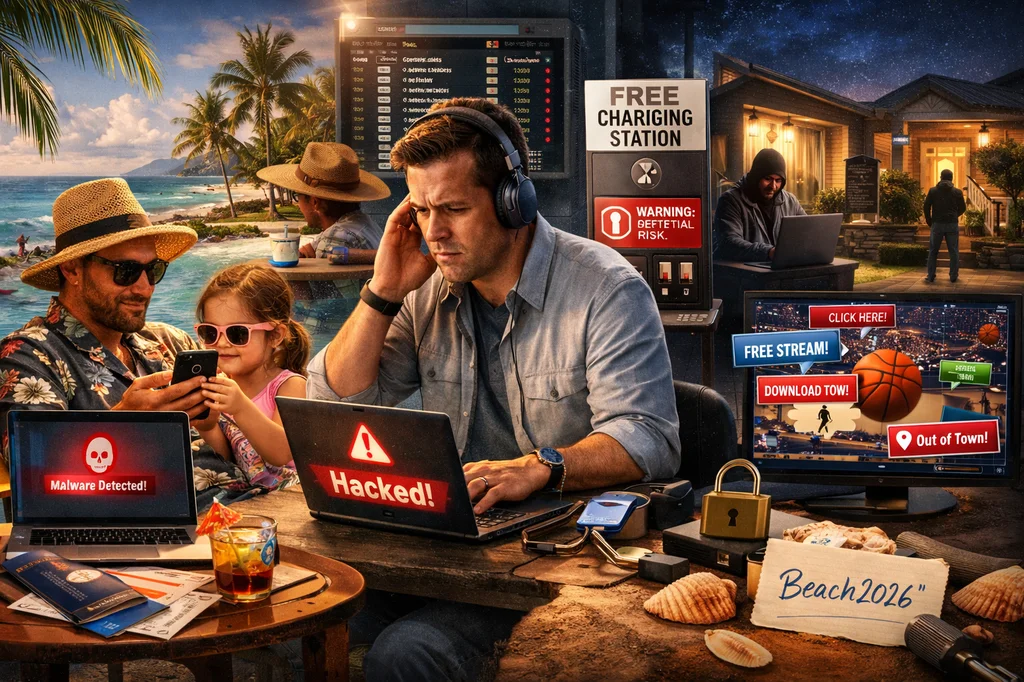
Spring break gets a bad reputation.
College kids. Questionable decisions. Stories that start with, “we thought it was a good idea at the time…”
But Salt Lake dental practices make spring break mistakes, too.
They’re just quieter. And they usually involve Dentrix, digital X-rays, HIPAA compliance, and remote access to your practice management system.
You’re trying to be present with your family. But your dental practice doesn’t completely stop. Hygiene is still booked out. Insurance claims are still processing. Your front desk is still logging into Eaglesoft. So you rush. You multitask. You say, “I’ll just log in real quick and check the schedule.”
That’s where the problems start.
Here are the most common vacation tech mistakes Salt Lake City dental practice owners make — and how to avoid bringing a cybersecurity disaster back to your operatory.
The “Free Wi-Fi in the Hotel Lobby” Login
The hotel has Wi-Fi. The airport has Wi-Fi. The coffee shop in Park City has Wi-Fi. You connect without thinking — because you just need to approve payroll or check tomorrow’s production schedule in Dentrix.
The risk: Fake networks with names like “GrandAmerica_Guest” that are actually run by someone sitting in the parking lot. Everything you type — practice management logins, email credentials, QuickBooks access, insurance portals — can be captured.
For dental practices in Salt Lake City without secure remote access protocols, this is one of the fastest ways credentials get compromised and HIPAA compliance gets threatened.
The fix: Use your phone’s hotspot for anything tied to patient data. Better yet, make sure your Managed IT Services provider has set up encrypted, secure remote access designed specifically for dental practices.
If your current IT company hasn’t talked to you about this, that’s a red flag.
The “Streaming the Game Between Patients” Situation
You’re out of town, but you still want to check in. Or maybe you’re squeezing in a little downtime and Google “free live stream” for the game.
Three pop-ups later, something downloads. You’re not sure what. But it looked legitimate.
The risk: Malware that sits quietly on your laptop. The moment you reconnect to your practice network — boom. Now your server, your digital imaging system, and your cloud-based backups are exposed.
For Salt Lake dental offices running Dexis, CBCT imaging, or integrated intraoral cameras, one infected device can ripple through the entire network.
The fix: Stick to official apps and verified platforms. And make sure your IT provider has endpoint protection and advanced cybersecurity monitoring in place — not just basic antivirus.
Quality IT security for dental practices isn’t optional anymore. It’s survival.
The “Sure, You Can Use My Laptop” Moment
Your kid is bored at the Airbnb. Your work laptop is right there. You hand it over for 20 minutes of peace.
An hour later, new browser extensions are installed. Random apps are downloaded. Permissions have been granted to things you’ve never heard of.
The risk: That laptop likely has saved passwords to your practice management software, your imaging system, your email, and maybe even your clearinghouse.
For a dental practice owner, that’s not just a personal risk. That’s protected health information.
The fix: Keep business devices separate. If it connects to your practice network or contains patient data, it should be treated like clinical equipment — not family entertainment.
A true IT provider for dental practices will also help you implement mobile device management and access controls to reduce this risk.
The “I’ll Just Check Dentrix Real Quick” Spiral
One quick login turns into reviewing tomorrow’s schedule.
Then you’re checking production numbers.
Then you’re inside patient charts.
All from a hotel network. All while rushing.
Every login is an opportunity for compromised credentials — especially without multi-factor authentication or secure VPN access.
This is how small oversights turn into ransomware attacks that shut down dental practices for days.
The fix: If it can wait, let it wait. If it can’t, use secure remote access configured by a Network Services Provider who understands dental workflows and HIPAA requirements.
Your IT support should reduce emergencies — not create new ones.
The “Posting from the Beach in Real Time” Overshare
You post: “Out of the office until the 15th!”
Location tagged. Practice name in bio. Everyone knows you’re away.
The risk: You’ve just announced that leadership is out of town. For cybercriminals targeting healthcare providers, that’s an opportunity.
Dental practices are increasingly targeted for cybersecurity attacks because of the value of patient data. Oversharing makes you easier to target.
The fix: Post the photos when you get home. Protect your practice like you protect your patients — proactively.
The “My Phone Is Dying, I’ll Use This USB Port” Panic
There’s a USB charging port at the airport. Your phone is at 2%. You plug in.
The risk: Juice jacking — compromised charging stations that access data while charging your device.
If your phone has access to patient emails, scheduling apps, cloud-based practice management systems, or secure messaging platforms, that’s a business-level IT security risk.
The fix: Bring your own charger and power brick. Small habits prevent big problems.
The best Managed Services providers educate your team on these simple but critical behaviors.
The “Vacation Password” Special
You create a quick password for the resort Wi-Fi: “Beach2026!”
Then reuse it for three other logins because it’s easy.
The risk: One compromised account unlocks multiple systems — potentially including your practice email or vendor portals.
For dental practices without structured password management, this is how cybersecurity incidents begin.
The fix: Use a password manager. Enable multi-factor authentication across your systems. A professional IT company serving Salt Lake dental offices will make this standard, not optional.
The Takeaway
None of these mistakes happen because you’re careless.
They happen because you’re exhausted.
You’re running a dental practice in Salt Lake City. You’re managing staff, production goals, insurance reimbursements, compliance requirements, and patient care. When you finally step away, your brain is still half in the office.
The goal isn’t perfection.
It’s protection.
For dental practices, the difference between chaos and calm usually comes down to whether you have proactive Managed IT Services in place — not reactive break-fix support.
Heading Out for Spring Break?
If your dental practice already has strong cybersecurity, encrypted backups, secure cloud-based systems, and a responsive IT provider who understands Dentrix, Eaglesoft, Open Dental, Dexis, and HIPAA compliance — enjoy your vacation.
But if you recognized yourself in a few of these (no judgment), it may be time to tighten up your IT security before the next trip.
At Qual IT, we provide Managed IT Services in Salt Lake City specifically for dental practices. We act as your dedicated IT provider, handling network security, cloud-based systems, backups, compliance support, and fast IT support — so you never have to wonder if your patient data is safe.
You take care of your patients.
We’ll take care of your IT.
If you’re ready for predictable pricing, proactive cybersecurity, and an IT company that actually understands dentistry, click here to book your free network assessment.
No pressure. No tech jargon. Just real answers and real protection for your practice.