
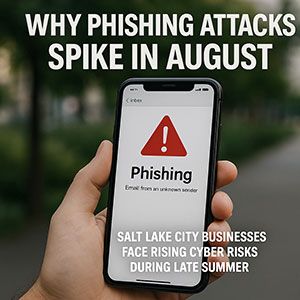
 Cyber Threats Don’t Take Vacations. Neither Should Your IT Security.
You might be squeezing in that last Bear Lake getaway or catching up after a packed July, but here’s the thing: Cybercriminals are just getting started. According to cybersecurity leaders like ProofPoint and Check Point, phishing attacks don’t slow down in late summer—they ramp up. And if you’re running a CPA firm in Salt Lake City, the consequences of one click on the wrong email could be catastrophic.
At Qual IT, we specialize in managed IT services for CPA firms in Salt Lake City, and here’s what we’re seeing behind the scenes.
What’s Fueling the Surge in Phishing Attacks?
Cybercriminals know your team is distracted. Vacations, hybrid work schedules, and pre-tax season prep leave room for human error. According to Check Point Research, there was a 55% jump in new vacation-related domains in May 2025 compared to the previous year. And here’s the kicker—1 in every 21 of those domains was malicious.
Meanwhile, late summer also brings back-to-school scams—targeting employees enrolled in university programs or parents coordinating school logistics. If one of your staff members opens a fake "tuition invoice" on a work machine, your entire network could be exposed.
Let’s be clear: If your firm’s systems aren’t protected with the right IT security protocols, you’re not just risking downtime—you’re risking client trust, compliance violations, and everything you’ve built.
What Salt Lake City CPAs Can Do—Now
Phishing emails today are powered by AI. That means no more laughably bad grammar or sketchy formatting. These scams are polished. Convincing. And they’re coming straight for your inbox.
If you own or manage a CPA firm in Utah, here’s how to get ahead of the threat:
Security Moves Every CPA Firm Should Make:
🔍 Train Your Team to Spot Phishing Red Flags
Look beyond typos. AI can craft emails that look legit. Instead, check the sender’s domain closely and hover over hyperlinks before clicking.
🌐 Scrutinize URLs—Always
Scammers love domain tricks: think “.today” or “.biz” instead of .com. Encourage your staff to type web addresses directly instead of clicking links.
🔒 Enable Multifactor Authentication (MFA)
Even if a password is compromised, MFA can block unauthorized access to your firm’s systems and sensitive client data.
🧠 Keep Personal Email Off Work Devices
One personal click on a phishing email can infect your network. Reinforce strict boundaries between work and personal tech use.
🧰 Invest in Endpoint Detection & Response (EDR)
Ask your IT provider about EDR tools. These solutions monitor activity in real-time, detect suspicious behavior, and flag threats before damage is done.
📶 Avoid Public Wi-Fi Without a VPN
Remote work is the norm now, but public networks are still a risk. Make sure anyone working offsite uses a secure VPN tunnel.
Why This Matters More for CPA Firms
Phishing isn’t just annoying—it’s dangerous. For CPAs, the stakes are higher:
- You hold sensitive financial data.
- You're bound by AICPA security standards and IRS compliance.
- Your clients trust you with their business and personal lives.
All it takes is one breach for that trust to evaporate.
And if you’re thinking, “Well, my IT guy will catch it,” consider this: By the time your internal team reacts, the breach may already be in motion.
That’s why Salt Lake City CPA firms are moving to outsourced managed IT services that specialize in cybersecurity and compliance. Like Qual IT.
One Wrong Click Shouldn’t Derail Tax Season
You’ve got enough on your plate with quarterly filings, audit prep, and AICPA regulation changes. Don’t let preventable cyber threats become part of your daily stress.
At Qual IT, we provide CPA-specific IT support, cloud-based security, and real-time monitoring so you can get back to what matters—serving your clients and growing your firm.
Start the Season Secure.
Click here to book your FREE Network Assessment with Qual IT today.
Let’s make sure your firm is locked down before the next phishing wave hits Salt Lake City.