
September 2026 | CPA Firm Managed IT Salt Lake City | Productivity & Efficiency | Proactive IT for Accounting Firms
If you're like most CPA firm partners, you're always looking for ways to save time — especially right now, with October 15 extension returns stacked up and January closer than it feels.
New software, AI tools and productivity systems all promise to help. But the Salt Lake City accounting firms that run with the fewest interruptions usually have one thing in common: better habits — often reinforced by the right IT support behind the scenes.
The biggest time-savers aren't the ones getting the most attention. They're the routines that prevent small problems from becoming expensive distractions. And here's the thing about habits in a CPA firm: every one of them gets multiplied by tax season volume. A habit built this fall pays off a hundredfold in January. Here are five worth revisiting now.
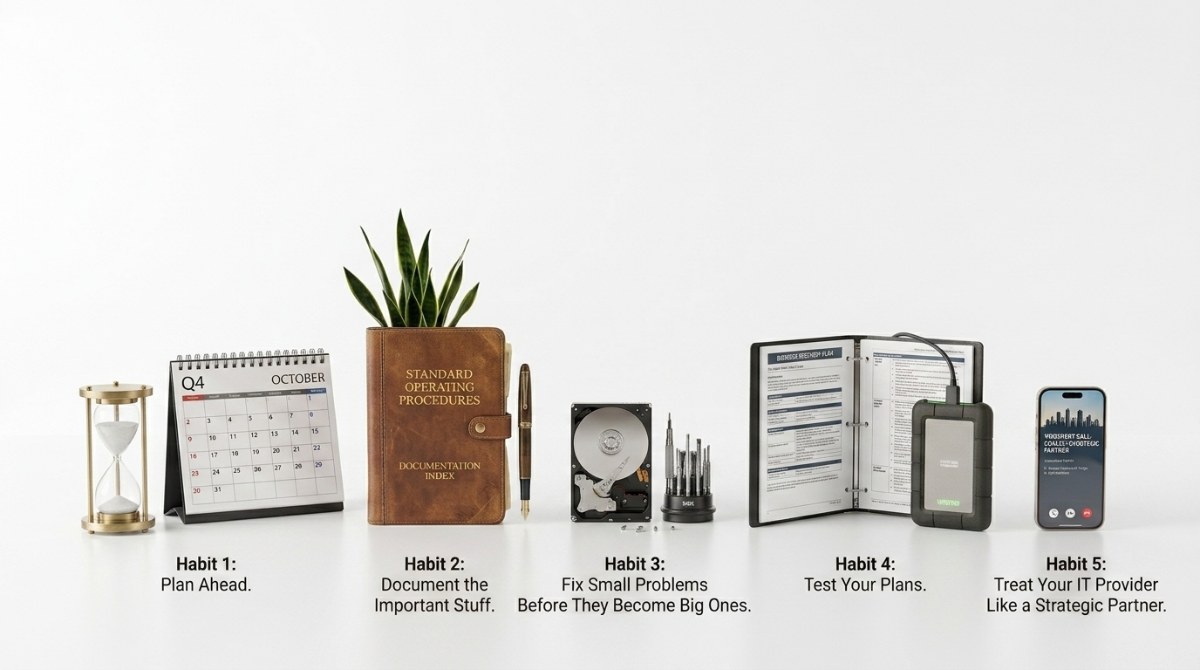
Habit 1: Plan Ahead Instead of Playing Catch-Up
If you wait until January to evaluate what's working, you're already playing catch-up.
Well-run firms set aside time to review priorities, discuss potential roadblocks and prepare for what's next — software renewals, staffing for the season, the workflow bottlenecks that made last April harder than it needed to be. Those conversations don't need to be long, but they do need to happen consistently.
When you make planning a habit, you're less likely to spend time reacting to surprises and more likely to stay focused on client work. A little planning in October prevents a lot of scrambling in February.
Habit 2: Document the Important Stuff
If your firm depends on one person remembering how something works, you've created a single point of failure — and that's a significant risk.
Every firm has one: the office manager who knows exactly how returns flow from the portal into UltraTax CS, how e-file rejections get worked, which client uses which entity structure, where the engagement letters live. If that person is out sick during the extension push, work doesn't slow down — it stops.
Processes, vendor contacts, key procedures and responsibilities should be easy to find, understand and share. Good documentation keeps returns moving when someone is unavailable, reduces the time your accounting staff spends searching for answers — and it's also a core expectation of the Written Information Security Plan the IRS requires under Publication 4557. The less your team has to guess, the more returns get out the door.
Habit 3: Fix Small Problems Before They Become Big Ones
Your firm probably has a list of minor frustrations people have learned to work around.
Maybe it's the scanner that jams on every third engagement, the workstation that takes four minutes to open Lacerte, or the portal upload that fails often enough that clients have started emailing documents instead. Because those issues aren't urgent in September, they get pushed aside.
Now multiply each one by tax season volume. A 90-second annoyance repeated across hundreds of returns becomes days of lost billable time — and the email workaround becomes a genuine security problem when the attachments contain SSNs. The most efficient firms address small problems while they're still manageable. This is exactly what proactive IT support is built for: catching the slow hard drive, the failing switch, the unpatched software before it costs your staff a week in February.
Small issues may seem harmless, but they rarely stay that way.
Habit 4: Test Your Plans Instead of Making Assumptions
It's easy to make assumptions when everything seems to be working.
"Our client returns are backed up."
"Our team knows what to do."
"We'll figure it out."
Resilient firms replace assumptions with confidence. They verify that backups of client tax records actually restore, review recovery plans and walk through scenarios before they're forced to respond to one. A backup that's never been tested is a hope, not a plan — and a firm that discovers a corrupt backup on October 10 has no good options left.
September is National Preparedness Month — a good reminder that preparedness isn't only for families and communities. For a firm holding thousands of client SSNs, it's a professional obligation. The time you spend preparing for a disruption is usually far less than the time you'd spend recovering from one.
Habit 5: Treat Your IT Provider Like a Strategic Partner
If the only time you talk to your IT provider is when something breaks, you're missing opportunities to prevent problems in the first place.
The most successful firms have regular conversations about goals, risks, software decisions and seasonal readiness. That allows technology decisions to support the practice instead of reacting to problems after they happen — renewals decided in October, workstations refreshed in November, security tightened in December, everything tested before organizers go out.
A strong partner for CPA firm managed IT in Salt Lake City reinforces the habits that keep your firm running efficiently — offering guidance, planning and support long before an issue turns into an interruption. The best technology relationships prevent problems, not just solve them.
Frequently Asked Questions
Do you offer cybersecurity and IT support for CPA firms in Salt Lake City?
Yes. Qual IT provides IT support for CPA firms in Salt Lake City, including help desk service, proactive monitoring, cybersecurity, backup verification for client tax records and support for tax software and client portals. We work with Salt Lake City CPA firms to protect client data and keep systems running through tax season.
How does proactive IT support save accounting firms time?
Proactive IT support catches issues before they cause downtime: patching software, monitoring hardware health, verifying backups and closing security gaps. Instead of losing hours to a failed workstation or a portal outage during a deadline week, your accounting staff stays focused on client work.
How does IT support relate to IRS data security compliance?
IRS Publication 4557 requires tax preparers to maintain a Written Information Security Plan with documented safeguards for client data — access controls, encryption, backups and incident response. A provider experienced in IRS data security compliance IT in Utah helps you implement those safeguards and keep the documentation current, so compliance is built into daily operations rather than assembled after the fact.
Small Habits Make a Big Difference
The firms that save the most time consistently build habits that reduce friction, improve visibility and keep returns moving.
As you close out extension season and look toward January, ask yourself which of these habits your firm is already doing well — and which ones deserve attention during the one stretch of the year when you actually have time to fix them.
If building a healthy, resilient technology strategy is on that list, schedule a 10-minute discovery call with Qual IT. We'll help you identify opportunities for improvement and make sure your firm is ready for tax season. Book your discovery call here.