
August 2026 | Civil Engineering IT Support Salt Lake City | Business Continuity | Engineering Company IT Services Utah
When your project team hits turbulence on the way to a DOT submittal deadline, the last thing you want to hear from your IT lead is, "Give me a minute — we have never handled this before." For Salt Lake City engineering firms, an IT disruption in the middle of a government submittal window is not just inconvenient. It is a project crisis that can damage client relationships, delay contract payments, and in some cases create compliance exposure.
Civil and structural engineering practices operate on exactly the same principle as any other high-stakes profession: the response to a crisis is built in advance. Pilots spend thousands of hours preparing for situations they hope never to face. When turbulence hits, the response is already there. All they have to do is execute it.
For engineering firms in Salt Lake City, the emergency is the time to execute the recovery plan — not to build it. And the gap between those two realities is the difference between a disruption and a disaster.
The Emergencies Salt Lake City Engineering Firms Do Not Practice For
Disruptions in engineering environments show up during normal project operations and force immediate decisions under pressure — affecting multiple project teams, clients, and deadlines at once.
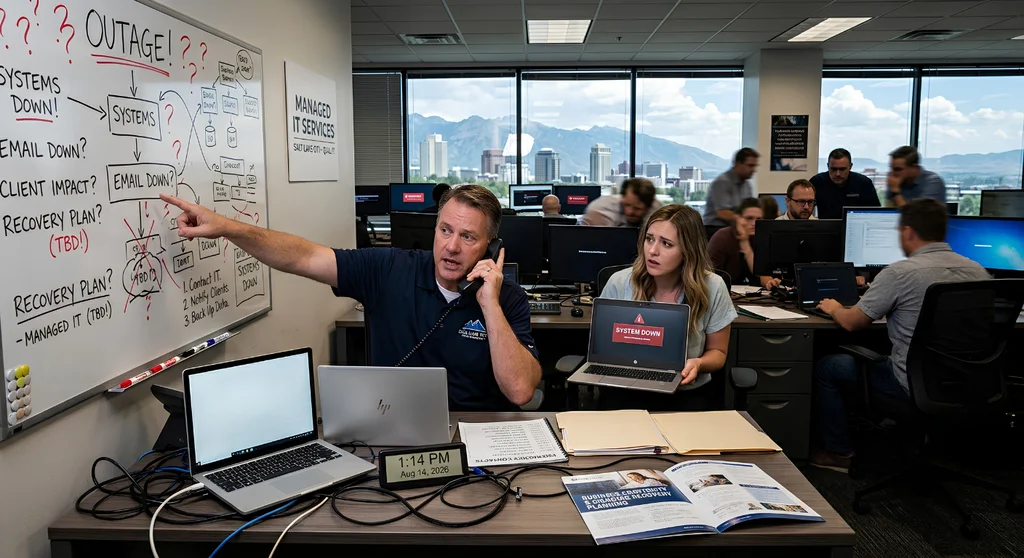
AutoCAD Civil 3D becomes inaccessible. Newforma project data is unreachable. An HPC workstation running ANSYS simulations goes offline. A ransomware infection spreads through the engineering network, encrypting drawing sets and project files. An internet outage severs access to Autodesk Construction Cloud during the final hours of a DOT submittal window.
Most engineering firm leaders understand these risks and invest in backups, security tools, and project management systems to reduce them. But preparation often stops at setup instead of extending into how the engineering team responds in the moment — and that gap stays invisible until something breaks.
Then, all at once, questions that should be easy to answer become complicated:
- Who on the engineering team takes charge of the IT response?
- Which project files and systems get restored first to protect the most critical deadlines?
- How long will full recovery of the CAD environment actually take?
- What do we tell the client or the agency when submittals are delayed?
- How do subconsultants access shared project files during the outage?
Engineering teams end up working through those answers during the disruption itself — slowing every decision, adding confusion across project teams, and extending downtime that IT support for your engineering firm in Salt Lake City could have prevented.
The Hidden Cost of Learning During the Crisis
When an engineering firm is figuring out its recovery response during an active disruption, the impact spreads across every active project. Each step requires a decision that has not been made before, and every decision depends on information that may not be immediately accessible.
Project managers pause to evaluate options instead of communicating with clients. Design engineers wait for direction before restarting work. Progress stalls across multiple project phases as each action depends on the last IT decision.
Subconsultants trying to access shared Newforma project files or AutoCAD drawing sets cannot get in. Clients experience the impact through delayed submittals, inconsistent communication, and eroding confidence in your firm's ability to deliver.
Recovery takes longer because the engineering team must make restoration priority decisions under pressure — decisions that could have been documented in advance — while active project deadlines continue to approach.
Now picture two engineering firms facing the exact same outage. Same systems down. Same scope. Same starting point.
One has practiced for this. Responsibility is documented, restoration priorities were decided in advance, and the engineering team moves through defined steps while keeping clients informed of realistic timelines. The other is building the response as it goes — every decision triggers three more questions, hours pass, and what could have been a manageable disruption becomes a project crisis.
The difference between disruption and disaster in an engineering firm is almost always preparation — and specifically, the preparation that happened before anyone opened an incident ticket.
What Readiness Looks Like for an Engineering Firm
No client expects their engineering firm to improvise when systems go down. No agency expects a DOT submittal to be late because the civil engineering firm did not have a recovery plan for its CAD environment. The expectation across every professional services context is the same: preparation happens before anything goes wrong, so when something does, the response is already built.
Engineering firms that operate this way respond faster, assign recovery ownership clearly, and move through restoration of project files and engineering documents without hesitation. Project engineers know which systems are being restored and in what order. Subconsultants get clear communication. Clients receive accurate timeline estimates instead of silence.
The DOT submittal goes out. The project keeps moving. The client never has to wonder whether your firm is in control.
Preparation feels unnecessary until the moment it becomes critical. For engineering firms that work on government contracts, infrastructure projects, or tight construction administration schedules, that moment can arrive with very little warning.
We have seen what happens when engineering firms are ready — and when they are not. We have worked with engineering practices through CAD system failures, ransomware incidents that encrypted drawing sets, and outages that threatened active submittals. The firms that came through with their project delivery and client relationships intact were not necessarily the ones with the most sophisticated technology. They were the ones with a documented plan and a partner who knew how to execute it alongside their engineering team.
CMMC and Incident Response: An Added Dimension for Government-Contracted Engineering Firms
For engineering firms holding or pursuing government contracts, incident response planning is not just a business continuity best practice — it is a CMMC requirement. The Cybersecurity Maturity Model Certification framework mandates documented, tested incident response and recovery capabilities. An engineering firm that discovers it cannot recover its project files and engineering documents during an audit or incident review is not just operationally exposed. It is potentially non-compliant with its government contract obligations.
Qual IT helps Salt Lake City engineering firms build and document recovery procedures that align with CMMC expectations — so that a disruption does not simultaneously become an operational problem and a compliance problem.
Frequently Asked Questions
Do you offer IT support for engineering firms and technical consultancies in Salt Lake City?
Yes. Qual IT provides IT support for civil, structural, mechanical, and environmental engineering firms across Salt Lake City and the Wasatch Front. We support environments built around AutoCAD Civil 3D, Bentley MicroStation, Newforma, ProjectSight, Deltek Vantagepoint, ETABS, RISA, ANSYS, and Esri ArcGIS.
How does a managed IT services provider help engineering firms with disaster recovery?
A managed IT provider like Qual IT builds, documents, and tests your recovery plan for CAD files and engineering documents before anything goes wrong. When a disruption occurs during an active project phase, your engineering team is not starting from zero — you have a defined process, documented restoration priorities, and a partner who knows how to execute the recovery alongside your team.
Does Qual IT help Salt Lake City engineering firms with CMMC incident response compliance?
Yes. Qual IT helps engineering firms across Salt Lake City prepare for CMMC requirements related to incident response, system recovery, and documentation of cybersecurity procedures — including backup and recovery of controlled unclassified information associated with government contracts.
Know Where Your Engineering Firm Stands
When a disruption hits — whether it is a CAD system failure, a ransomware incident, or an internet outage during a DOT submittal window — will your engineering team execute a recovery plan, or be forced to create one in real time?
We work with Salt Lake City engineering firms to protect project data and support technical workflows. Schedule a 10-minute discovery call with Qual IT to evaluate how prepared your engineering team is to respond, recover, and keep project delivery moving when the unexpected happens.