
August 2026 | IT Support for Dental Offices Salt Lake City | HIPAA IT Support for Dentists | Dental Office Cybersecurity Salt Lake City
When your flight hits turbulence, the last thing you want to hear from the pilot is, “Give me a minute — I have never handled this before.”
Flying feels safe not because problems never happen, but because pilots spend thousands of hours preparing for situations they hope they will never face. When something goes wrong, the response is already built. All they have to do is execute it.
The same principle holds in every profession where mistakes are costly. And in a dental office — where the appointment schedule is revenue, every chair-hour has value, and downtime means lost production — the distinction between having a plan and building one during an emergency is everything.
The Dental Emergencies Nobody Practices For
Disruptions show up during normal practice operations and force immediate decisions under pressure, affecting patients, staff, and revenue all at once.
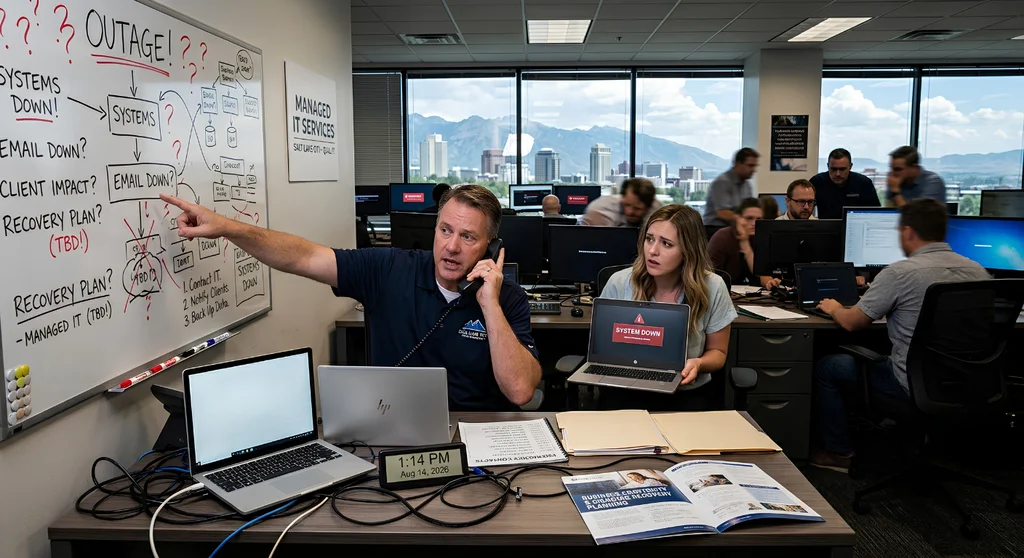
Dentrix goes offline. Imaging files in Dexis or Planmeca become inaccessible. A ransomware attack locks the practice management system. The front desk cannot pull up the appointment schedule. The dentist cannot access a patient’s X-ray history or treatment plan mid-procedure. Patient communication platforms like Weave or Lighthouse 360 stop delivering confirmations and reminders, and patients start arriving for appointments the team did not know were still on the books.
Most dental office owners understand these risks and invest in some form of backup, antivirus software, or cybersecurity tools. But preparation often stops at setup instead of extending into how the front desk and dental team actually respond in the moment when something breaks.
That gap stays invisible until it is not. Then, all at once, questions that should have easy answers become urgent and complicated:
- Who takes charge of the response?
- What gets restored first — the scheduling system, the imaging server, or the billing platform?
- How long will recovery take, and how many appointments need to be rescheduled?
- What do you tell patients who are sitting in the waiting room right now?
- Does this qualify as a HIPAA reportable incident, and if so, what are the notification timelines?
The front desk and dental team end up working through those answers during the disruption itself — while the phone is ringing, while patients are waiting, and while every minute of delay represents real lost chair time and revenue.
The Hidden Cost of Learning During the Crisis
When a dental practice is figuring things out during a disruption, the impact spreads fast — because every step requires a decision that has not been made before.
The dentist pauses or delays procedures while waiting to access patient records or imaging. The front desk fields calls with no accurate answers to give and no timeline to share. Staff members improvise responses that may or may not be consistent with HIPAA guidance. Meanwhile, the appointment schedule collapses one slot at a time.
Patients who cannot be seen that day get rescheduled. Some of them do not come back. Word spreads quietly. Revenue is lost. And if patient records and imaging were affected by the incident, HIPAA breach notification requirements layer in an entirely new set of obligations with strict timelines that do not wait for the systems to come back online.
Now picture two Salt Lake City dental practices facing the exact same Dentrix outage. Same systems down. Same scope. Same starting point.
One practice has prepared for this. Ownership is clear, priorities were decided in advance, and the front desk and dental team move through defined steps while keeping patients informed. The other practice is building the response as it goes — every decision triggers three more questions, the afternoon fills with empty chairs, and what could have been a manageable two-hour disruption becomes a day of cancelled appointments and scrambling staff.
The difference between disruption and disaster in a dental office is almost always preparation. The systems and the incident do not determine the outcome. The plan does.
The Value of Being Ready
No patient expects their dentist to improvise mid-procedure. No dental office expects its front desk to figure out a ransomware response on the fly while patients are waiting. The expectation in every high-stakes environment is the same: preparation happens before anything goes wrong, so when something does, the response is already there.
Dental practices that operate this way respond faster, assign ownership clearly, and move through recovery without hesitation. The front desk does not stop to figure out the next step — they simply take it. Patients experience less disruption because the practice does not have to stop operating to figure out how to keep operating.
Preparation feels unnecessary until the moment it becomes critical. We have seen what happens when dental practices are ready — and when they are not. We have worked with practices through Dentrix failures, ransomware incidents targeting patient records and X-ray archives, and imaging server outages that could have caused serious long-term damage to patient trust and practice revenue. The ones that came through with their operations and reputation intact were not necessarily the ones with the most sophisticated technology. They were the ones who had a plan and an IT support partner who knew how to execute it.
That is what Qual IT does. We address issues when they arise and help make sure your front desk and dental team are never starting from scratch when it matters most — when the waiting room is full, the schedule is at stake, and every decision has a cost.
Frequently Asked Questions
Do you offer HIPAA-compliant IT services for dental offices in Salt Lake City?
Yes. Qual IT works with Salt Lake City dental practices to build, document, and test recovery plans that meet HIPAA requirements — including documented incident response procedures, backup verification for patient records and X-ray archives, and breach notification protocols so your team knows exactly what to do and when. We support dental offices across Salt Lake City and the greater Wasatch Front running Dentrix, Eaglesoft, Curve Dental, Dexis, Carestream, Planmeca, Weave, and other dental systems.
How does a managed IT services provider help dental offices with disaster recovery?
A managed IT provider like Qual IT builds, documents, and tests your recovery plan before anything goes wrong. When a disruption occurs — whether it is Dentrix going offline, an imaging server failure, or a ransomware attack on patient records — your front desk and dental team are not starting from zero. You have a defined process, clear ownership, and a partner who knows how to execute the plan so your practice gets back to seeing patients as quickly as possible.
Does Qual IT help Salt Lake City dental practices with incident response?
Yes. Qual IT helps dental practices across Salt Lake City prepare for, respond to, and recover from IT incidents — including ransomware targeting Dentrix and patient records, imaging server failures, hardware outages, and HIPAA compliance events that require documented breach response procedures and patient notification timelines.
Know Where You Stand
When a disruption hits your dental practice, will your team execute a plan — or be forced to create one in real time while the waiting room fills, the appointment schedule falls apart, and every delay costs chair time?
The practices that recover fastest are the ones that asked that question before the emergency, not during it. A controlled test, a documented response plan, and a knowledgeable IT support partner are the difference between a two-hour disruption and a two-day crisis.
We work with Salt Lake City dental practices to keep systems running and patient data secure.
Schedule a 10-minute discovery call with Qual IT to evaluate how prepared your practice is to respond, recover, and keep your chairs filled when the unexpected happens. Book your discovery call here.