
August 2026 | IT Support for Manufacturers Salt Lake City | Manufacturing IT Services Utah | Industrial Cybersecurity Salt Lake City
Mike Tyson once said, "Everyone has a plan until they get punched in the mouth."
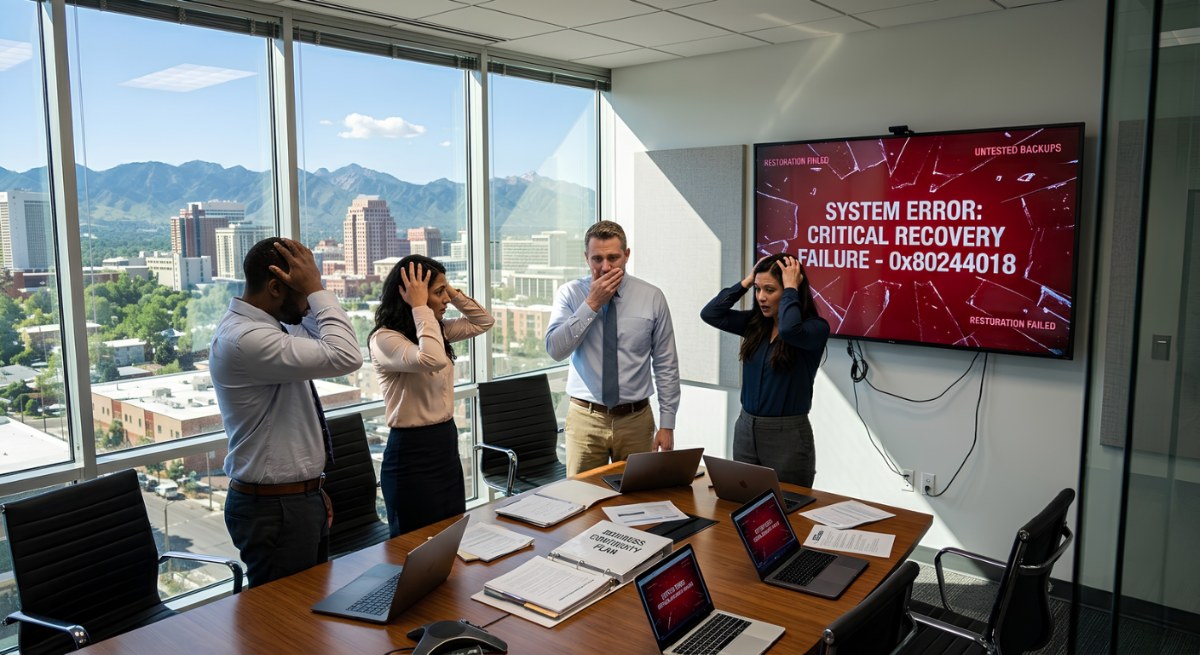
For Salt Lake City manufacturers, that punch often arrives as a ransomware attack that locks the ERP, a server failure that takes the MES offline mid-shift, or an OT outage that shuts down production without warning. In manufacturing, you don't get to pause while you figure out what went wrong. The line is down, the clock is running, and every hour costs real money.
That's the thing about assumptions. They feel like facts right up until they're tested. For Salt Lake City manufacturers relying on IT support or self-managed infrastructure, these are the four assumptions that most often cause the real operational damage.
Assumption #1: "Our ERP Vendor Handles Our Backups"
Having an untested backup of your ERP is like keeping a spare in the truck bed and discovering it's flat when you're three hours from the nearest shop floor — with a full load on the trailer.
Most manufacturers assume that because they're running SAP, Epicor, Infor, or Microsoft Dynamics, their ERP vendor is handling backups on their behalf. That assumption is often wrong — and it's usually discovered at the worst possible time. ERP vendors manage their software. Backup of your production data, CAD files, configuration settings, and operational records is typically your responsibility.
A backup proves its value only when it helps you recover. The most dangerous backup of ERP and production systems is the one you've never tested — and the one your production and operations team can't actually restore from under pressure.
Assumption #2: "Someone Would Tell Us If There Was a Problem"
Monitoring tools are valuable — but confusing detection with protection is a costly mistake on the shop floor.
A severe weather alert can tell you a storm is coming. It doesn't reinforce the loading dock doors or protect the SCADA systems. The alert is only useful if you know what to do next. Your IT monitoring works the same way. It tells you something is wrong. What happens after that alert fires is entirely up to you and your IT support partner.
For manufacturers in Salt Lake City running OT systems — Rockwell PLCs, Siemens Opcenter, SCADA environments — the stakes of a slow or unclear response are immediate and physical. Without a documented response plan and a capable managed IT services partner who understands industrial environments, alerts become noise instead of action. And while your production and operations team is trying to figure out who's responsible, the line keeps sitting idle.
Assumption #3: "Our Shop Floor Team Knows What to Do"
Every team looks prepared — until the shift it actually matters.
Picture this: It's a Friday afternoon and your SAP system drops offline. Suddenly nobody on the floor can agree on who's in charge, what to restore first, or how long recovery will take. Your operations manager is calling the ERP vendor. Your IT contact is troubleshooting remotely. Your plant manager wants answers. And the production line isn't moving.
Shop floor staff are highly skilled at running equipment, managing production, and hitting targets. They're not trained to make real-time IT recovery decisions under pressure — and they shouldn't have to be. When there's no documented recovery plan and no practice run, even the most capable production and operations team is starting from zero during a crisis.
You don't run a plant fire drill because you expect a fire tomorrow. You run it so that if there ever is one, nobody is standing around asking which way to go. A recovery plan for your ERP and OT systems works exactly the same way. When something goes wrong, you want your team executing a plan they already know — not figuring out the steps while downtime costs mount.
Chaos rarely comes from the disruption itself. It comes from not knowing what to do next. And in manufacturing, not knowing what to do next is measured in dollars per hour.
Assumption #4: "Manufacturers Aren't Targeted"
Nobody thinks they'll be the one. Until they are.
This assumption is particularly dangerous for manufacturers because the reality is the opposite. Manufacturing is one of the most frequently targeted sectors for ransomware. Attackers know exactly what they're doing: lock the ERP, take the MES offline, disable SCADA access, and watch the pressure build as production halts. The ransom demand arrives while your plant sits idle.
The disruptions don't always come from sophisticated attacks. An employee on the shop floor clicks a phishing link. OT vendor remote access isn't secured properly. A legacy industrial workstation running Windows 7 gets exploited because it was never prioritized for patching. A power event corrupts data on a server that hasn't been tested in a year.
The question isn't whether something unexpected will happen to your Salt Lake City manufacturing operation. It's whether you'll be operationally ready when it does. The manufacturers that recover fastest aren't the ones that avoided the disruption — they're the ones who expected it, tested their recovery of ERP and production systems, and had a partner who knew how to execute the plan.
Frequently Asked Questions
Do you offer IT and cybersecurity support for manufacturing companies in Salt Lake City?
Yes. Qual IT provides manufacturing IT services, industrial cybersecurity, and tested backup and recovery planning for ERP, MES, OT, and production systems. We work with Salt Lake City manufacturers to protect production systems and reduce operational downtime.
How often should Salt Lake City manufacturers test their backups of ERP and production systems?
At minimum, quarterly. Manufacturers running OT systems, SCADA environments, or regulated production processes should test more frequently. The goal is to verify that backups of ERP, production data, and CAD files restore completely and within an acceptable time frame — before a ransomware attack or system failure forces the issue.
What's the difference between backup and disaster recovery for manufacturing?
Backup is the process of copying and storing your ERP data, CAD files, MES configurations, and production records. Disaster recovery is the plan for restoring those systems and getting production running again after an incident. You need both — and both need to be tested to be reliable in a real manufacturing environment.
You Can't Block a Punch You Didn't Prepare For
It's rarely the dramatic cyberattack that catches Salt Lake City manufacturers off guard — it's the ordinary failures that hit mid-shift on a Wednesday when nobody is expecting it.
The good news is that most of these risks can be addressed before they become operational problems. That's exactly what Qual IT helps Salt Lake City manufacturers do.
We work with Salt Lake City manufacturers to protect production systems and reduce operational downtime. Schedule a 10-minute discovery call to walk through your backup of ERP and production systems, your recovery process, and your business continuity plan. We'll identify what's been tested, what hasn't, and where gaps may exist.