
August 2026 | Engineering Company IT Services Utah | Backup & Disaster Recovery | IT Support for Engineering Firms Salt Lake City
Mike Tyson once said, "Everyone has a plan until they get punched in the mouth."
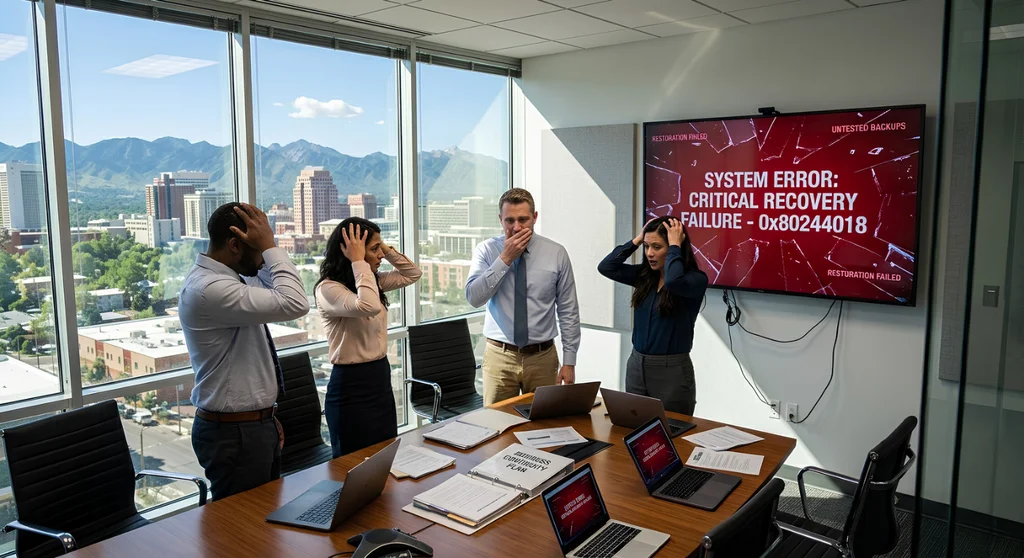
For Salt Lake City engineering firms, that punch usually arrives as a disruption you assumed you were ready for — a failed restore of critical CAD files, an unexpected outage during a DOT submittal window, or a security incident that exposes gaps nobody knew existed. That is the thing about assumptions. They feel like facts right up until they are tested.
For engineering firms relying on IT support in Salt Lake City or managing their own infrastructure, these are the four assumptions that most often cause the real damage to project delivery and engineering data.
Assumption #1: "The Autodesk Cloud Handles Our Backups"
Autodesk cloud products — including Autodesk Construction Cloud and BIM 360 — offer sync and version history for files stored in those platforms. But sync is not the same as backup, and version history is not the same as a recoverable archive of your complete project file environment.
Many engineering firms discover this distinction too late. AutoCAD Civil 3D project files stored on local servers, ETABS models saved to network drives, ANSYS simulation outputs on engineering workstations, and Newforma project data on internal systems — none of these are automatically covered by Autodesk's cloud.
A backup proves its value only when it restores your complete engineering environment within a time frame that keeps projects on track. The most dangerous backup is the one you have never tested — and the most dangerous assumption is that another platform is handling it for you.
Assumption #2: "Our Monitoring Tool Will Catch Problems Before They Affect Us"
Monitoring tools are valuable — but confusing detection with protection is a costly mistake that engineering firms make regularly.
A weather alert tells you a storm is coming. It does not board up the windows or move the equipment to safety. The alert is only useful if you know exactly what to do next — and if someone with the right expertise is ready to act on it immediately.
Your monitoring tool works the same way. It tells your engineering team that something is wrong. What happens after that alert fires is entirely up to your response plan and the people responsible for executing it. Without a documented incident response procedure and a capable IT support partner for your engineering firm in Salt Lake City, alerts become noise instead of action — and by the time someone figures out the right response, project files and engineering documents may already be at risk.
Assumption #3: "Our Project Engineers Know What to Do"
Every engineering team looks prepared — until something actually goes wrong.
Picture this: It is late on a Thursday afternoon, a week before a major DOT submittal. AutoCAD Civil 3D becomes inaccessible. The Newforma project database is unreachable. Suddenly nobody on the engineering team can agree on who is in charge of the IT response, whether the most recent drawing set is backed up, or how long recovery will take.
When there is no documented recovery plan and no practice run, even a capable engineering team is starting from zero under the worst possible conditions. Your structural engineers and civil designers are not IT professionals — and expecting them to improvise an IT recovery response while a client deadline approaches is a plan that will fail.
A recovery plan works exactly the same way as the field safety protocols your engineering firm already maintains. When something goes wrong, you want your team executing a documented process they already know — not figuring things out under pressure while project delivery stalls.
Chaos rarely comes from the disruption itself. It comes from not knowing what to do next — and for engineering firms, that chaos is measured in missed submittals and damaged client relationships.
Assumption #4: "Engineering Firms Are Not Targets"
Nobody thinks their engineering firm will be the one. Until it is.
When your engineering team is focused on project delivery, client presentations, and keeping design schedules on track, a cyberattack or ransomware incident feels like something that happens to other organizations. But engineering firms hold exactly the kind of intellectual property that attackers target: proprietary design calculations, structural models, environmental assessments, and project files tied to government contracts.
The question for Salt Lake City engineering firms is not whether a disruption will happen. It is whether your engineering team will be ready when it does. The firms that recover fastest are not the ones that avoided the incident — they are the ones that expected it, documented their response, and tested their recovery of CAD files and simulation data before the pressure hit.
For engineering firms pursuing CMMC certification for government contract work, this assumption is especially costly. CMMC requires documented incident response and recovery capabilities — not just the intention to have them.
Frequently Asked Questions
Do you offer IT support for engineering firms and technical consultancies in Salt Lake City?
Yes. Qual IT provides IT support specifically for engineering firms and technical consultancies across Salt Lake City and the Wasatch Front. We understand the technical environments that civil, structural, mechanical, and environmental engineering firms depend on — including AutoCAD Civil 3D, Bentley MicroStation, RISA, ETABS, SolidWorks, ANSYS, and Newforma.
What is the difference between backup and disaster recovery for engineering firms?
Backup is the process of copying and storing your CAD files, simulation data, and project documents. Disaster recovery is the documented plan for restoring that data and getting your engineering systems back online after an incident — within a time frame that keeps your project delivery on track. You need both, and both need to be tested to be reliable.
How often should Salt Lake City engineering firms test their backups?
At minimum, quarterly. Engineering firms working on government contracts or pursuing CMMC certification should test more frequently. The goal is to verify that your backup of CAD files and simulation data restores completely and within an acceptable time frame — before an actual incident occurs during an active project phase.
You Cannot Block a Punch You Did Not Prepare For
It is rarely the dramatic event that catches engineering firms off guard. It is the ordinary ones — a failed drive, a corrupted AutoCAD file set, a ransomware infection that spreads through an engineering workstation — that hit on a Wednesday afternoon when nobody is expecting it and a project deadline is a week away.
The good news is that most of these risks can be addressed before they become project problems. That is exactly what Qual IT helps Salt Lake City engineering firms do — documenting, testing, and validating recovery of project files and engineering documents before the pressure hits.
We work with Salt Lake City engineering firms to protect project data and support technical workflows. Schedule a 10-minute discovery call to walk through your backup of CAD files and simulation data, your recovery process, and your business continuity plan.